1.5 - Alkane Properties & Combustion
Alkane properties and chain length
- All alkanes react in much the same way, but their physical properties change steadily as the carbon chain gets longer.
- Alkanes do not dissolve in water, however long the chain.
Three properties that change with chain length
- Boiling point rises - The intermolecular forces get stronger as molecules get bigger, so more energy is needed to pull them apart.
- Short-chain alkanes boil below room temperature and are gases; longer chains boil above it and are liquids, and the longest chains are solids.
- A short-chain alkane with a low boiling point is more volatile (evaporates easily).
- Viscosity rises - Viscosity measures how easily a liquid flows. Short chains are runny and pour freely; long chains are thick and slow-flowing.
- Flammability falls - Flammability is how easily something ignites. Short chains catch light easily; the longer the chain, the harder it is to set alight.
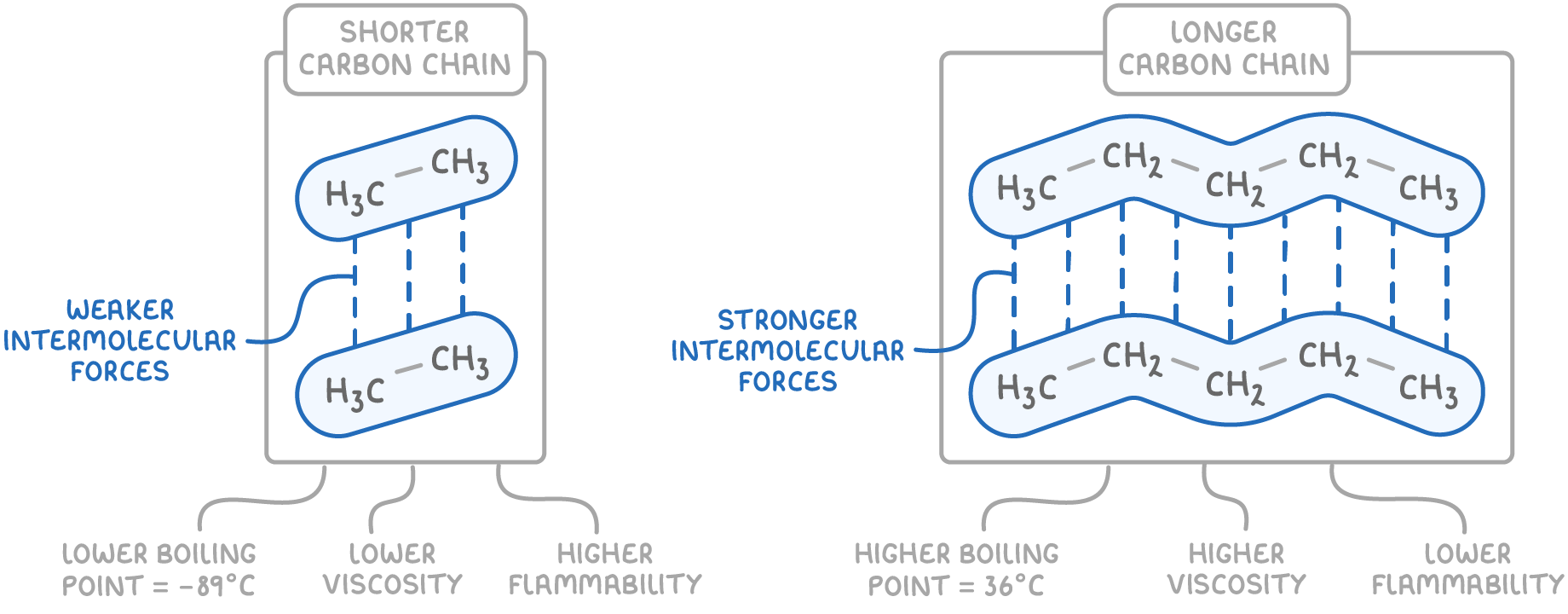
Ethane on the left and pentane on the right, with their boiling points.
Why short chains make useful fuels
- A fuel has to be easy to ignite and easy to flow to where it's burned.
- Short-chain alkanes have low boiling points and high flammability, so they ignite easily and burn cleanly.
- Longer-chain alkanes are harder to ignite and thicker to pump, so they're burned in specialist equipment built to handle them.
Complete and incomplete combustion
- Alkanes are generally unreactive because their C-C and C-H bonds are strong single covalent bonds, so they take part in very few reactions.
- Burning is the main reaction they undergo, which is why they matter as fuels. A fuel is a substance that releases energy as heat when it's burned.
Complete combustion
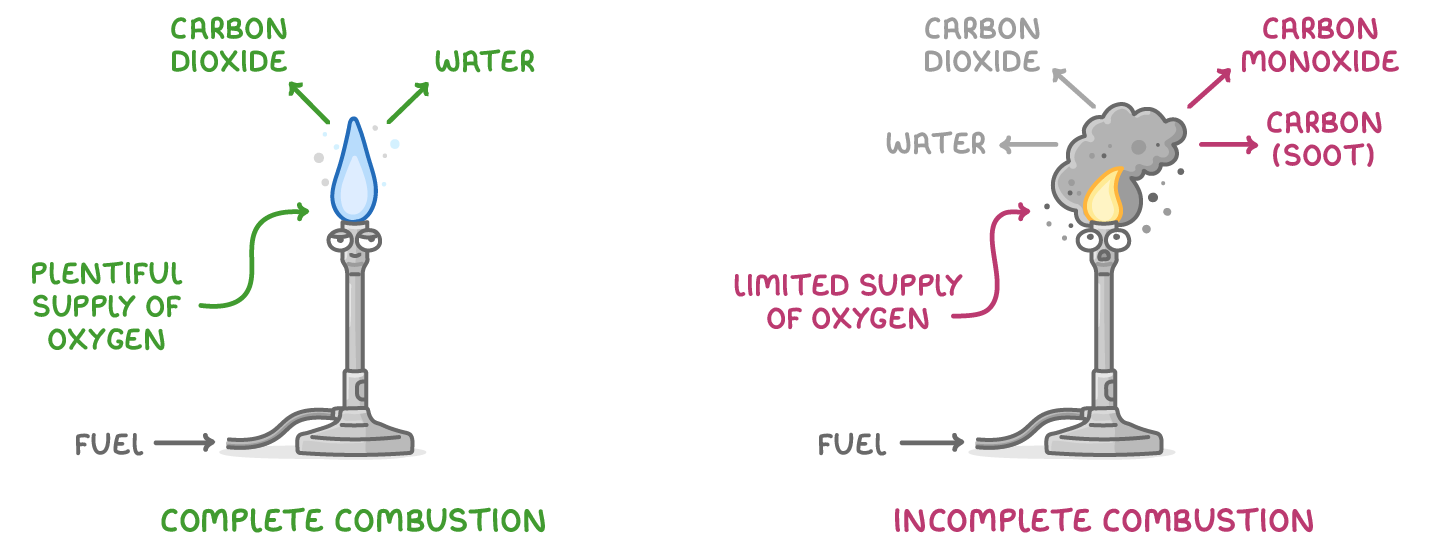
- When a hydrocarbon burns in a plentiful supply of oxygen, the reaction is called complete combustion.
- Every carbon atom is oxidised to carbon dioxide and every hydrogen atom to water:
- hydrocarbon + oxygen → carbon dioxide + water
For methane, the simplest hydrocarbon:
CH4 + 2O2 → CO2 + 2H2O
Complete combustion releases a large amount of energy, which is why hydrocarbons are used as fuels.
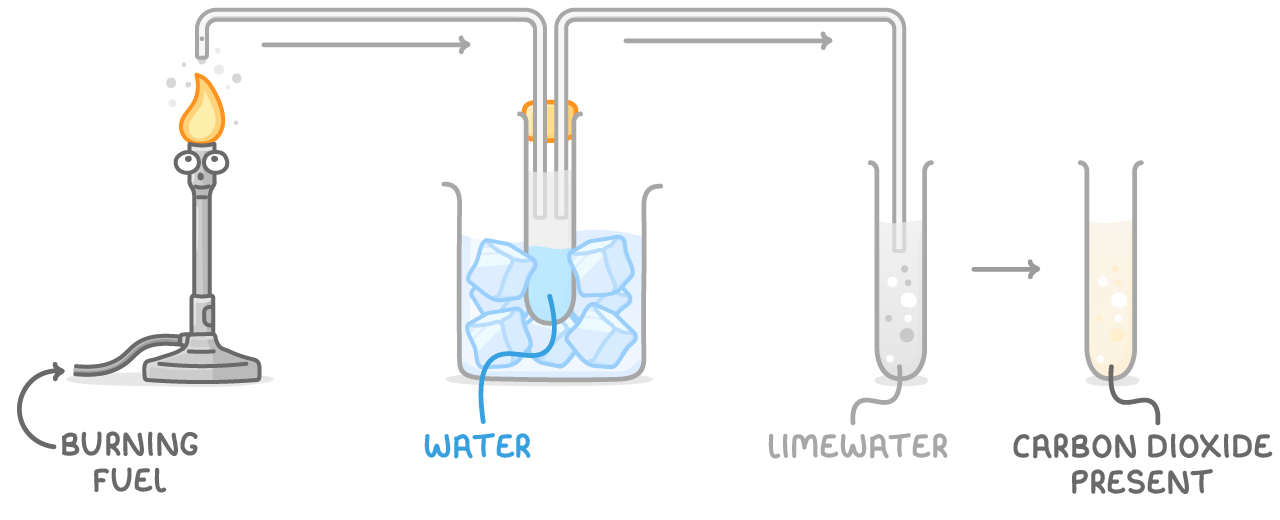
Both products can be identified if the gases leaving a burning fuel are collected:
- Carbon dioxide turns limewater from colourless to milky when the gases are bubbled through it.
- Water condenses to a colourless liquid when the gases are cooled.
Incomplete combustion
- Burning a hydrocarbon in a limited supply of oxygen gives incomplete combustion.
- There's not enough oxygen to oxidise every carbon atom to carbon dioxide, so other products form:
- Carbon monoxide, CO - A toxic gas with one oxygen atom per carbon atom instead of two.
- Carbon - Released as fine solid particles (particulates), seen as soot.
- Carbon dioxide and water are still formed, so the products are usually a mixture of all four.
- Incomplete combustion produces a smoky yellow flame and releases less energy than complete combustion of the same amount of fuel.
Balancing an incomplete combustion equation
Balance it the same way as a complete combustion equation, with carbon monoxide written in place of carbon dioxide:
2C3H8 + 7O2 → 6CO + 8H2O
- Order: balance the carbon atoms first, then the hydrogen atoms, and the oxygen atoms last.
- Most fuels are compounds of carbon and hydrogen, but some contain sulfur, which oxidises to sulfur dioxide as it burns.
Writing a combustion equation
Burning a hydrocarbon fuel in plenty of oxygen always gives carbon dioxide and water:
fuel + O2 → CO2 + H2O
To balance the equation, put balancing numbers in front of the formulae. Never change the formulae themselves.
The method
- Write the unbalanced equation. Put the fuel and oxygen (O2) on the left, and carbon dioxide and water on the right.
- Balance the carbon atoms. Count the carbon atoms in one molecule of fuel and write that number in front of CO2.
- Balance the hydrogen atoms. Count the hydrogen atoms in one molecule of fuel and halve it (each H2O holds two). Write the result in front of H2O.
- Balance the oxygen atoms last. Count the oxygen atoms on the right: two in every CO2 plus one in every H2O. If the fuel contains oxygen, subtract it. Halve what's left (each O2 holds two) and write the result in front of O2.
- Clear any half. If the number in front of O2 ends in a half, double every balancing number so they are all whole numbers.
- Check. Count each element on both sides to confirm the totals match.
Worked example - Combustion equation for propane
Write the balanced symbol equation for the complete combustion of propane, C3H8.
Step 1 - Write the unbalanced equation
Fuel and oxygen on the left, carbon dioxide and water on the right:
C3H8 + O2 → CO2 + H2O
Step 2 - Balance the carbon atoms
One molecule of propane holds three carbon atoms, so three CO2 are needed:
C3H8 + O2 → 3CO2 + H2O
Step 3 - Balance the hydrogen atoms
Propane holds eight hydrogen atoms. Halving eight gives four, so four H2O are needed:
C3H8 + O2 → 3CO2 + 4H2O
Step 4 - Balance the oxygen atoms last
The right side holds 3 × 2 = 6 oxygen atoms in CO2 and 4 × 1 = 4 in H2O, so 10 in total. Propane contains no oxygen, so all 10 come from O2. Halving 10 gives five:
C3H8 + 5O2 → 3CO2 + 4H2O
Step 5 - Clear any half
Five is already a whole number, so nothing is doubled.
Step 6 - Check
- Carbon: 3 on the left, 3 on the right.
- Hydrogen: 8 on the left, 8 on the right.
- Oxygen: 10 on the left, 6 + 4 = 10 on the right.
The balanced equation for the complete combustion of propane is:
C3H8 + 5O2 → 3CO2 + 4H2O