1.10 - Chemical Cells
A chemical cell and its voltage
- A chemical cell uses a chemical reaction to produce electricity.
- While the reaction runs, the cell produces a voltage (also called a potential difference) across its two terminals.
- Connect the cell into a circuit and this voltage pushes a current round it.
- A voltmeter placed across the cell reads the size of the voltage it produces.
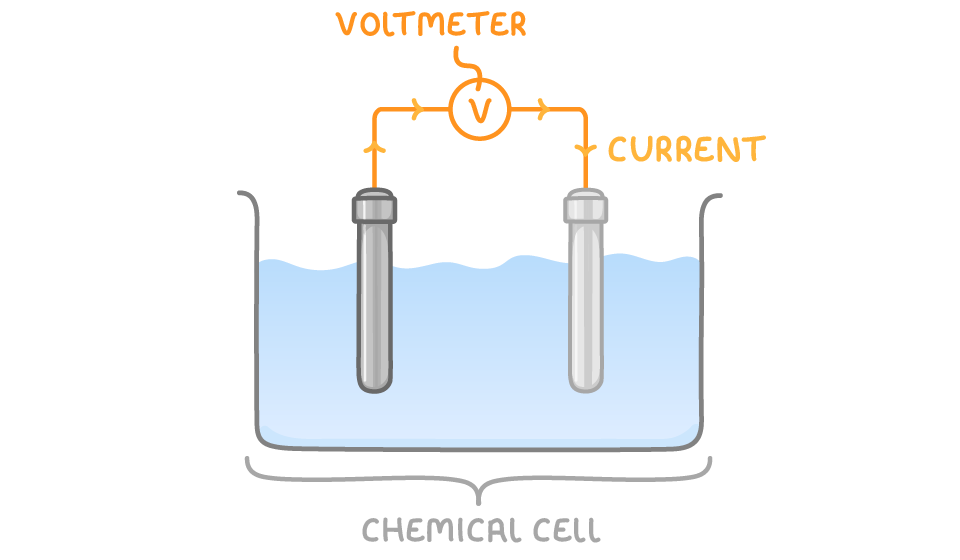
The simplest cell is two different metals in an electrolyte, joined by a wire.
Why a cell goes flat
- A cell doesn't produce electricity forever, because a chemical reaction uses up what it's made from.
- As the cell is used, its reactants are steadily turned into products.
- Once one reactant is completely used up, the reaction stops, so the voltage falls away and the current stops.
TermDefinition
Chemical cellA device that uses a chemical reaction to produce electricity.
Key points to remember
How were these notes?