3.15 - Carboxylic Acids
The carboxylic acids
- Carboxylic acids are a homologous series - a family built on the same pattern: they share a general formula, each member differs from the next by a CH2 unit, and they all have similar chemical properties.
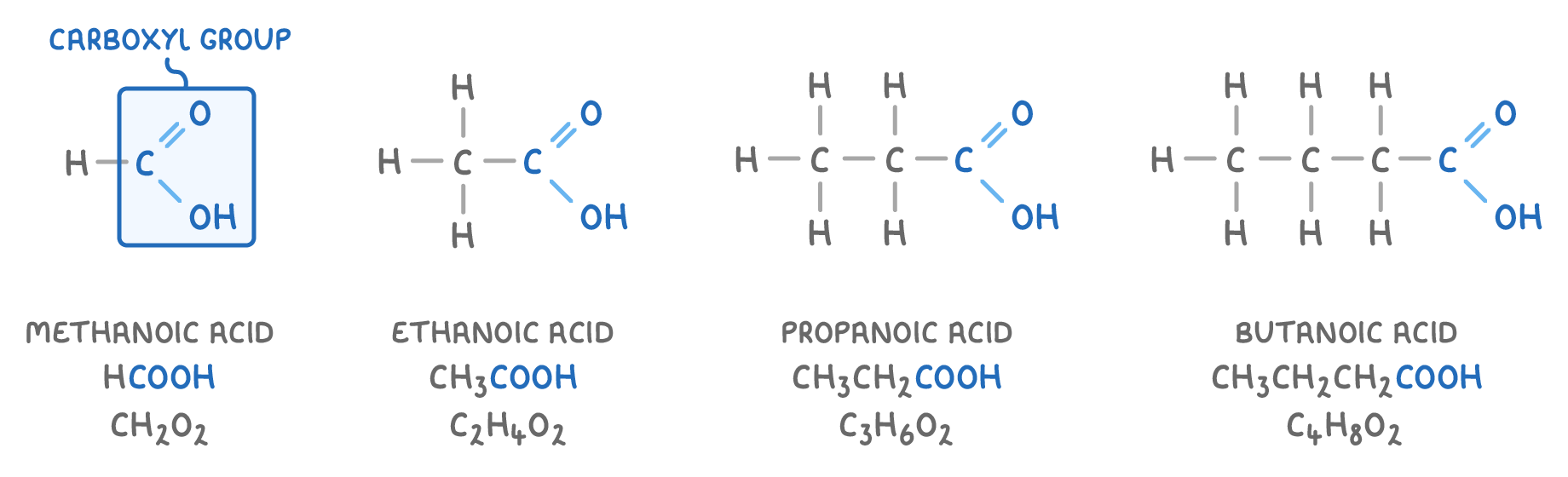
- They all share the functional group -COOH, the carboxyl group:
- A carbon atom joined to two oxygen atoms - one by a double bond, the other by a single bond.
- That second oxygen carries a hydrogen atom on a single bond.
- The carbon uses its fourth bond to join to the rest of the chain.
- It's the hydrogen atom on that oxygen that makes the compound an acid.
Naming carboxylic acids
- All names end in -oic acid, and the prefix says how many carbon atoms the molecule has: meth- (1), eth- (2), prop- (3), but- (4).
- The carbon atom in the carboxyl group is counted in - Ethanoic acid has two carbon atoms in all, one of them the carbon of the COOH.
The first four members
- Written on one line, the four atoms of the group are kept together at the end as COOH, so the group can be seen at a glance.
- The molecular formula gives the totals and hides the group. For example, C2H5COOH and C3H6O2 are the same molecule written two different ways.
- All four acids are liquids at room temperature and pressure.
Where they turn up
- Vinegar is a dilute solution of ethanoic acid in water, which gives it its sharp taste and smell.
- Carboxylic acids are used in foods (as flavours and preservatives) and in personal care products such as soaps.
What carboxylic acids do
- Carboxylic acids are a family of organic acids. A solution of one behaves the way any other acid solution behaves.
- When dissolved in water, a carboxylic acid forms an acidic solution.
- It's acidic because the acid releases hydrogen ions, H+, into the water.
- Because it contains hydrogen ions, the solution has a pH below 7 and turns universal indicator red, orange or yellow.
- When a carboxylic acid reacts, it reacts as an acid: its acidic hydrogen is replaced by a metal (or other positive ion) to form a salt.
Carboxylic acids are weak acids
An acid releases hydrogen ions, H+, when dissolved in water by ionising.
Strong versus weak
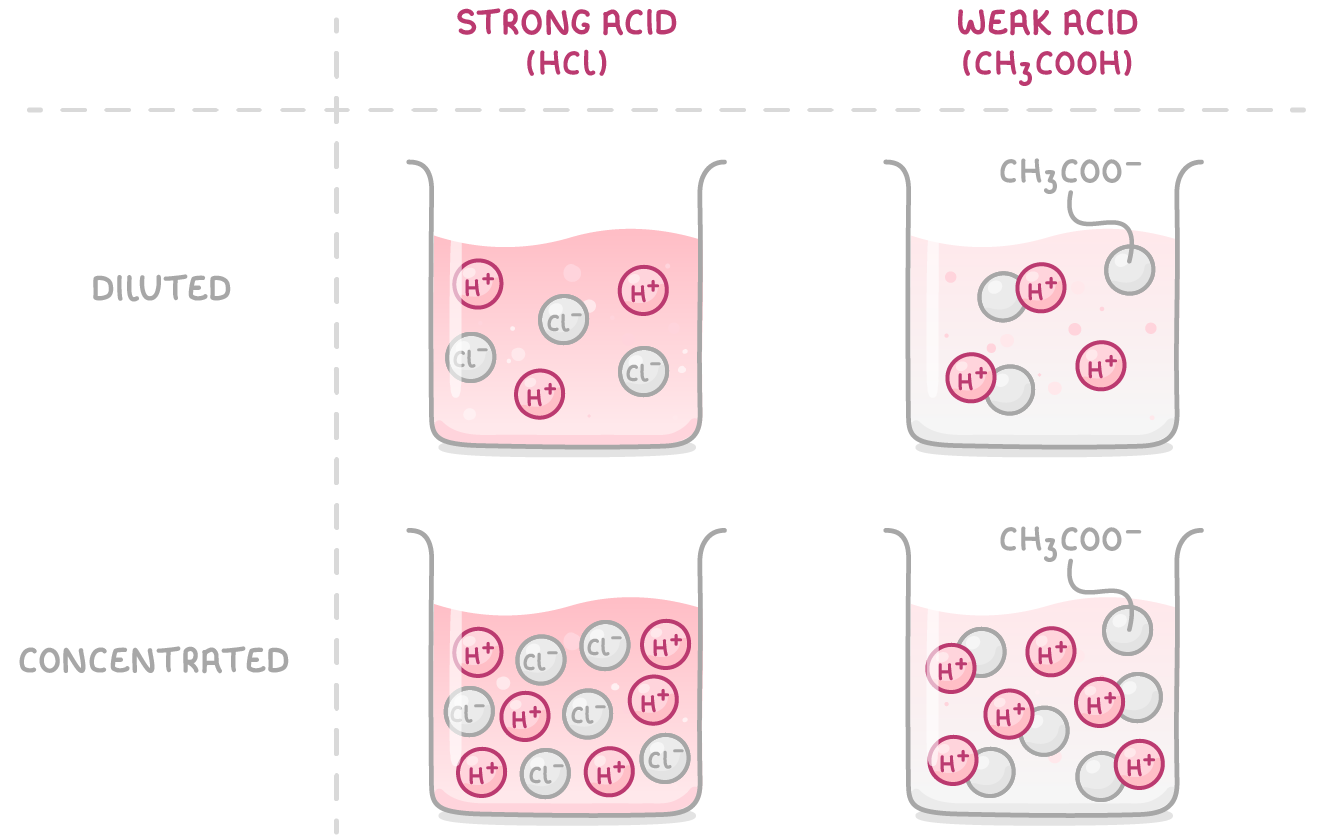
- Strong acid - Ionises completely in water. Every molecule splits up to release its H+ ion.
- Weak acid - Ionises only partially in water. Only a small fraction of the molecules release their H+ ions, forming an equilibrium mixture of ions and un-ionised molecules.
Carboxylic acids are weak acids because they only partially ionise in aqueous solution.
Why this changes the pH
- pH depends on the concentration of hydrogen ions: the higher the concentration of H+, the lower the pH.
- At the same concentration, a weak acid has fewer free H+ ions in solution than a strong acid.
- Therefore, a weak acid has a higher pH and reacts more slowly than a strong acid of the same concentration.
Strength and concentration are different things
- Concentration is the amount of acid dissolved per unit volume.
- Strength is the fraction of acid molecules that ionise in water.
TermDefinition
Homologous seriesA family of compounds with the same general formula and similar chemical properties. Each member differs from the next by a CH2 unit.
Carboxyl groupThe -COOH functional group that all carboxylic acids share.
Strong acidAn acid that is completely ionised in aqueous solution.
Weak acidAn acid that is only partially ionised in aqueous solution.
Key points to remember
How were these notes?