5.6 - Tests for Cations
The flame test
- A cation is a positively charged ion.
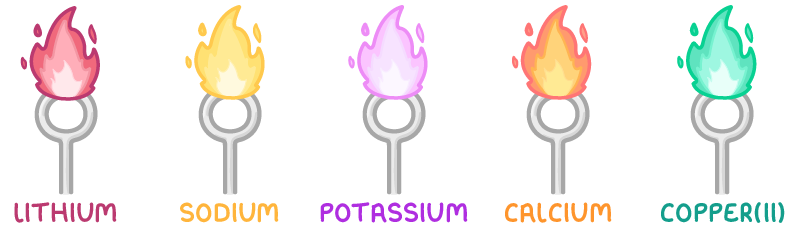
- When a metal compound is heated in a flame, it gives off a characteristic colour that identifies the metal ion.
Carrying out the test
-
Clean the wire. Dip a nichrome or platinum wire loop in hydrochloric acid, then hold it in a blue Bunsen flame until it burns with no colour. Any residue left from an earlier test would mask the sample's colour. Hydrochloric acid is used because chloride ions give no flame colour.
-
Pick up the sample. Dip the clean wire loop into the solid sample so a little clings to it.
-
Hold the loop in the flame and record the colour. Use the roaring blue flame (air hole open), which is the hottest part and won't add any yellow colour of its own.
Flame colours
| Metal ion | Flame colour |
|---|---|
| Lithium, Li+ | crimson (red) |
| Sodium, Na+ | yellow (yellow-orange) |
| Potassium, K+ | lilac |
| Calcium, Ca2+ | orange-red (brick red) |
| Copper(II), Cu2+ | blue-green (green) |
What the test cannot do
- A flame test only works reliably on a single metal ion.
- If a sample contains a mixture of ions, the colours blend and a strong colour masks a weaker one (e.g. sodium's yellow completely masks potassium's lilac).
Precipitates with sodium hydroxide
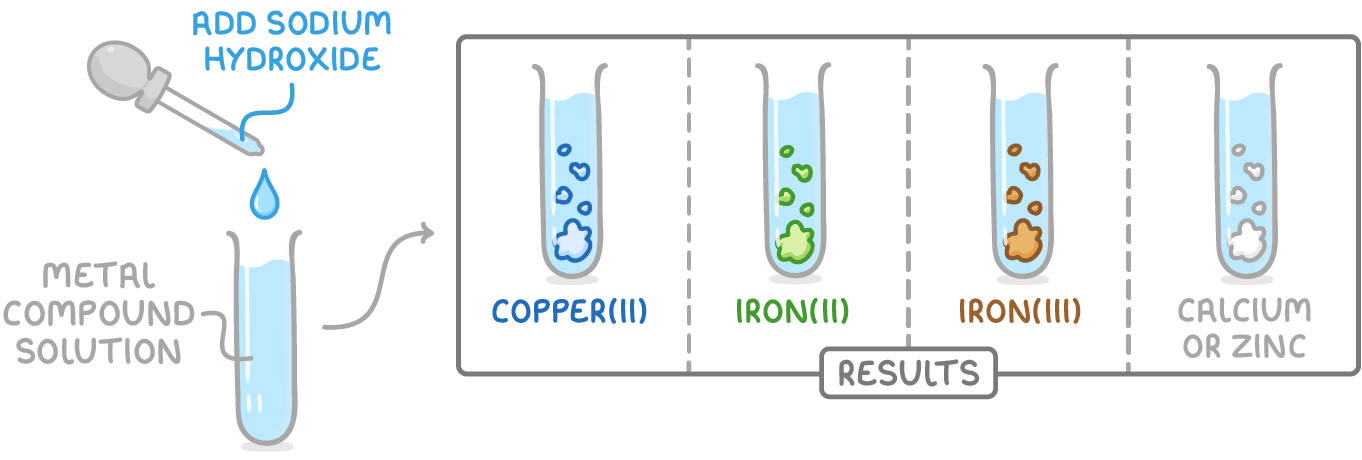
- Adding sodium hydroxide solution to a solution of a metal compound identifies the positive ion (cation) it contains.
- Most metal hydroxides are insoluble in water. When mixed, the insoluble metal hydroxide forms as a solid suspended in the liquid - a precipitate.
- Method - Dissolve the sample in water, add dilute sodium hydroxide a little at a time, and record the colour of the precipitate.
| Metal ion | Precipitate formed | Colour |
|---|---|---|
| Copper(II), Cu2+ | copper(II) hydroxide, Cu(OH)2 | blue |
| Iron(II), Fe2+ | iron(II) hydroxide, Fe(OH)2 | green |
| Iron(III), Fe3+ | iron(III) hydroxide, Fe(OH)3 | brown |
| Calcium, Ca2+ | calcium hydroxide, Ca(OH)2 | white |
| Zinc, Zn2+ | zinc hydroxide, Zn(OH)2 | white |
Telling the white precipitates apart
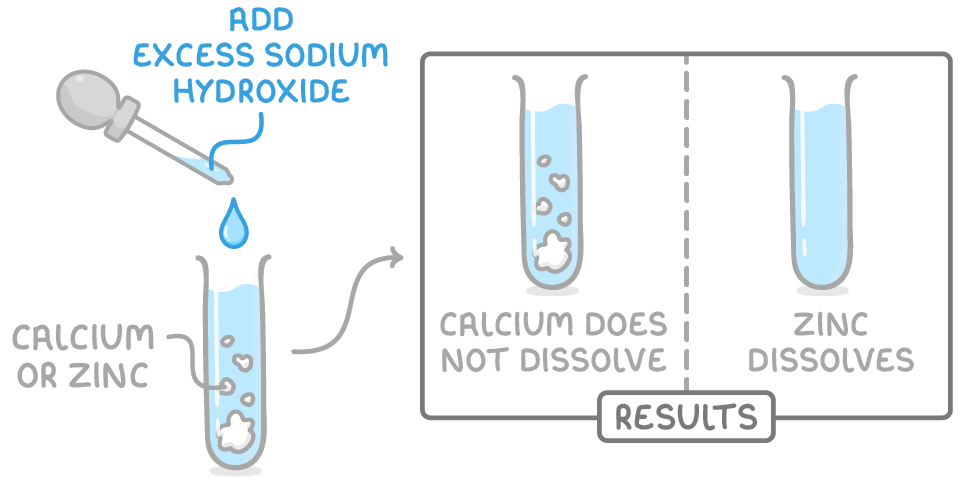
Add dilute sodium hydroxide until it is in excess.
| White precipitate | With sodium hydroxide in excess |
|---|---|
| Calcium, Ca2+ | does not dissolve |
| Zinc, Zn2+ | dissolves to give a colourless solution |
- Only zinc hydroxide dissolves in excess sodium hydroxide. The calcium precipitate remains unchanged.
- This test cannot identify Group 1 metals. Lithium, sodium, and potassium hydroxides are soluble in water, so no precipitate forms. These are identified using flame tests instead.
Worked example - Identifying a compound from tests
A white solid is thought to be a single ionic compound. Four tests are carried out. Name the compound and give its formula.
- A flame test on the solid gives no colour.
- Adding sodium hydroxide solution to a solution of the solid gives a green precipitate.
- Adding dilute hydrochloric acid to a fresh portion of the solid produces no bubbles.
- Acidifying a fresh portion of the solution with dilute hydrochloric acid, then adding barium chloride solution, gives a white precipitate.
Step 1 - Analyse each observation
- No flame colour - Rules out Li+, Na+, K+, Ca2+, and Cu2+.
- Green precipitate with NaOH - Confirms iron(II) hydroxide, so the cation is Fe2+.
- No bubbles with dilute acid - Rules out carbonate (CO32-).
- White precipitate with HCl and BaCl2 - Confirms barium sulfate precipitate, so the anion is sulfate, SO42-.
Step 2 - Combine the ions to find the formula
- Fe2+ and SO42- balance in a 1:1 ratio.
- Name - Iron(II) sulfate
- Formula - FeSO4
TermDefinition
CationA positively charged ion, which moves towards the cathode during electrolysis.
PrecipitateAn insoluble solid that forms in a solution during a chemical reaction, usually when two solutions are mixed.
Key points to remember
How were these notes?