5.5 - Tests for Anions
Qualitative analysis
- Qualitative analysis identifies which substances or ions are present in a sample.
- Quantitative analysis determines how much of a substance is present.
- A chemical test must give a result unique to that ion so it can be identified without ambiguity.
Precipitation reactions
- A precipitate is an insoluble solid that forms when two solutions are mixed.
- In a precipitation test, a reagent is added that forms an insoluble solid with the ion being tested.
- If that ion is present, a precipitate forms; its distinct colour or appearance identifies the ion.
- Both negative ions (anions) and positive ions (cations) can be identified using precipitation tests.
The test for carbonate ions
- A carbonate contains the carbonate ion, CO32-, a negatively charged ion (an anion).
- Carbonates react with dilute acids to produce a salt, water, and carbon dioxide gas.
Carrying out the test
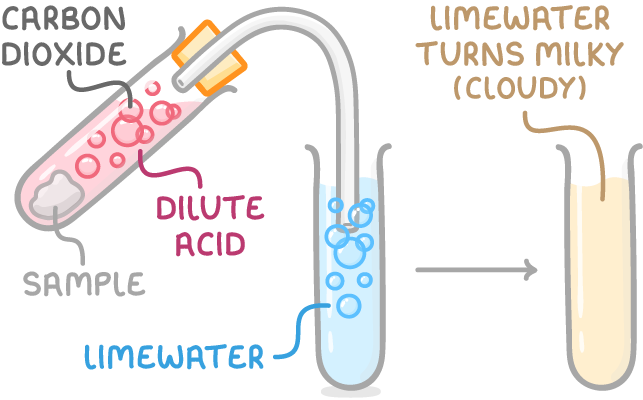
- Add dilute acid (usually dilute hydrochloric acid) to the sample.
- If carbonate ions are present, the mixture fizzes (effervesces) as carbon dioxide gas bubbles off.
- Bubble the gas through limewater (calcium hydroxide solution).
Reading the result
- Carbon dioxide reacts with calcium hydroxide to form insoluble calcium carbonate, turning the limewater cloudy (milky).
- Fizzing and the limewater turning cloudy white is the positive result: the sample contains carbonate ions.
The test for halide ions
Chloride (Cl-), bromide (Br-), and iodide (I-) are the halide ions - the negatively charged ions (anions) of Group 7.
Carrying out the test
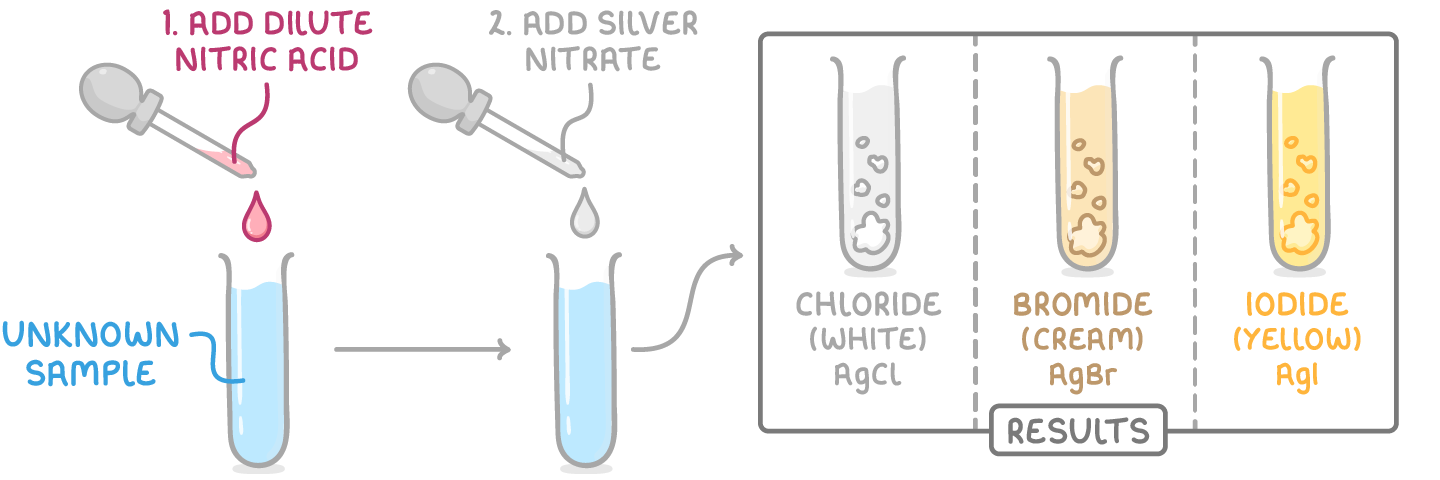
- Add dilute nitric acid - This reacts away any carbonate ions in the sample that would otherwise form a pale precipitate and give a false positive.
- Hydrochloric acid must not be used, as it contains chloride ions that would react with the silver nitrate.
- Add silver nitrate solution - Silver ions react with halide ions to form insoluble silver halides.
Results
- Chloride (Cl-) - Forms a white precipitate (silver chloride, AgCl).
- Bromide (Br-) - Forms a cream precipitate (silver bromide, AgBr).
- Iodide (I-) - Forms a yellow precipitate (silver iodide, AgI).
The test for sulfate ions
The sulfate ion, SO42-, is the negatively charged ion (the anion) in a sulfate.
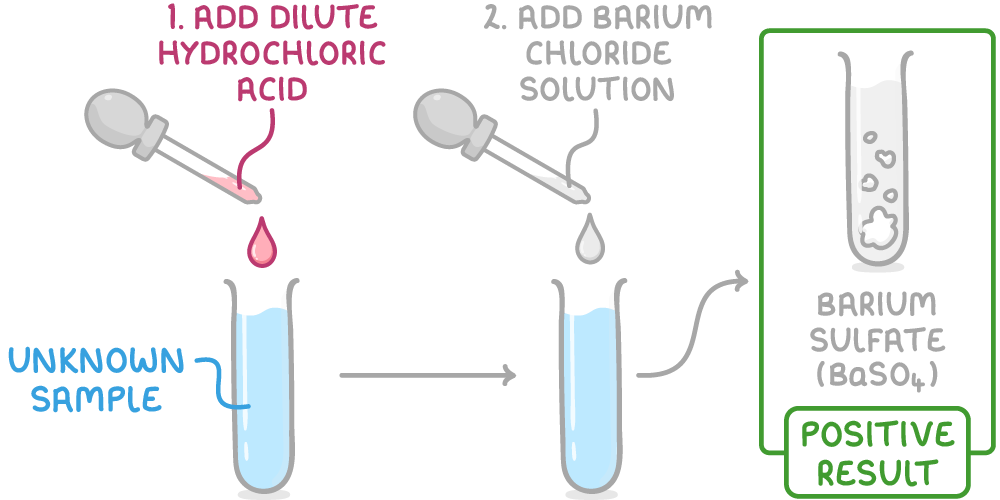
Step 1 - Add dilute hydrochloric acid
- Carbonate and sulfite ions also form insoluble white solids with barium ions; the acid reacts them away first to prevent a false positive.
- Sulfuric acid must not be used, as it adds sulfate ions and guarantees a false positive.
Step 2 - Add barium chloride solution
Barium ions react with sulfate ions to form a white precipitate of insoluble barium sulfate.
A white precipitate is the positive result: the sample contains sulfate ions.
TermDefinition
Qualitative analysisAnalysis that identifies which substances or ions are present in a sample.
Quantitative analysisAnalysis that determines how much of a substance is present in a sample.
PrecipitateAn insoluble solid that forms in a solution during a chemical reaction, usually when two solutions are mixed.
Key points to remember
How were these notes?