6.5 - The Contact Process
Making sulfuric acid in three stages
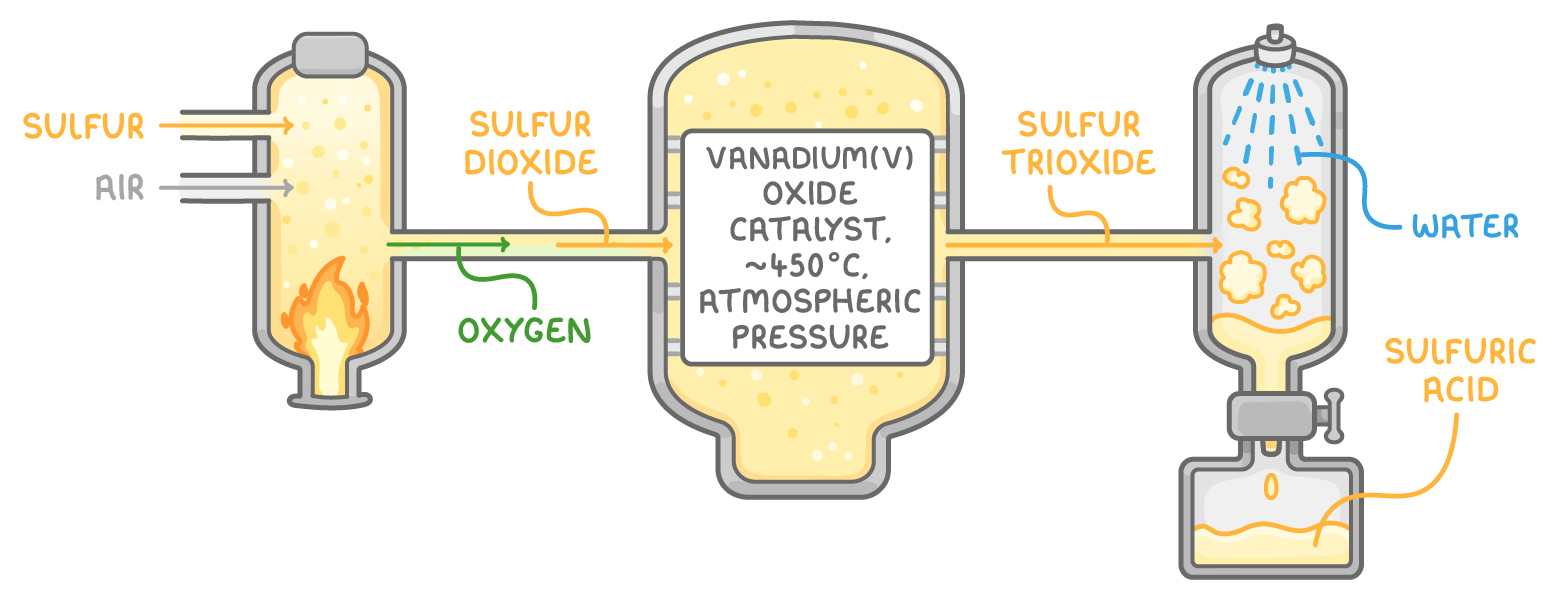
Sulfuric acid is manufactured by the Contact process in three stages.
Stage 1 - Making sulfur dioxide
Sulfur is burned in air to make sulfur dioxide.
S(s) + O2(g) → SO2(g)
Stage 2 - Making sulfur trioxide
- The sulfur dioxide reacts with more oxygen to make sulfur trioxide.
- This reaction is exothermic and reversible:
- 2SO2(g) + O2(g) ⇌ 2SO3(g)
Carried out over a catalyst of vanadium(V) oxide, V2O5, at about 450 °C and atmospheric pressure.
Stage 3 - Making sulfuric acid
The sulfur trioxide reacts with water to give sulfuric acid.
H2O(l) + SO3(g) → H2SO4(aq)
Contact process conditions
The reaction to make sulfur trioxide is reversible:
2SO2(g) + O2(g) ⇌ 2SO3(g)
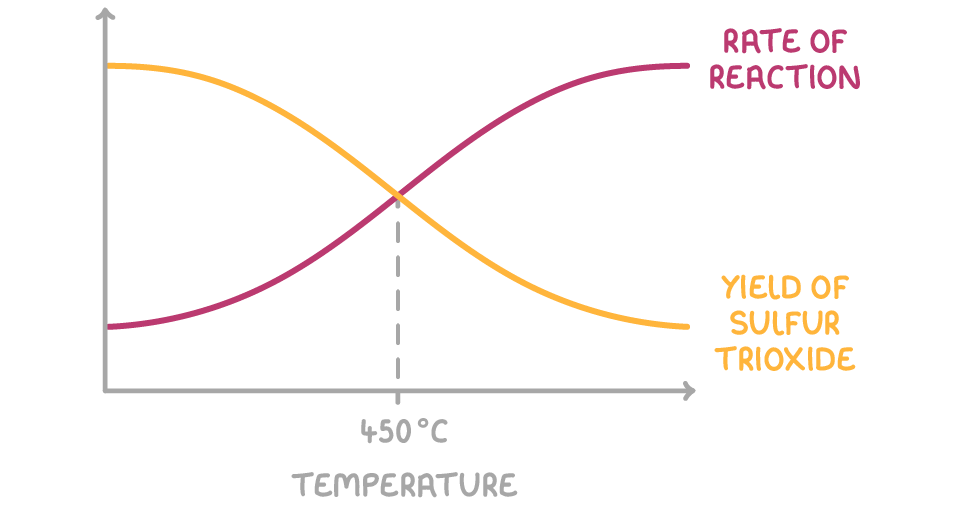
Temperature - About 450 °C
- The forward reaction is exothermic, so a lower temperature gives a higher yield of sulfur trioxide at equilibrium, but makes the reaction too slow.
- A higher temperature increases the rate, but reduces the yield.
- 450 °C is an optimum temperature that gives an acceptable yield at a reasonable rate.
Pressure - At or just above atmospheric
- An increase in pressure favours the forward reaction because there are 3 moles of gas on the left and only 2 moles on the right.
- However, the yield is already high (around 98%) at atmospheric pressure, so high-pressure equipment is not worth the extra cost.
Catalyst - Vanadium(V) oxide
- Speeds up the reaction without being used up.
- Increases the rate at 450 °C without affecting the position of equilibrium or yield.
TermDefinition
Contact processThe industrial process used to manufacture sulfuric acid.
Key points to remember
How were these notes?