7.6 - Reactivity Trends by Displacement
The experiment
Aim
To find the order of reactivity of four metals by testing whether each one displaces the others from solutions of their salts.
Background
- A more reactive metal takes the place of a less reactive metal in a solution of its salt. This is a displacement reaction.
- A less reactive metal can't displace a more reactive one, so nothing happens.
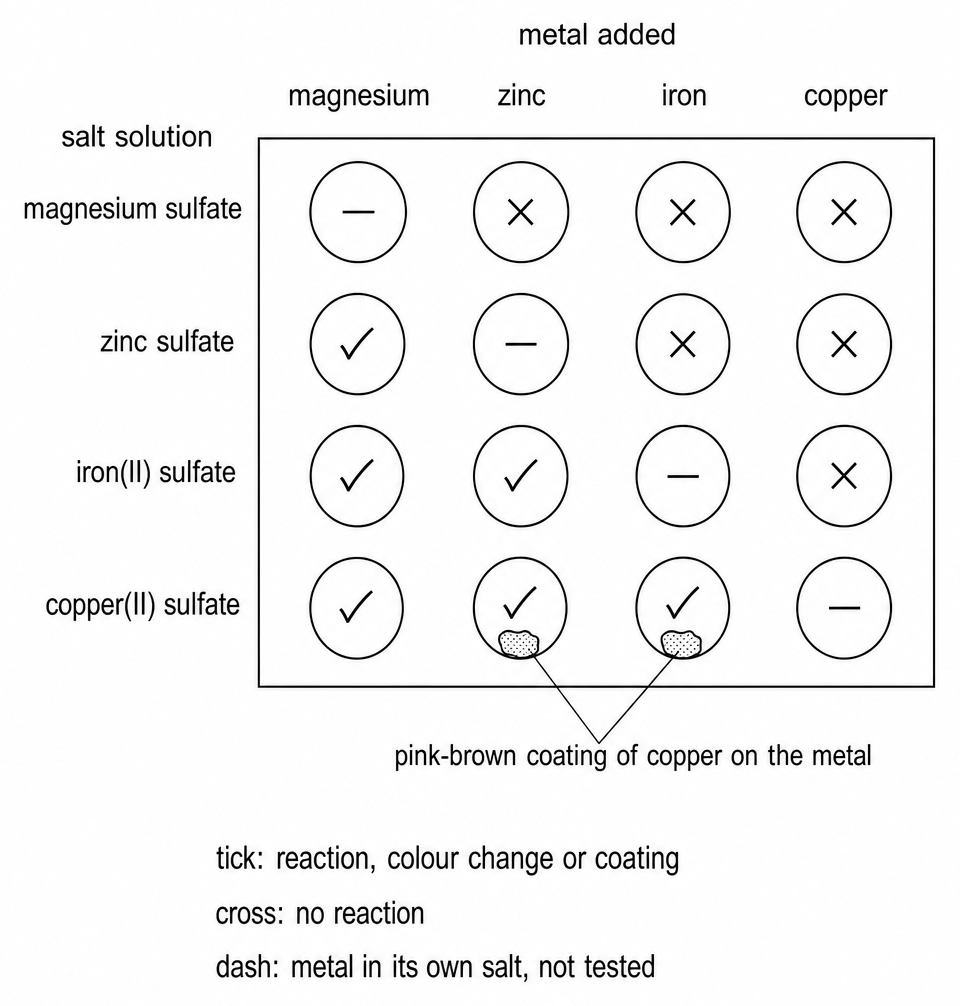
- You can't see reactivity directly, but you can see whether a displacement reaction happens, from a coating on the metal or a colour change in the solution.
- So in this practical you add each metal to the other metals' salt solutions, record which ones react, and use the pattern to put the metals in order.
Variables
- Independent variable - Which metal is added to which salt solution.
- Dependent variable - Whether a reaction happens, shown by a coating on the metal, a colour change, or a temperature rise.
- Control variables - The concentration of each salt solution, the size of each piece of metal, and the time before you record a result.
Method
- Clean the metals - Rub a small piece of magnesium, zinc, iron, and copper with emery paper to remove the oxide layer.
- Set out the salt solutions - Put a few drops of magnesium sulfate, zinc sulfate, iron(II) sulfate, and copper(II) sulfate solution into separate dips of a spotting tile.
- Add one metal - Put a piece of one metal into each of the solutions, and leave it for a few minutes.
- Record what happens - A coating forming on the metal, the colour of the solution fading, or no change.
- Test every metal - Rinse the tile and repeat with each of the other metals. A metal doesn't need testing in a solution of its own salt.
- Rank the metals - The metal that displaces all the others is the most reactive, and the one displaced by all the others is the least reactive.
Safety
- Eye protection - Wear it throughout.
- Salt solutions - They're irritants, so wash off any splashes straight away.
- Cleaned metal - Edges rubbed with emery paper can be sharp.
The experiment
Aim
To find the order of reactivity of chlorine, bromine, and iodine by testing whether each one displaces the others from solutions of their salts.
Background
- A more reactive halogen takes the place of a less reactive halogen in a solution of its salt. This is a displacement reaction.
- Reactivity decreases going down Group 7, so chlorine is the most reactive of the three and iodine the least.
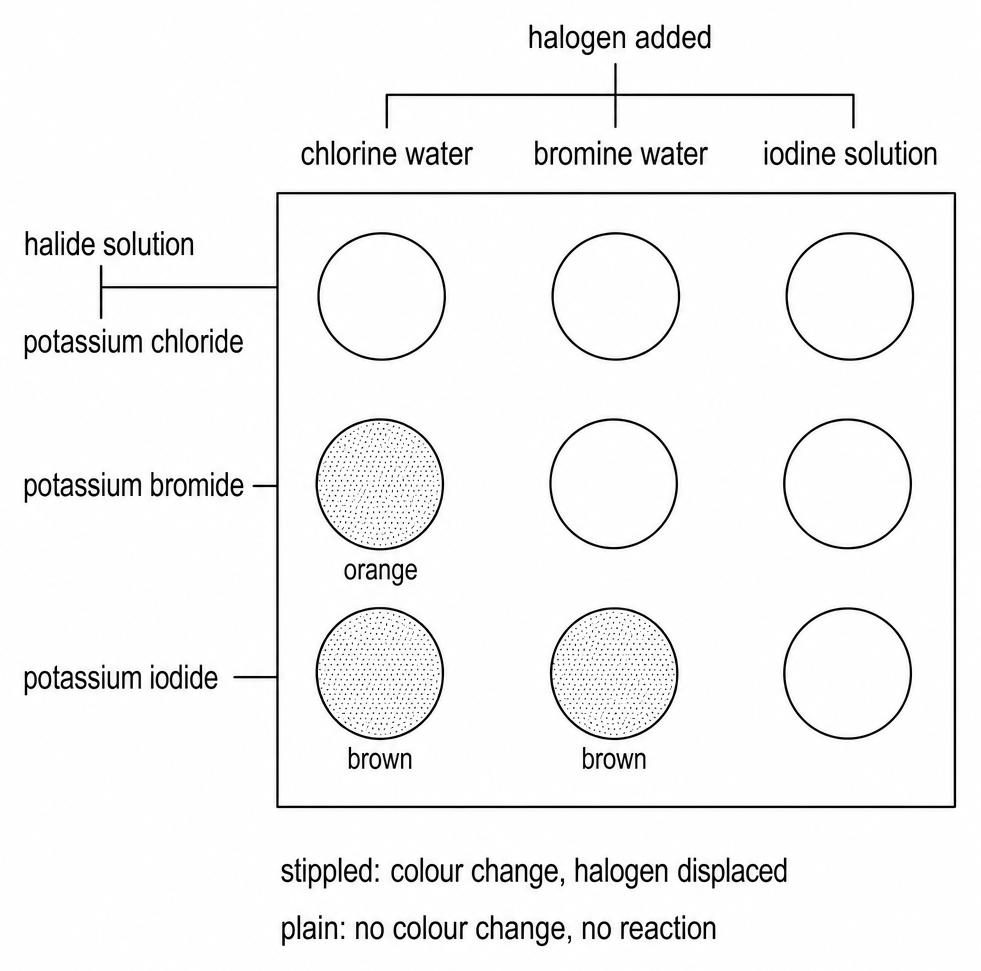
- You can't see reactivity directly, but you can see whether a displacement reaction happens, because the solution changes colour.
- So in this practical you add each halogen to solutions of the other halogens' salts, record which ones change colour, and check the order matches the periodic table.
Variables
- Independent variable - Which halogen solution is added to which halide solution.
- Dependent variable - Whether the colour changes, and the colour that appears.
- Control variables - The concentration of each solution and the number of drops added.
Method
- Set out the halide solutions - Put a few drops of potassium chloride, potassium bromide, and potassium iodide solution into separate dips of a spotting tile.
- Add chlorine water - Add a few drops to each solution and record any colour change.
- Repeat with bromine water and iodine solution - Use fresh halide solutions each time.
- Record the results in a grid - With the halogens added across the top and the halide solutions down the side.
- Rank the halogens - The halogen that displaces both of the others is the most reactive, and the one displaced by both of the others is the least reactive.
Safety
- Ventilation - Chlorine water and bromine water give off toxic vapour, so wear eye protection and work in a fume cupboard or a well-ventilated room.
- Avoid skin contact - Rinse off any spills straight away, and take care with iodine solution, which stains skin and clothes.
Common exam questions
Question 1
A metal is added to a salt solution and a reaction happens. What does this show?
The metal added is more reactive than the metal in the salt, so it has displaced it.
Question 2
Bubbles form on a piece of magnesium in a salt solution. Does this show displacement?
Not on its own. The bubbles are hydrogen from the magnesium reacting with the water or a trace of acid, not a sign that another metal has been displaced.
Question 3
How can you tell whether a grey coating on a metal is displaced iron?
Hold a magnet near it. Iron is attracted to a magnet, and the other metals in this practical aren't.
Question 4
Why does chlorine displace bromine from potassium bromide solution, but bromine can't displace chlorine from potassium chloride solution?
Chlorine is more reactive than bromine, so it can take bromine's place. Bromine is less reactive than chlorine, so it can't take chlorine's place.
Question 5
Write a balanced symbol equation for the reaction between magnesium and copper(II) sulfate solution.
Mg(s) + CuSO4(aq) → MgSO4(aq) + Cu(s)