4.19 - Tests for Gases
Tests for the common gases
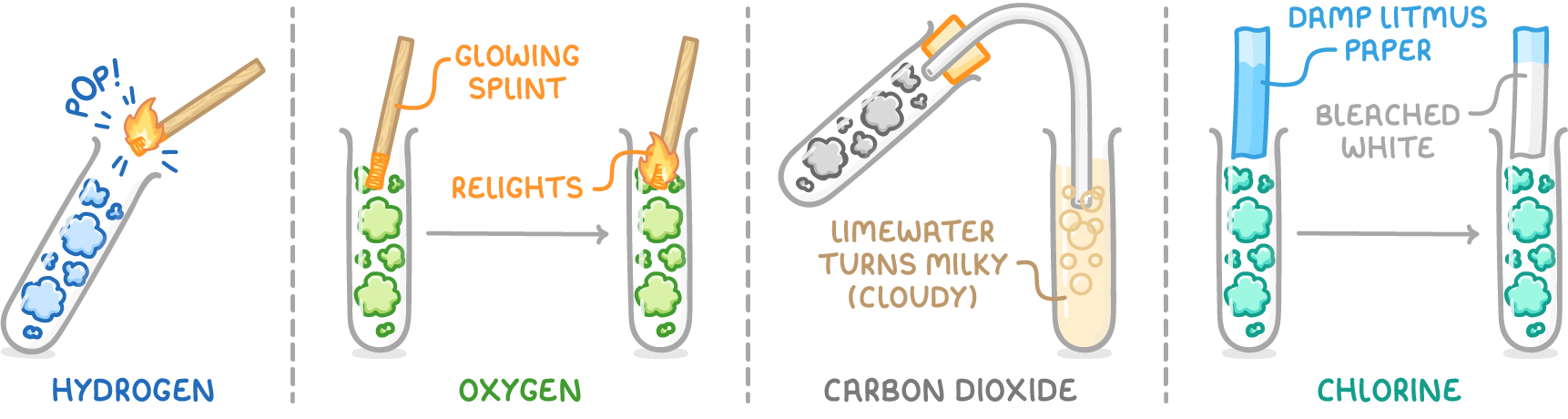
Hydrogen
- Hold a lit splint at the open end of a test tube of the gas.
- Hydrogen burns quickly with a squeaky pop.
Oxygen
- Insert a glowing splint into a test tube of the gas.
- If the gas is oxygen, the splint relights.
Carbon dioxide
- Bubble the gas through limewater (a colourless solution of calcium hydroxide).
- If the gas is carbon dioxide, the limewater turns cloudy (milky) as a white precipitate of calcium carbonate forms.
Chlorine
- Chlorine has a sharp, choking smell, but it is toxic, so an unknown gas is never smelled deliberately.
- Hold damp blue litmus paper in the gas.
- Chlorine bleaches the paper white (it may turn red briefly first because chlorine is acidic in solution).
- Damp universal indicator paper can be used instead: it turns red and is then bleached white.
- The paper must be damp so the gas can dissolve in the water.
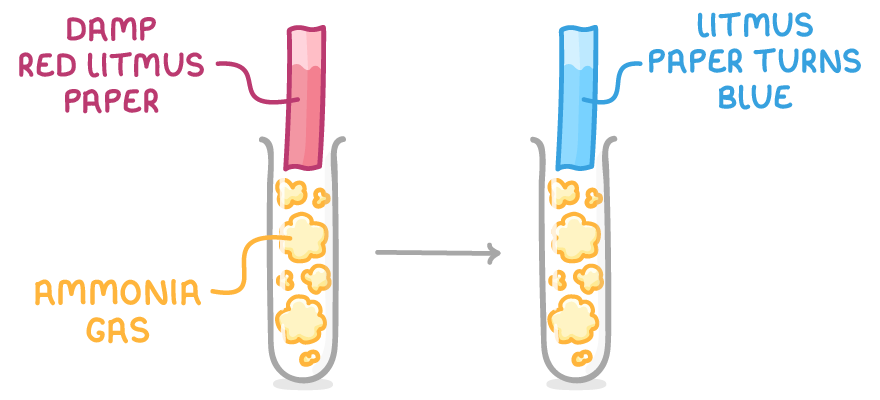
The test for ammonia
- Hold damp red litmus paper in the gas.
- Ammonia dissolves in the water on the paper to form an alkaline solution, turning the paper blue.
- The paper must be damp so the ammonia can dissolve.
Tests for water
A chemical test for water uses an anhydrous salt (one containing no water) that changes colour when water is added.
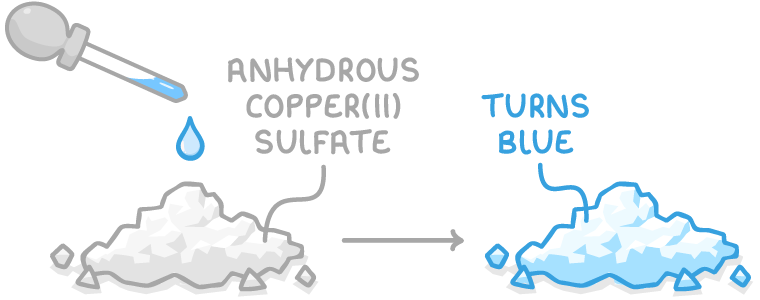
Anhydrous copper(II) sulfate
- Add the liquid to white anhydrous copper(II) sulfate.
- If water is present, the powder turns blue.
Testing for purity
- This test shows only that water is present.
- It does not show that the water is pure: any aqueous solution will also give a positive result.
TermDefinition
LimewaterA solution of calcium hydroxide in water that turns milky or cloudy when carbon dioxide is bubbled through it.
AnhydrousDescribes a substance that contains no water, such as a salt that has had its water of crystallisation removed.