6.2 - Naming Organic Compounds & Isomers
Naming a compound
A systematic name tells you how long the carbon chain is, which family the compound belongs to, and where its functional group sits.
Step 1 - Count the carbons for the stem
The number of carbons in the chain gives the stem, the first part of the name.
| Carbon atoms | 1 | 2 | 3 | 4 | 5 | 6 |
|---|---|---|---|---|---|---|
| Stem | meth- | eth- | prop- | but- | pent- | hex- |
Step 2 - Find the functional group for the suffix
The functional group is the atom or group of atoms that decides how the compound reacts, and it tells you which family the molecule belongs to. The family gives the suffix.
| Family | What identifies it | Suffix |
|---|---|---|
| alkanes | every carbon-to-carbon bond is single | -ane |
| alkenes | a carbon-to-carbon double bond, C=C | -ene |
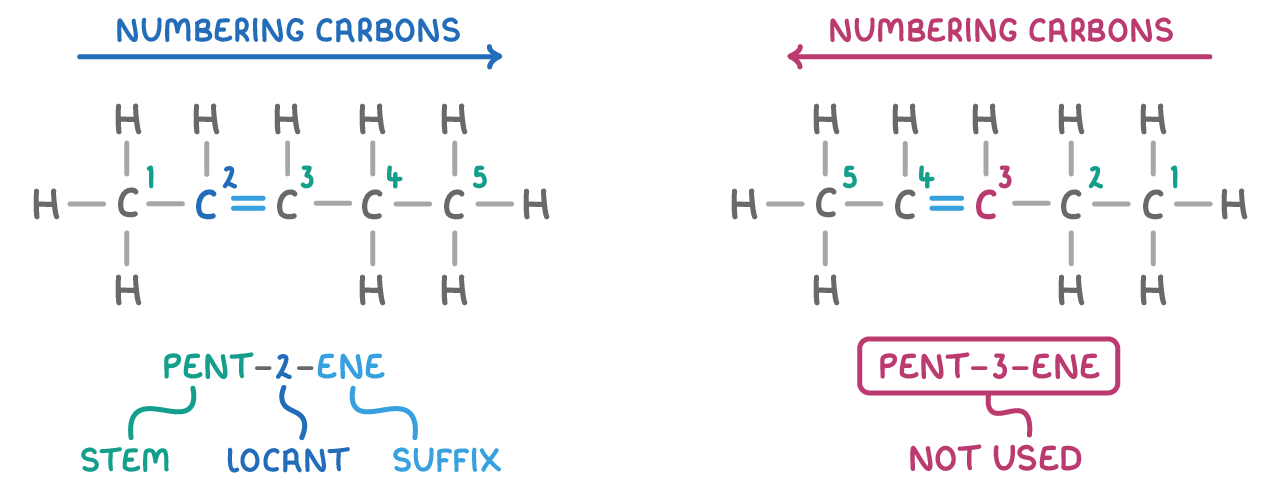
Step 3 - Number the chain
- Number every carbon in turn (1, 2, 3...), starting from whichever end gives the functional group the lower number.
- Try both ends - only the lower number is used.
Step 4 - Write in the locant
- The number is called the locant - it says which carbon the functional group is joined to.
- Write it between the stem and suffix, with a hyphen on either side.
- A double bond is numbered by the lower of the two carbons it joins.
Step 5 - Assemble the parts
Put them together: stem, then locant, then suffix.
When the locant is skipped
Not every name needs a locant:
- An alkane has no functional group to place, so its name is stem + suffix only.
- A double bond in a two- or three-carbon chain has only one possible position, so no number is written.
- The number is only needed once there's more than one possible position for the group.
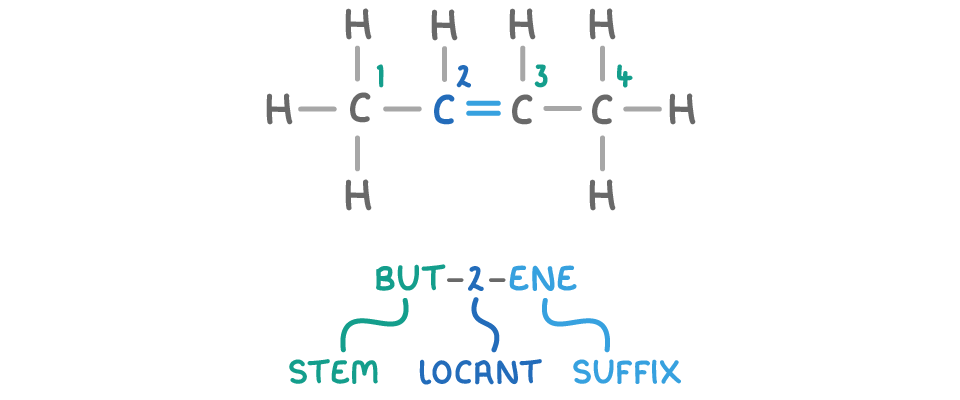
Worked example - Naming but-2-ene
Name the compound below.

Step 1 - Count the carbon atoms in the chain
Four carbon atoms joined in a row, so the stem is but-.
Step 2 - Find the functional group for the suffix
Two carbons are joined by a double bond (C=C), which puts the compound in the alkenes, so the suffix is -ene.
Step 3 - Number the chain
Numbering from either the left or the right puts the double bond between carbons 2 and 3. A double bond takes the lower number, so it's on carbon 2.
Step 4 - Write in the locant
The locant is 2, so the middle of the name is -2-.
Step 5 - Assemble the parts
but- + -2- + -ene
Systematic name = but-2-ene
Drawing a structure from its name
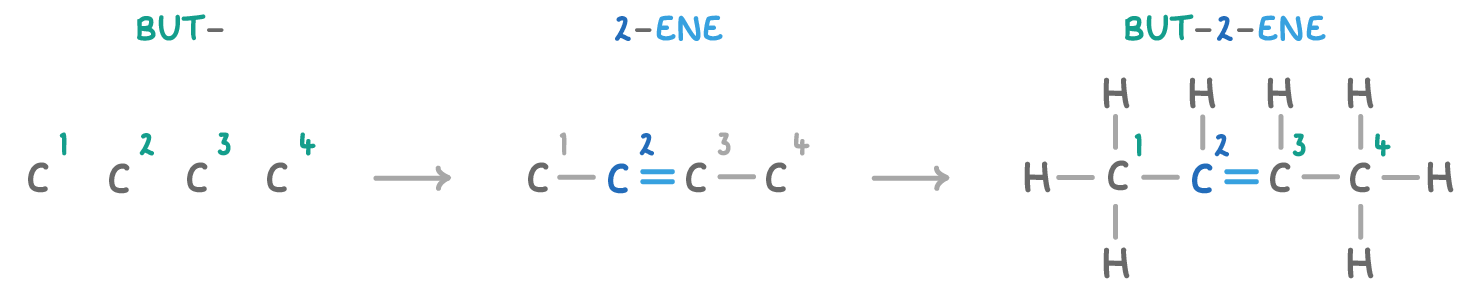
A structure can be drawn directly from its systematic name by working through each part.
Step 1 - Draw the carbon chain
Read the stem and draw that many carbons in a row, then number them. The bonds between them go in next. For but-2-ene, the stem is but-, so draw four carbons in a row.

Step 2 - Read the suffix for the functional group
The suffix -ene means there is a carbon-to-carbon double bond (C=C).
Step 3 - Place the group at its locant
The locant 2 means the double bond starts at carbon 2, so put a double bond between carbons 2 and 3.

Step 4 - Add hydrogen atoms
Carbon always forms four bonds and hydrogen forms one. Add hydrogens until every carbon has four bonds (a double bond counts as two bonds):
- Carbon 1 has one bond → 3 hydrogens
- Carbon 2 has three bonds → 1 hydrogen
- Carbon 3 has three bonds → 1 hydrogen
- Carbon 4 has one bond → 3 hydrogens

Step 5 - Check and count for the formula
Check every carbon has four bonds and count the atoms: four carbons and eight hydrogens gives the molecular formula C4H8.
Naming alcohols
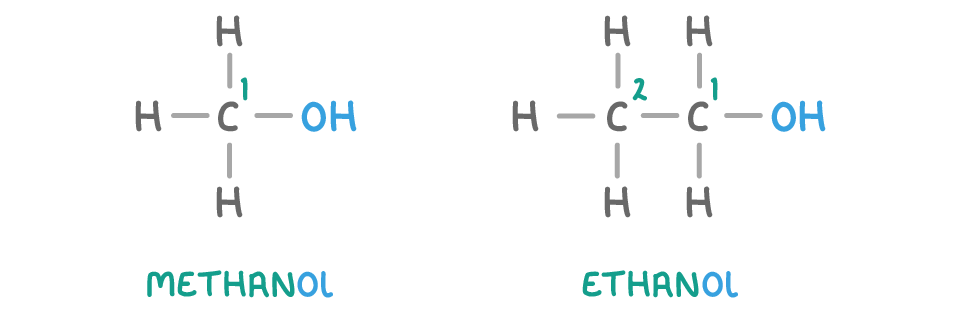
- An alcohol is an organic compound with a hydroxyl group (-OH) attached to a carbon atom.
- The hydroxyl group is the functional group of alcohols, so their names end in the suffix -ol.
- In methanol (1 carbon) and ethanol (2 carbons), the -OH group can only be on carbon 1, so no number is needed.
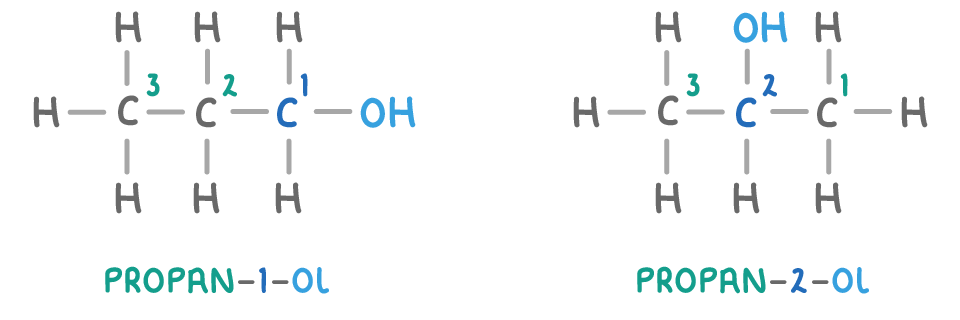
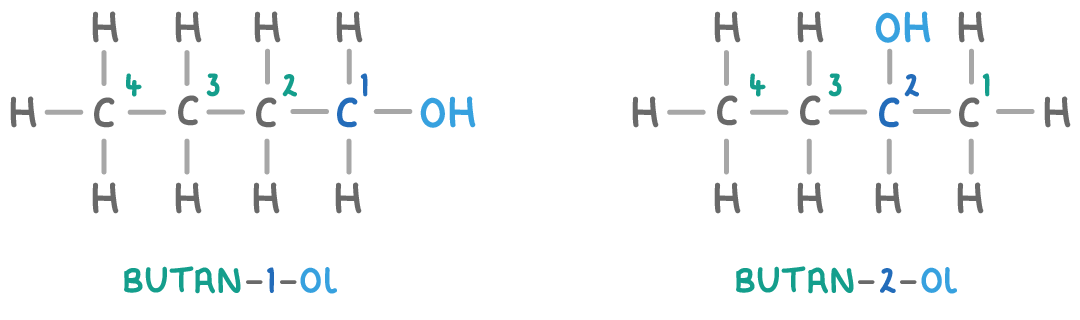
- From three carbons upwards, the -OH group can sit on different carbons, so a locant is needed to show its position.
Numbering the chain
- Number the carbon chain from the end that gives the -OH group the lowest possible number.
- Write that number between the stem and the suffix -ol.
Worked examples
Propan-1-ol: The -OH is on an end carbon of a three-carbon chain. Numbering from that end makes it carbon 1 (never propan-3-ol).
Butan-1-ol: The -OH is on the end carbon of a four-carbon chain, giving carbon 1.
Molecular formulae
- Propan-1-ol: C3H8O (or C3H7OH)
- Butan-1-ol: C4H10O (or C4H9OH)
Structural isomers
- A molecular formula shows the number of each type of atom in a molecule (e.g. C4H10), but not how they're joined.
- A structural formula shows how the atoms are arranged.
Definition of structural isomers
Structural isomers are compounds with the same molecular formula but different structural formulae.
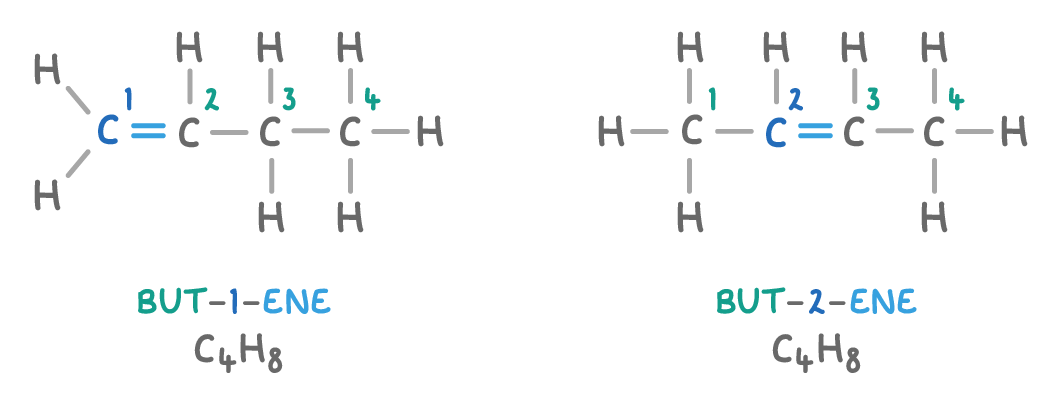
Position of functional group
The functional group can be attached at different points along the same carbon chain. For example, C4H8 gives but-1-ene (double bond between carbons 1 and 2) and but-2-ene (double bond between carbons 2 and 3).
Branching of the carbon chain
The arrangement of the carbon skeleton itself can differ. The steps below find every chain isomer systematically.
Step 1 - Draw the longest straight chain
Draw all carbons in a single row and fill in hydrogens. For C4H10, this is a straight four-carbon chain (butane).
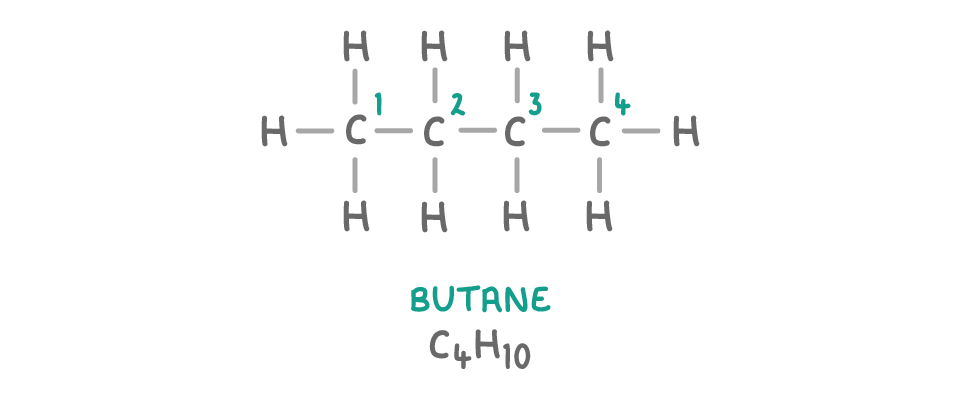
Step 2 - Shorten and branch
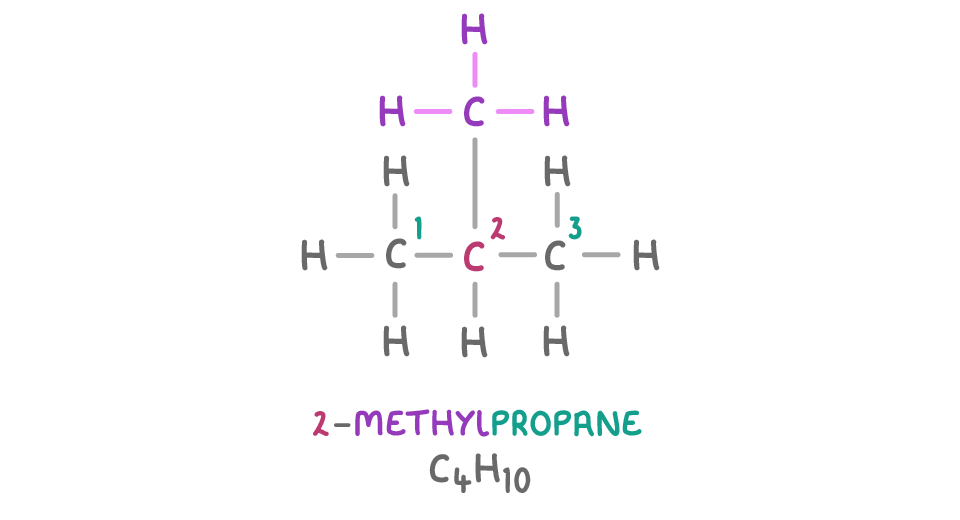
Shorten the chain by one carbon and attach that carbon to a middle carbon of the chain, then fill in hydrogens. For C4H10, this gives a three-carbon chain with a methyl branch on carbon 2 (2-methylpropane).
Step 3 - Repeat for every position
Try moving the branch to any other non-end position, or shorten the chain further. For C4H10, no other arrangements exist, so there are two structural isomers.
Common traps
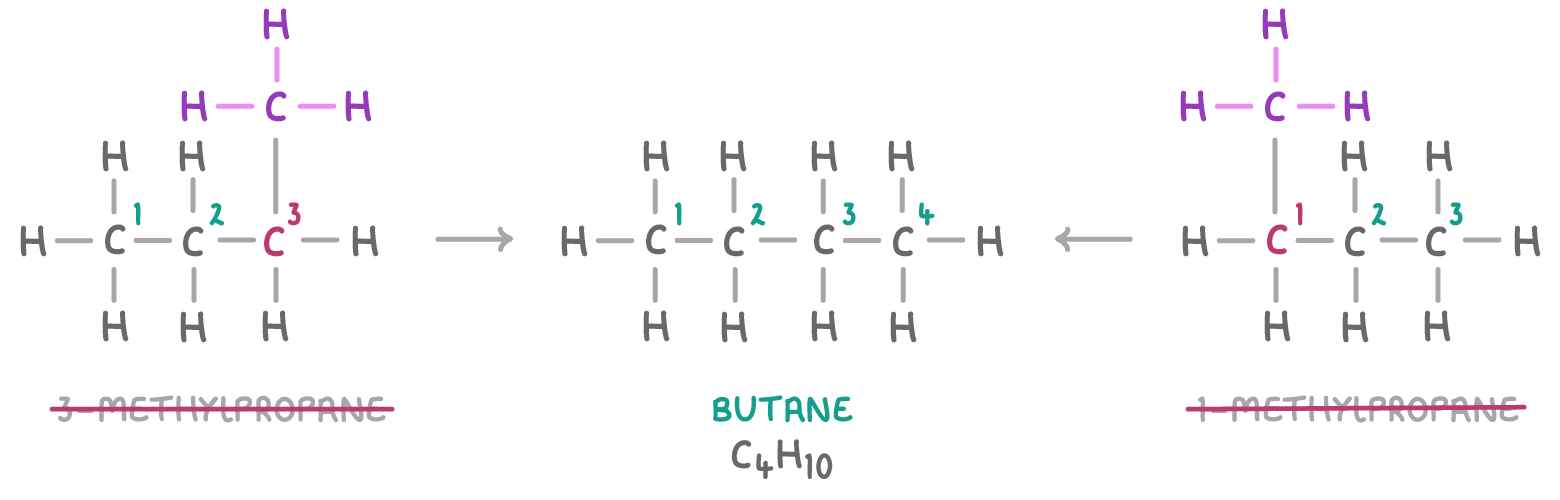
- Attaching a removed carbon to an end carbon does not create a branch - it just redraws the original straight chain.
- Bending a chain on paper does not make it a different molecule: what matters is which carbons are bonded together.
Properties of structural isomers
- Isomers can also have different functional groups, which puts them in different homologous series (for example, an alkene and a ring-shaped cycloalkane with the same molecular formula). Their chemical properties then differ as well.
- Isomers with the same functional group have similar chemical properties.
- Isomers have different physical properties (such as boiling point) because their molecular shapes differ.
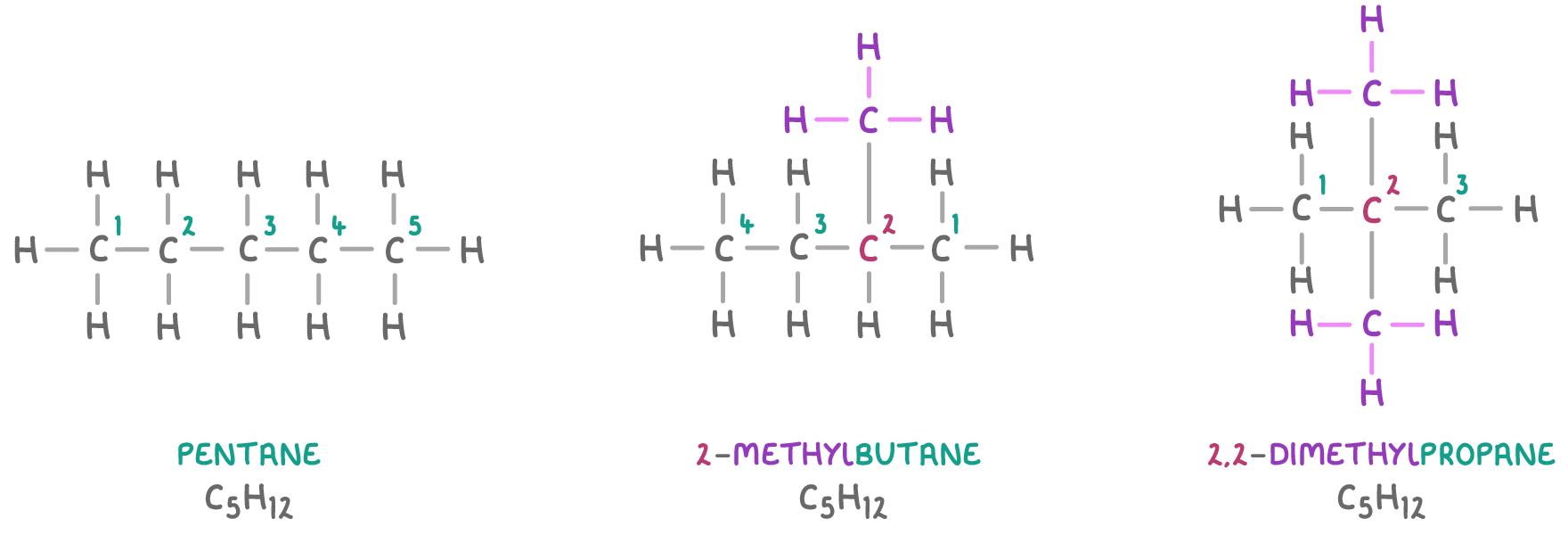
Worked example - The isomers of C5H12
Draw all the structural isomers of C5H12.
Step 1 - Draw the longest straight chain
Draw all five carbons in a continuous row and fill in twelve hydrogens. This is pentane.
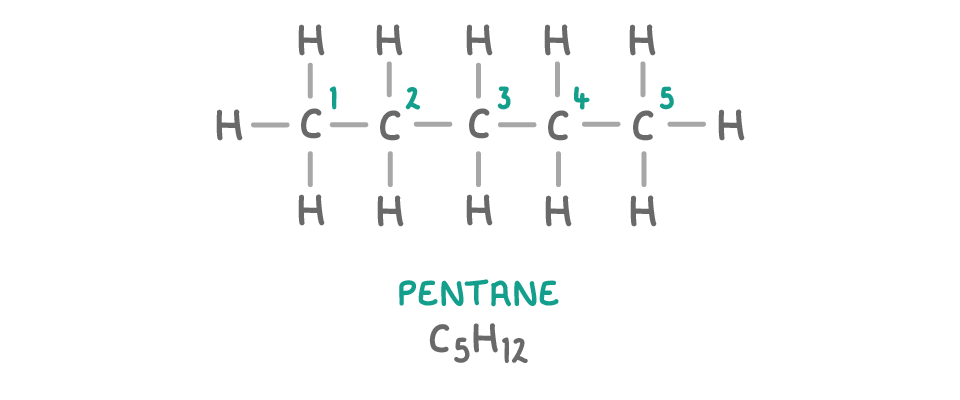
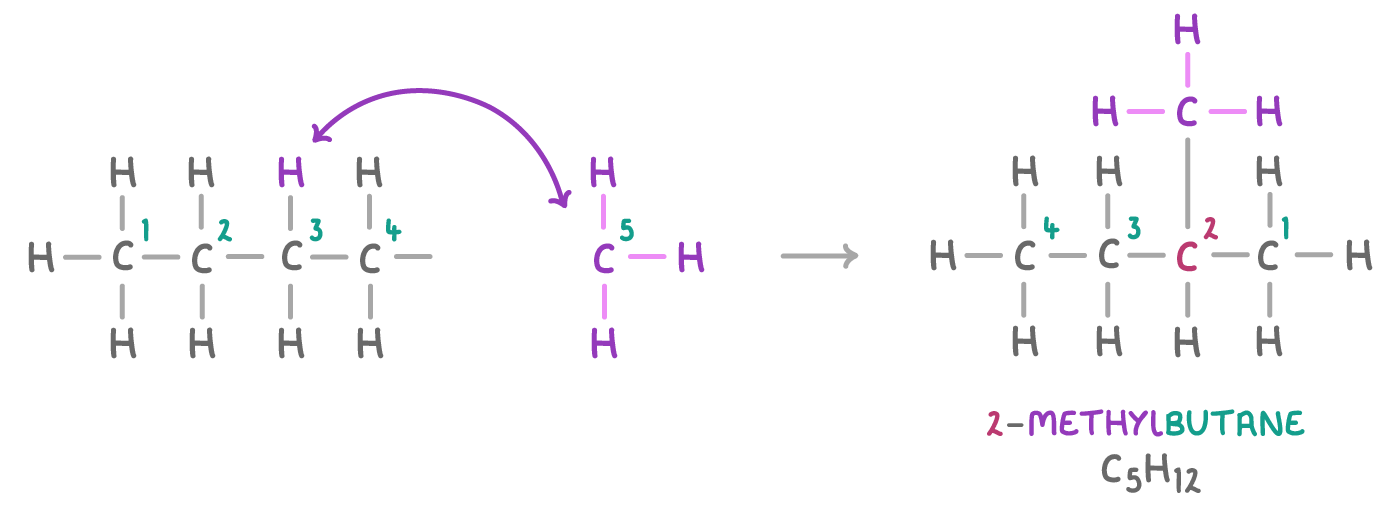
Step 2 - Shorten the chain by one carbon and add a branch
A four-carbon chain with one carbon branch attached to a middle carbon gives 2-methylbutane. Attaching the methyl group to the other middle carbon gives the exact same molecule numbered from the opposite end.
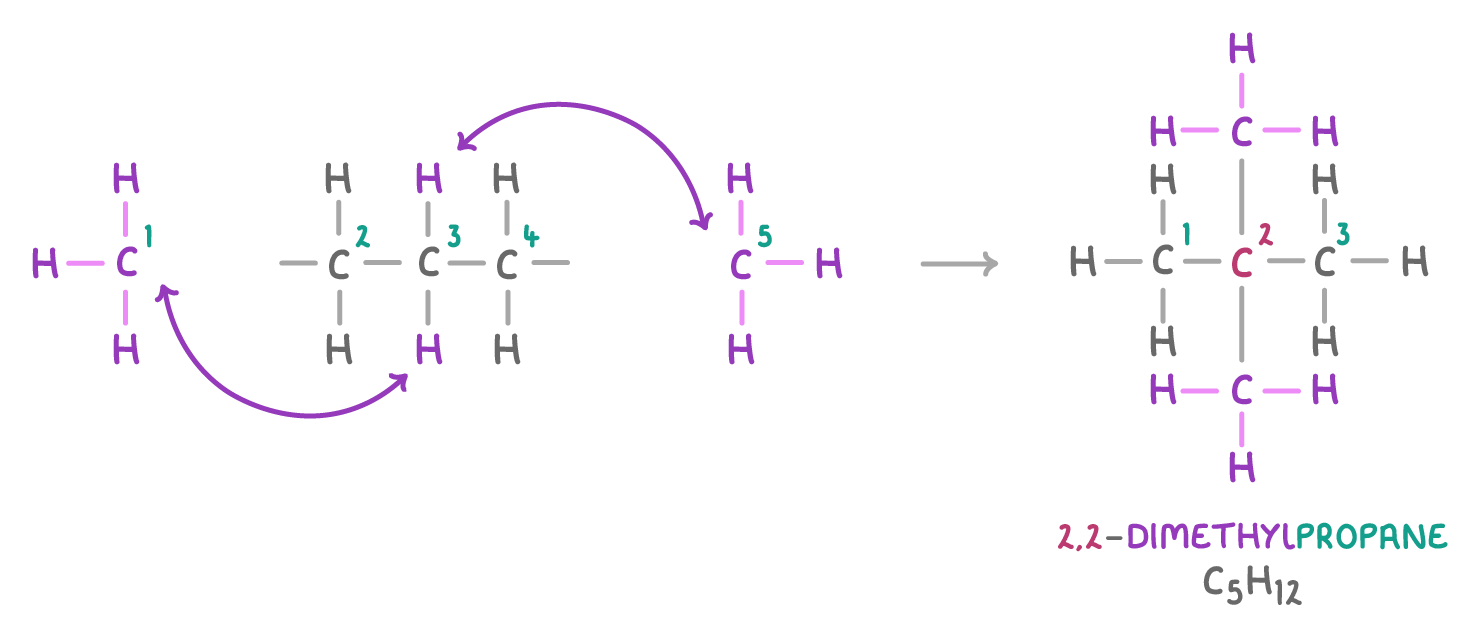
Step 3 - Shorten the chain by two carbons and add two branches
A three-carbon chain has only one middle carbon (carbon 2). Attaching both remaining carbons to it gives 2,2-dimethylpropane.
Shortening the chain to two carbons leaves no middle carbon to attach branches to, so no more isomers can be made.
Step 4 - Check each structure
Each structure has five carbons, twelve hydrogens, and every carbon has four bonds. All three are distinct: chains of 5, 4, and 3 carbons.
C5H12 has three structural isomers.