7.6 - Reactions of Dilute Acids
The experiment
Aim
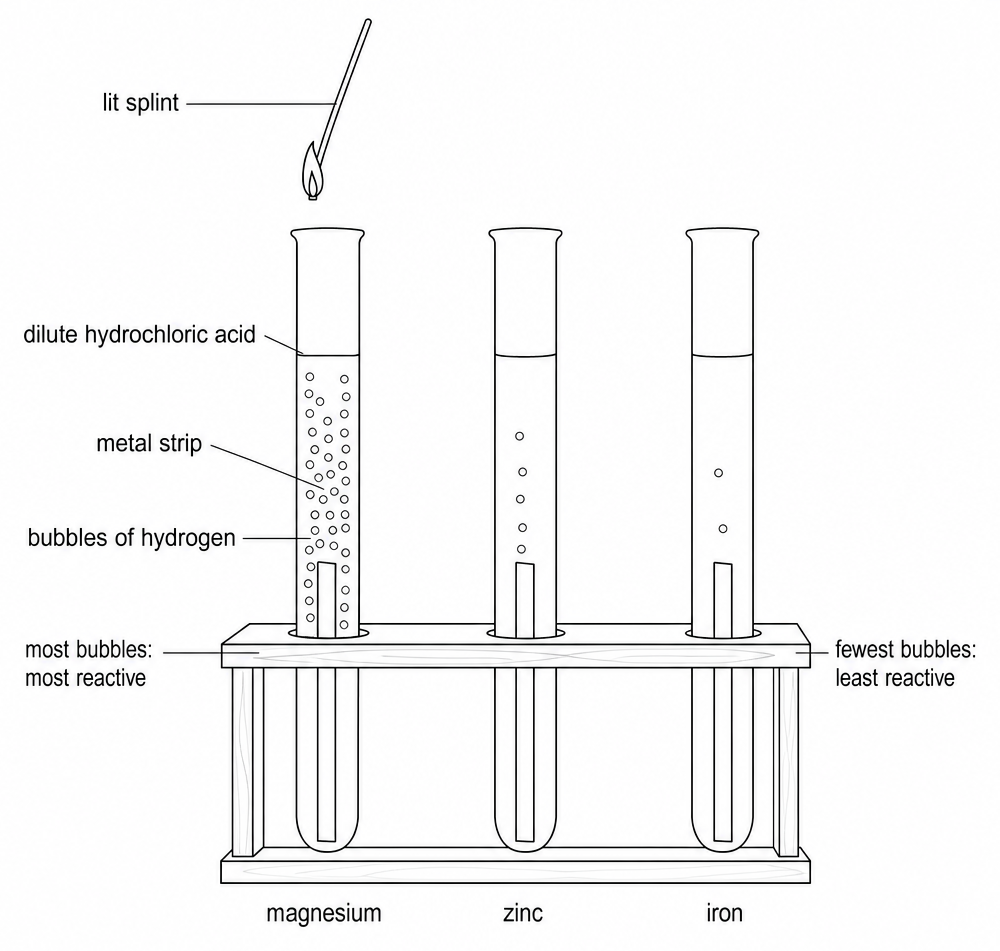
To compare how magnesium, zinc, and iron react with dilute hydrochloric acid and dilute sulfuric acid, and to use how fast each one reacts to put the metals in order of reactivity.
Background
- Acids react with metals to make a salt and hydrogen, as long as the metal is above hydrogen in the reactivity series.
- The more reactive the metal, the faster it reacts, and the faster bubbles of hydrogen are given off.
- You can't measure reactivity directly, but you can compare how quickly bubbles form.
- So in this practical you add three metals to the same acid, compare how fast each one fizzes, and use that to put them in order of reactivity.
Variables
- Independent variable - The metal added to the acid.
- Dependent variable - How quickly bubbles of gas form, judged by eye.
- Control variables - The acid and its volume and concentration, and the size and shape of each piece of metal.
Method
- Set up three tubes - Measure the same volume of dilute hydrochloric acid into each of three boiling tubes.
- Add the metals - Add a piece of magnesium to the first tube, and pieces of zinc and iron of the same size and shape to the other two.
- Compare the reactions - Watch all three at once, and note how fast bubbles form in each.
- Test the gas - Hold a lit splint at the mouth of a fizzing tube and listen for a squeaky pop.
- Repeat with sulfuric acid - Use dilute sulfuric acid instead, and check the order is the same.
- Record your results - Put your observations for both acids in a table, and rank the metals from fastest to slowest.
Safety
- Eye protection - Both acids are irritants.
- Hydrogen is flammable - Only bring the lit splint to a tube once it's fizzing, and point the tube away from people.
- Handle metals with tweezers - A cut strip can have sharp edges.
Common exam questions
Question 1
How do you test a gas to show it is hydrogen, and what is the result?
Hold a lit splint at the mouth of the tube. Hydrogen burns with a squeaky pop.
Question 2
How do you test a gas to show it is carbon dioxide, and what is the result?
Bubble the gas through limewater. Carbon dioxide turns the limewater cloudy.
Question 3
Why doesn't copper react with dilute hydrochloric acid or dilute sulfuric acid?
Copper is below hydrogen in the reactivity series, so it can't displace hydrogen from the acid.
Question 4
Write a word equation for the reaction between magnesium and hydrochloric acid.
Magnesium + hydrochloric acid → magnesium chloride + hydrogen
Question 5
Write a word equation for the reaction between calcium carbonate and hydrochloric acid.
Calcium carbonate + hydrochloric acid → calcium chloride + water + carbon dioxide