7.2 - Determining the Solubility of a Solid
The experiment
Aim
To find the solubility of a solid in water at a chosen temperature, and to see how solubility changes as temperature changes.
Background
- A saturated solution holds the most solute that can dissolve in it at that temperature.
- A solid's solubility is the mass of it that dissolves in 100 g of water at a stated temperature to make a saturated solution. For most solids, solubility rises as the temperature rises.
- You can't weigh the solid while it's dissolved, but you can evaporate the water and weigh the solid left behind.
- So in this practical you make a saturated solution, evaporate a sample of it, and use the masses of the solid and the water to work out the solubility at each temperature.
Variables
- Independent variable - The temperature of the water.
- Dependent variable - The solubility of the solid, in g per 100 g of water.
- Control variables - The solid used, the volume of water, and the time left for the solution to become saturated.
Method
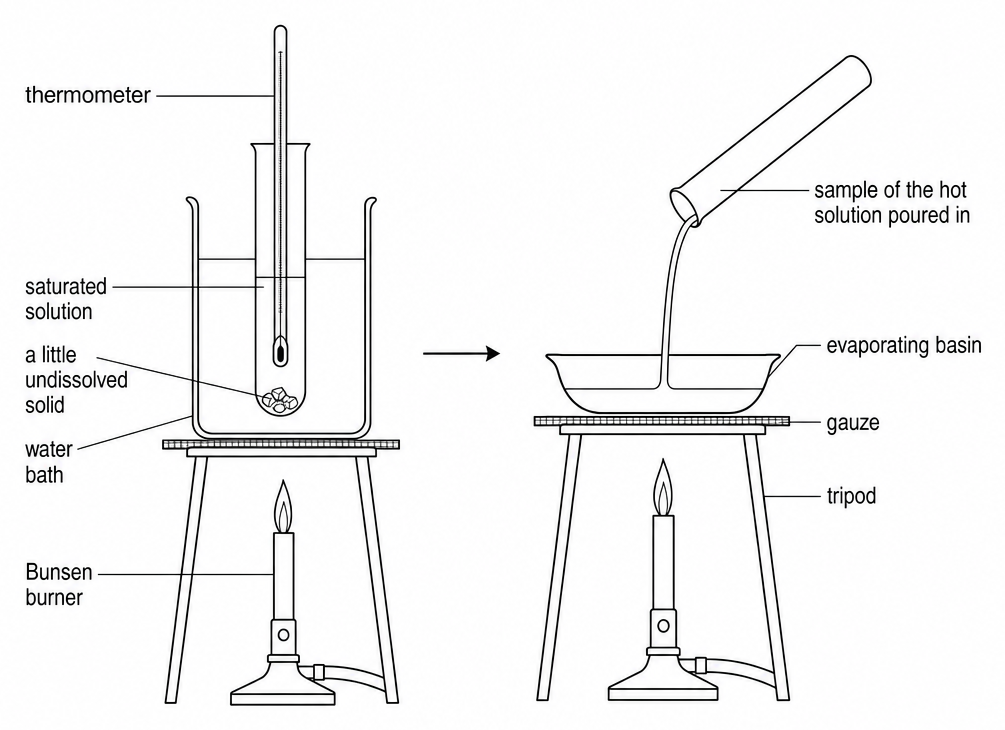
- Make a saturated solution - Stir more of the solid into water in a boiling tube than will dissolve, until some is left at the bottom.
- Bring it to temperature - Stand the tube in a water bath at the temperature you're testing for several minutes, stirring now and then, and check the solution's temperature with a thermometer.
- Weigh an empty evaporating basin - And record its mass.
- Add a sample of the solution - Pour some into the basin without any of the undissolved solid, and weigh the basin again.
- Evaporate the water - Heat the basin gently until the solid looks dry, then let it cool and weigh it.
- Heat to constant mass - Heat, cool and weigh the basin again, and keep going until two readings agree.
- Repeat at other temperatures - So you can plot a solubility curve.
Safety
- Eye protection - Wear it throughout.
- Hot basin - Move it with tongs, since it stays hot long after heating stops.
- Heat gently - Some solids spit as the last of the water leaves.
Worked example - Solubility of potassium nitrate
A student investigated how the solubility of potassium nitrate changes with temperature. These are her readings at 20 °C.
| Reading | Mass in g |
|---|---|
| Empty evaporating basin | 24.00 |
| Basin and saturated solution | 53.00 |
| Basin and dry potassium nitrate, at constant mass | 33.00 |
She repeated the experiment at other temperatures, and got these results.
| Temperature in °C | 0 | 20 | 40 | 60 | 80 |
|---|---|---|---|---|---|
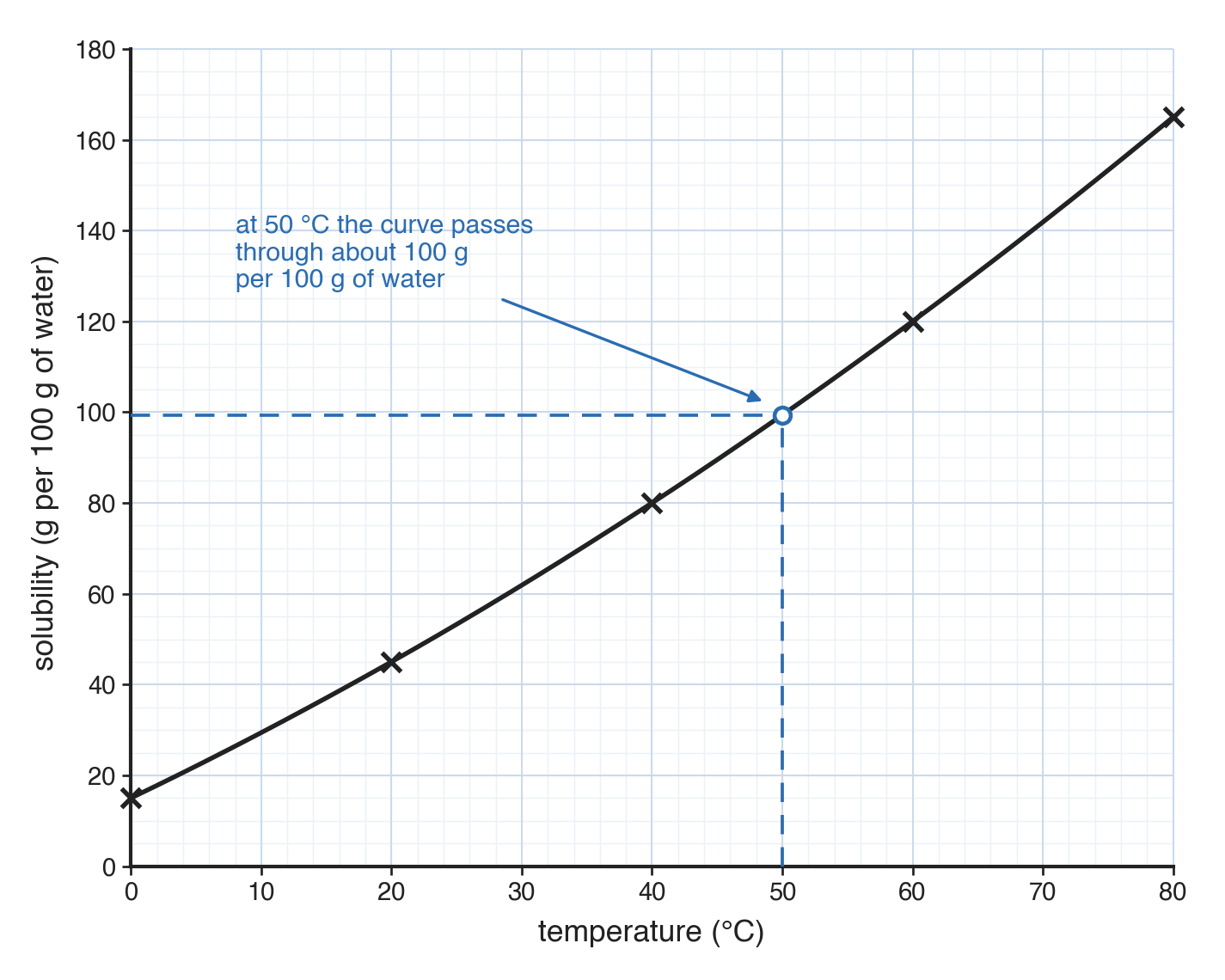
| Solubility in g per 100 g of water | 15 | 45 | 80 | 120 | 165 |
Find the solubility at 20 °C from her readings, plot a solubility curve, and use it to find the solubility at 50 °C.
Step 1 - Find the mass of dry solid
Subtract the mass of the empty basin from the final constant mass.
33.00 - 24.00 = 9.00 g
Step 2 - Find the mass of water evaporated
Subtract the final constant mass from the mass of the basin and solution.
53.00 - 33.00 = 20.00 g
Step 3 - Calculate the solubility
This matches the 20 °C value in her results.
Step 4 - Plot the solubility curve
Plot solubility on the y-axis against temperature on the x-axis, and draw a smooth curve through all five points.
Step 5 - Read off the solubility at 50 °C
Draw a line up from 50 °C to the curve, then across to the y-axis. The solubility at 50 °C is about 100 g per 100 g of water.
Step 6 - Describe the trend
Solubility increases as the temperature increases, and it rises more steeply at higher temperatures.
Common exam questions
Question 1
Why must the solution be saturated before a sample is taken?
Solubility is the mass that saturates 100 g of water at that temperature. If the solution isn't saturated, less solid is dissolved than could be, so the solubility comes out too low.
Question 2
Why must none of the undissolved solid go into the basin?
It isn't part of the solution. It would add to the mass of dry solid and make the solubility too high.
Question 3
Why is the basin heated to constant mass?
One heating can leave some water behind, which would be weighed as solid and make the solubility too high. When two weighings agree, all the water has gone.
Question 4
Some solid spits out of the basin while it's heated. What effect does this have on the solubility?
The solubility comes out too low. The final mass is smaller, so the mass of solid looks smaller and the mass of water looks bigger.
Question 5
Why is the basin left to cool before it's weighed?
A hot basin warms the air around the balance, which makes the reading inaccurate. It could also burn you.