6.10 - Esters
Esters, and how one is made
An ester is a compound made when a carboxylic acid and an alcohol react together.
What makes a compound an ester
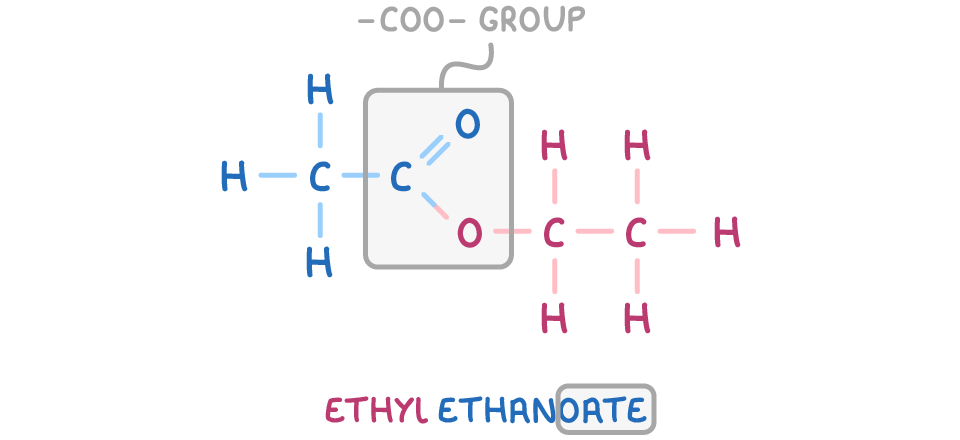
- Every ester contains the -COO- group: a carbon joined to two oxygen atoms, one by a double bond and the other by a single bond, with that singly bonded oxygen joined on to a carbon chain.
- The group sits in the middle of the molecule, with a carbon chain running off each side (in an ester of methanoic acid, such as methyl methanoate, HCOOCH3, a hydrogen atom takes the place of the chain on the acid side).
- You can identify an ester:
- From its structure - Find the -COO- group with a carbon chain joined to its singly bonded oxygen
- From its name - Every ester's name ends in -oate
Making an ester
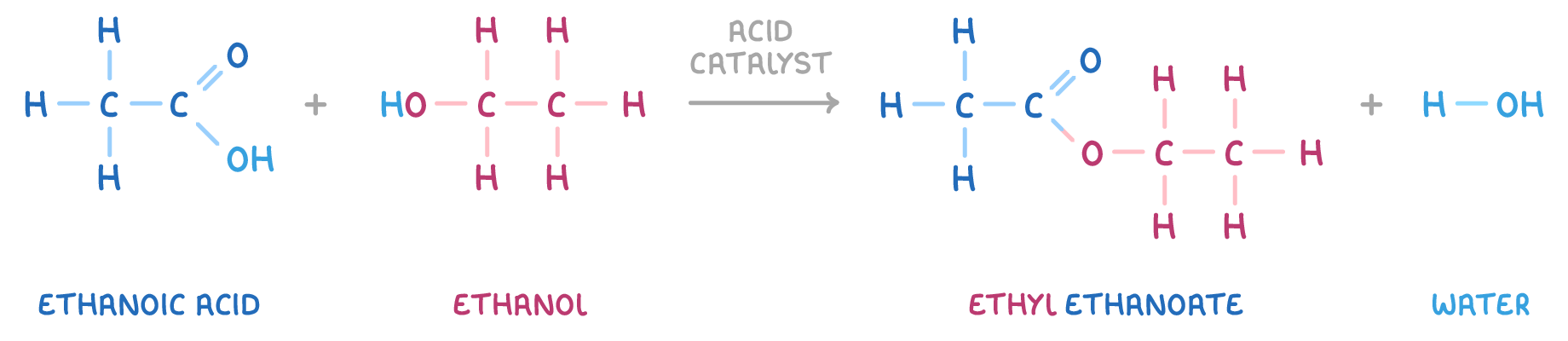
A carboxylic acid and an alcohol are warmed together with an acid catalyst.
carboxylic acid + alcohol → ester + water
When they react:
- The carboxylic acid loses the -OH from its -COOH group
- The alcohol loses the hydrogen from its -OH group
- The remaining parts join together to form the ester, and the lost atoms form water.
Ethyl ethanoate
The ester made from ethanoic acid and ethanol is ethyl ethanoate:
CH3COOH + CH3CH2OH → CH3COOCH2CH3 + H2O
Its structural formula is CH3COOCH2CH3.
Naming an ester from its two parents
An ester's name is in two parts, each coming from one of the two compounds it was made from.
- The first part comes from the alcohol - Take the alcohol's name, drop the -ol ending and put -yl in its place:
- Methanol → methyl, ethanol → ethyl, propan-1-ol → propyl, butan-1-ol → butyl
- The second part comes from the carboxylic acid - Take the acid's name, drop the -oic acid ending and put -oate in its place:
- Methanoic acid → methanoate, ethanoic acid → ethanoate, propanoic acid → propanoate, butanoic acid → butanoate
Watch the order. The name begins with the alcohol part, but chemical equations usually write the acid first.
Building an ester from its parents
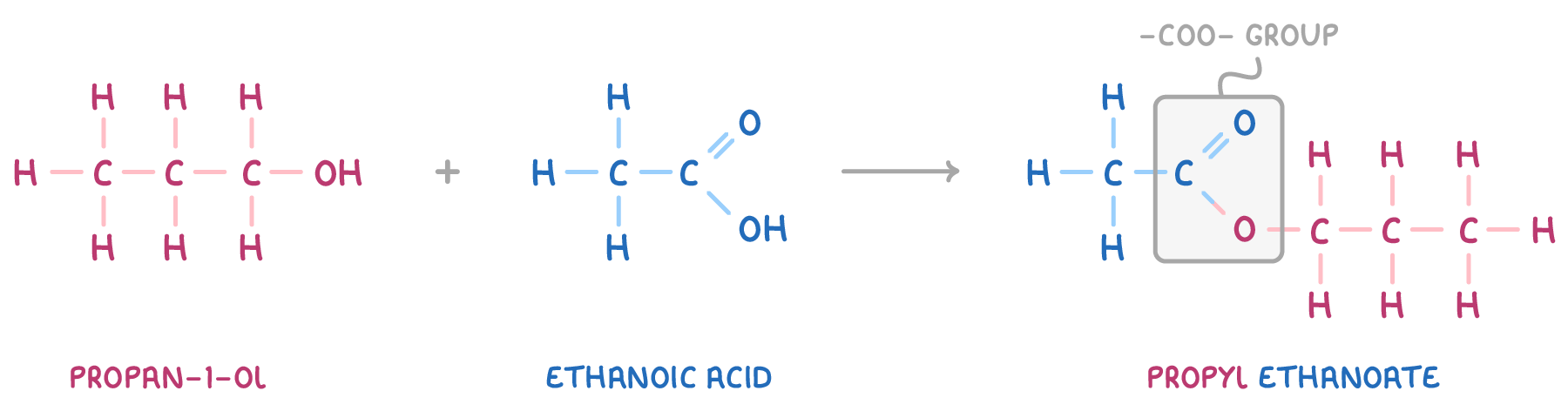
Take propan-1-ol and ethanoic acid:
- Name - Propan-1-ol gives propyl and ethanoic acid gives ethanoate, making propyl ethanoate.
- Structure - Ethanoic acid is CH3COOH and propan-1-ol is CH3CH2CH2OH, so propyl ethanoate is CH3COOCH2CH2CH3 - the piece from the acid on the left of the -COO- group, and the piece from the alcohol on its right.
Working backwards to the parents
- From a name - Methyl butanoate splits into methanol and butanoic acid.
- From a structure - Find the -COO- group and split the chain. The chain including the C=O carbon came from the acid; the chain attached to the single-bonded oxygen came from the alcohol.
- In CH3CH2COOCH3, the three-carbon piece is from propanoic acid and the one-carbon piece is from methanol, giving methyl propanoate.
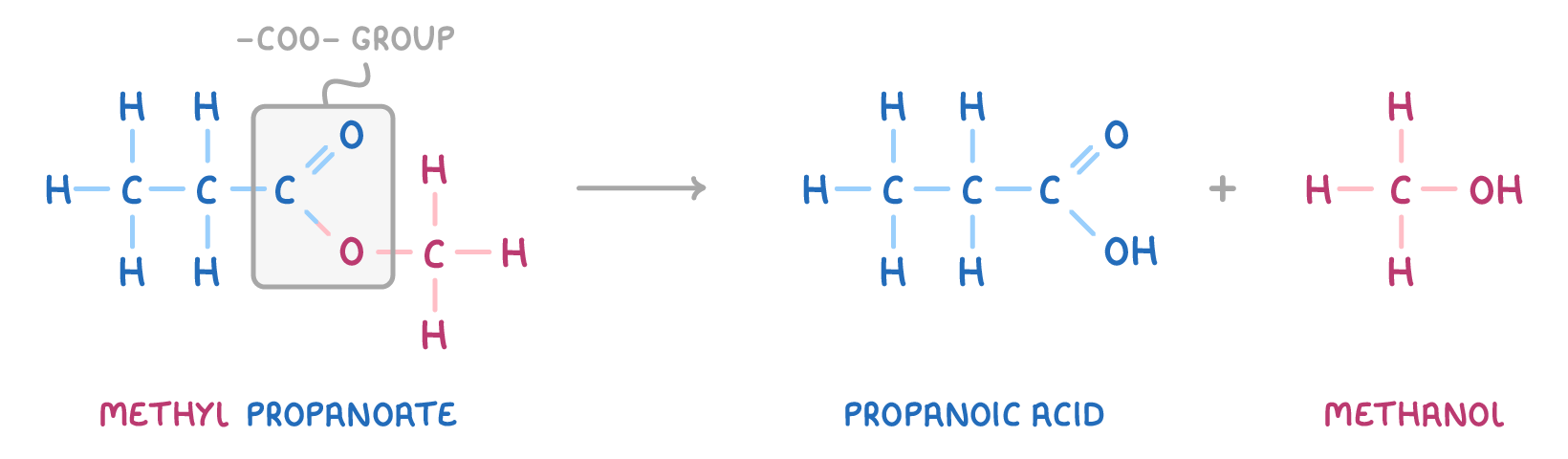
A molecular formula isn't enough. Ethyl ethanoate and methyl propanoate both have the formula C4H8O2. It's where the -COO- group sits along the chain that tells them apart.
Properties and uses of esters
- Esters are volatile (they evaporate easily) and have distinctive, sweet or fruity smells.
- For example, ethyl ethanoate has a characteristic pear-drop smell.
Uses
- Perfumes - Because they're volatile and smell pleasant, esters evaporate easily from the skin to release their scent.
- Food flavourings - Esters are added to foods and drinks to give them fruity flavours and aromas.
TermDefinition
EsterA compound formed when a carboxylic acid reacts with an alcohol.