Atom Economy & Percentage Yield - exam practice
Atom Economy & Percentage Yield
Question 1 of 4
This question is about the reduction of iron oxide with carbon.
The equation for the reaction between iron oxide and carbon is below.
Complete the balanced symbol equation for the reaction.
Explain why carbon can be used to reduce iron but cannot be used to reduce magnesium.
A student is investigating the thermal decomposition of calcium carbonate.
The equation for the reaction is
CaCO3(s) → CaO(s) + CO2(g)
(You may need a periodic table)
The student heats 12.00 grams of calcium carbonate for 15 minutes.
After 15 minutes the mass of solid remaining is 4.14 grams.
Calculate the mass of carbon dioxide given off.
Calculate the relative formula mass of calcium carbonate, CaCO3.
The student heated the calcium carbonate and measured the mass each minute for 10 minutes.
Plot a graph to show how the mass of solids varied over time.
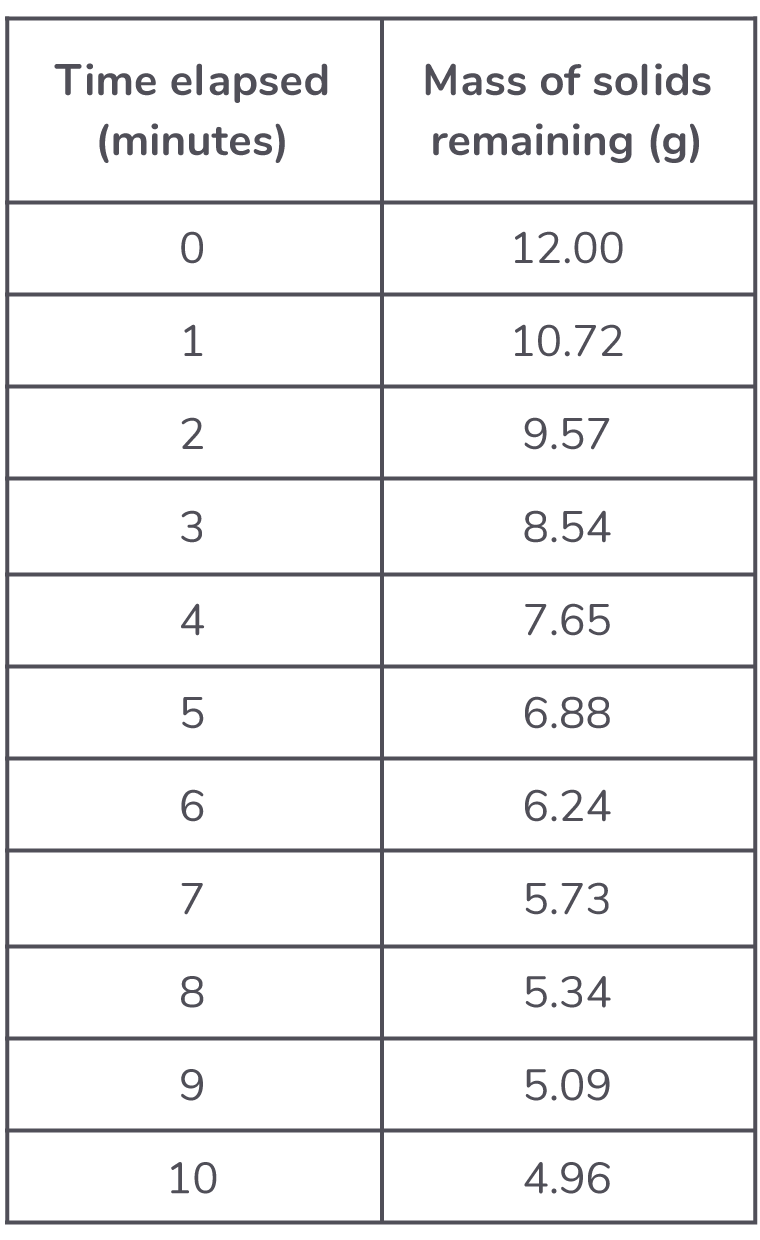
Describe how the mass of solids remaining varies over time.
A student is completing a titration of sulfuric acid and sodium hydroxide.
The equation for the reaction is below.
Complete the balanced symbol equation for the reaction between sulfuric acid and sodium hydroxide.
Calculate the relative formula mass of sodium sulfate, Na2SO4.
(You may need a periodic table)
A student heats zinc carbonate over a Bunsen burner.
The zinc carbonate thermally decomposes to form zinc oxide and carbon dioxide.
The student predicts the yield should be 0.73 g.
The student actually obtains 0.63 g of zinc oxide.
State the equation for percentage yield.
Calculate the percentage yield for the students experiment.
The student started with 1.2 g of zinc carbonate and obtained 0.63 g of zinc oxide.
Calculate the mass of carbon dioxide released.