Solutions & Solubility - exam practice
Solutions & Solubility
Question 1 of 5
Copper sulfate crystals are blue and highly soluble in water.
A student places copper sulfate crystals at the bottom of a beaker containing water.
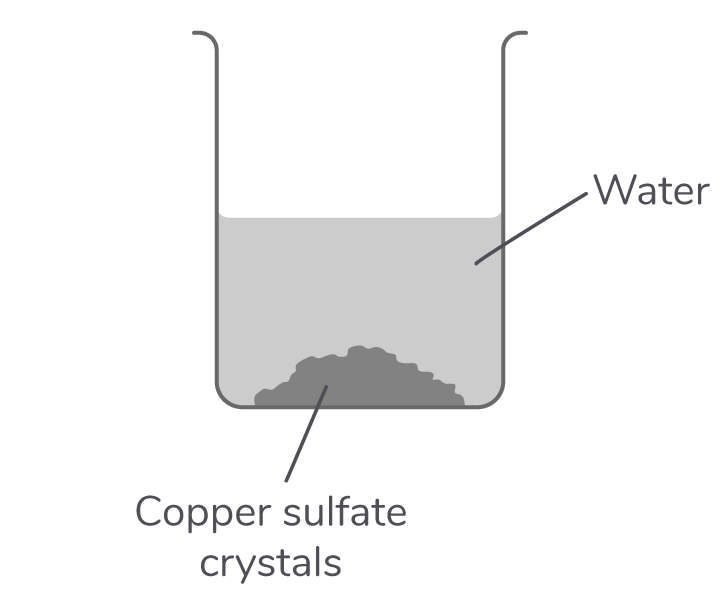
Predict the changes in the appearance of the crystals and the resulting solution as the crystals of copper sulfate dissolve.
What is the name of the process that occurs as the crystals dissolve to form a solution?
The student repeats the experiment using cold, lukewarm, and hot water.
The image below shows the beakers containing water and copper sulfate crystals at different temperatures.
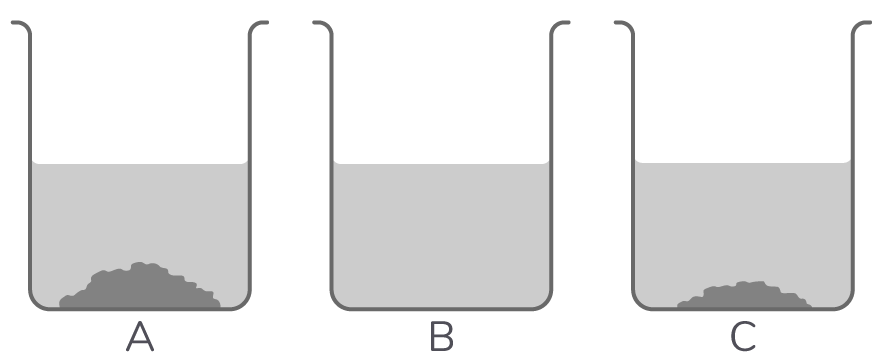
Which of the beakers, A, B, or C, contain cold water?
Justify your answer.
Which of the beakers, A, B, or C, contains hot water?
Justify your answer.
Explain, in terms of particles, why the observed differences occur when hot water is used instead of cold water.
The solubility of a solid in water is the maximum mass of the solid that can dissolve in 100 g of water at a given temperature.
Which of the following definitions describes a saturated solution?
The graph shows the solubilities of solids X, Y, and Z, at different temperatures.
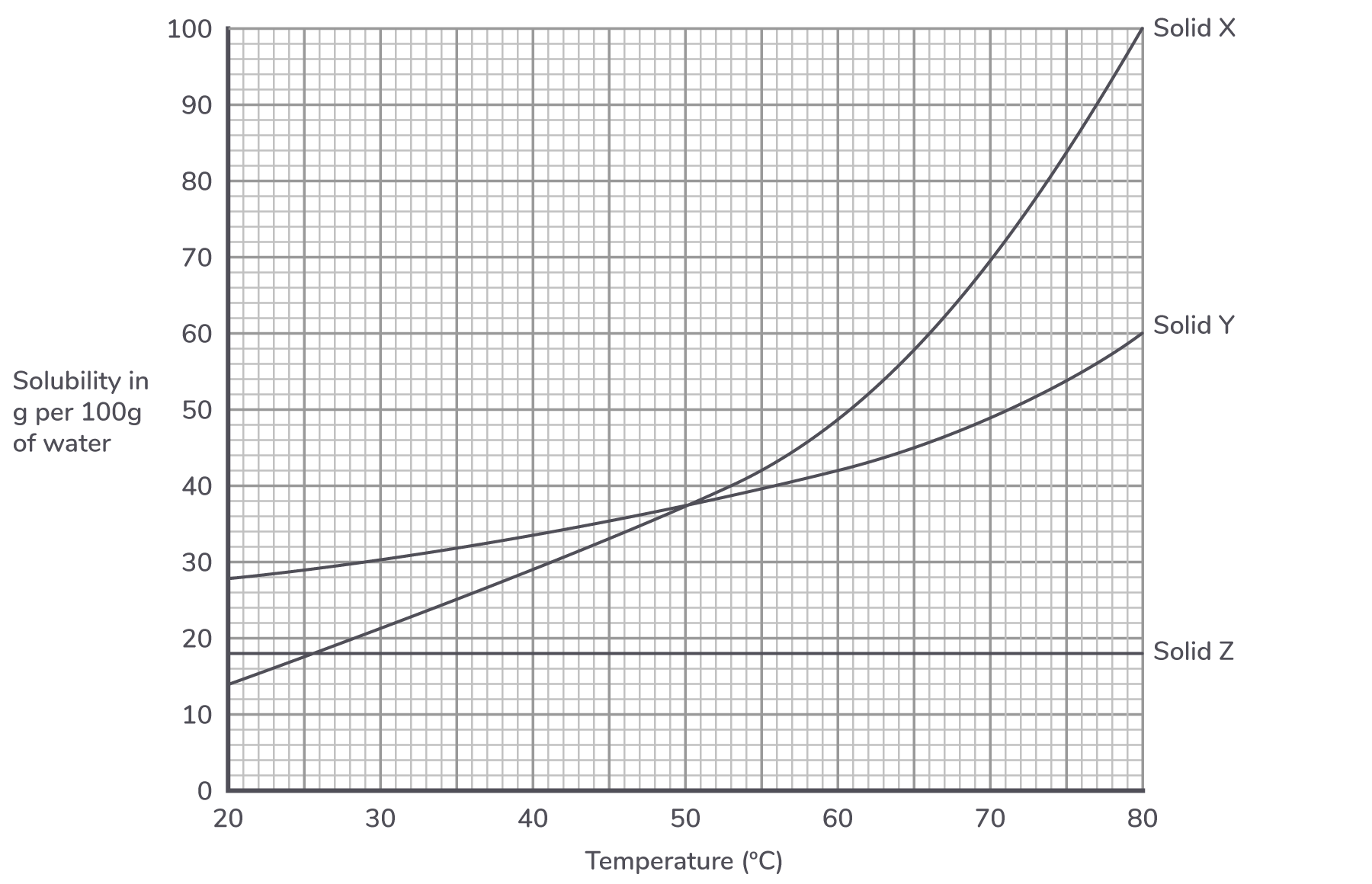
Using the data from the graph, identify which of the solids is most soluble at 20°C.
Using the data from the graph, identify which of the solids is most soluble at 60°C.
Describe the relationship between solubility and temperature for:
- solid X
- solid Z
Explain what you would observe if a saturated solution of solid X were cooled from 80°C to 20°C.
A chemist investigates the solubility of potassium chloride in water.
She measures the masses of potassium chloride that dissolve in 50 cm3 of water at different temperatures.
The chemist's results are shown in the table below.
There is an anomalous result at 40°C.

Plot the chemist's results on the grid below.
Draw a line of best fit.
Suggest two possible mistakes that could have caused the anomaly in the results.
Use your graph to estimate the solubility of potassium chloride at 40°C, in grams per 100 g of water.
A teacher investigates the solubility of silver nitrate in water.
He measures the masses of silver nitrate that dissolve in 25 cm3 of water at different temperatures.
The teacher's results are shown in the table below.

Plot the teacher's results on the grid below.
Draw a line of best fit.
Use your graph to estimate the solubility of silver nitrate in grams per 100 g of water at:
- 0°C
- 100°C
Describe the relationship between solubility and temperature for silver nitrate.
A scientist investigates the solubility of potassium nitrate in water at different temperatures.
The table below gives the masses of silver nitrate that dissolve in 100 cm3 of water at different temperatures.

Plot the scientist's results on the grid below, and draw a line of best fit.
Extend your curve to estimate the solubility of potassium nitrate at 0°C.
Use your graph to find the maximum mass of potassium nitrate that could dissolve in 50 g of water at 50°C.
What is the correct term for a solution in which the maximum possible amount of solute has been dissolved in the solvent?