9.13 - Comparing Materials & Choosing One
Comparing the classes of material
The four classes of material are glass and clay ceramics, polymers, composites, and metals.
Properties of metals
- Shiny and good conductors of heat and electricity.
- Malleable - Can be hammered or pressed into shape.
- Ductile - Can be drawn out into a wire.
- Stiff, with generally high densities and high melting points.
- Not brittle - Under a large force a metal bends or dents rather than shattering.
- Some metals corrode in air and water.
The properties materials are compared on
- Melting point - The temperature at which a solid melts into a liquid.
- Electrical conductivity - How well a material conducts electricity.
- Strength - How well a material resists an applied force.
- Stiffness - How well a material resists bending.
- Hardness - How well a material resists being scratched or dented.
- Brittleness - How easily a material breaks under force, snapping rather than bending.
- Density - The mass of a given volume.
The four classes compared
| Glass and clay ceramics | Polymers | Composites | Metals | |
|---|---|---|---|---|
| Melting point | very high | low, soften before melting | depends on materials combined | high |
| Electrical conductivity | insulator | insulator | insulator unless reinforcement conducts | good conductor |
| Strength | low pulled, high squashed | low to moderate | can be very high | high |
| Stiffness | high | low for most | depends on reinforcement | high |
| Hardness | high | low | moderate to high | moderate to high |
| Brittleness | high | low | low | low |
| Density | moderate to high | low | low to moderate | high |
- A choice of material is usually a set of compromises: a ceramic is hard and stiff but shatters, a polymer is light and cheap but weak, a metal is strong but heavy, and a composite has tailored properties but costs more.
- A property that's an advantage for one use can be a disadvantage for another: metal is ideal for a saucepan because it conducts heat well, but poor for the handle for the same reason.
Worked example - Choosing a material for a bike frame
A company is choosing a material for a bicycle frame. The frame has to be as light as possible, take a large pulling force without breaking, and not shatter if the bicycle is dropped. Using the data below, decide which material to choose and give a reason for rejecting each of the others.
| Material | Density (g/cm3) | Tensile strength (MPa) | Brittleness |
|---|---|---|---|
| A clay ceramic | 2.4 | 30 | high |
| A rigid polymer | 0.95 | 40 | low |
| A carbon fibre composite | 1.6 | 1,800 | low |
| Aluminium | 2.7 | 300 | low |
Step 1 - Turn each requirement into a property
- Light → low density
- Takes a large pulling force → high tensile strength
- Survives a drop → low brittleness
Step 2 - Rule out the clay ceramic
- Highly brittle, so the frame would shatter if dropped.
- At 30 MPa it also has the lowest tensile strength - it fails two requirements.
Step 3 - Rule out the rigid polymer
Lightest and not brittle, but at 40 MPa its tensile strength is far too low for a frame carrying a rider.
Step 4 - Separate the last two on the numbers
- Aluminium and the composite are both strong enough and neither is brittle.
- The composite has the higher tensile strength (1,800 MPa vs 300 MPa) and the lower density (1.6 g/cm3 vs 2.7 g/cm3).
Step 5 - Answer
- Choose the carbon fibre composite - it meets all three requirements and beats aluminium on strength and weight.
- The clay ceramic is rejected because it's brittle and weak in tension, the rigid polymer because it's far too weak, and aluminium because the composite is both stronger and lighter.
Why a metal suits its job
- A metal is picked for a job because of its properties.
- While all metals conduct heat and electricity and have relatively high strength, they differ in density, conductivity, hardness, and reactivity.
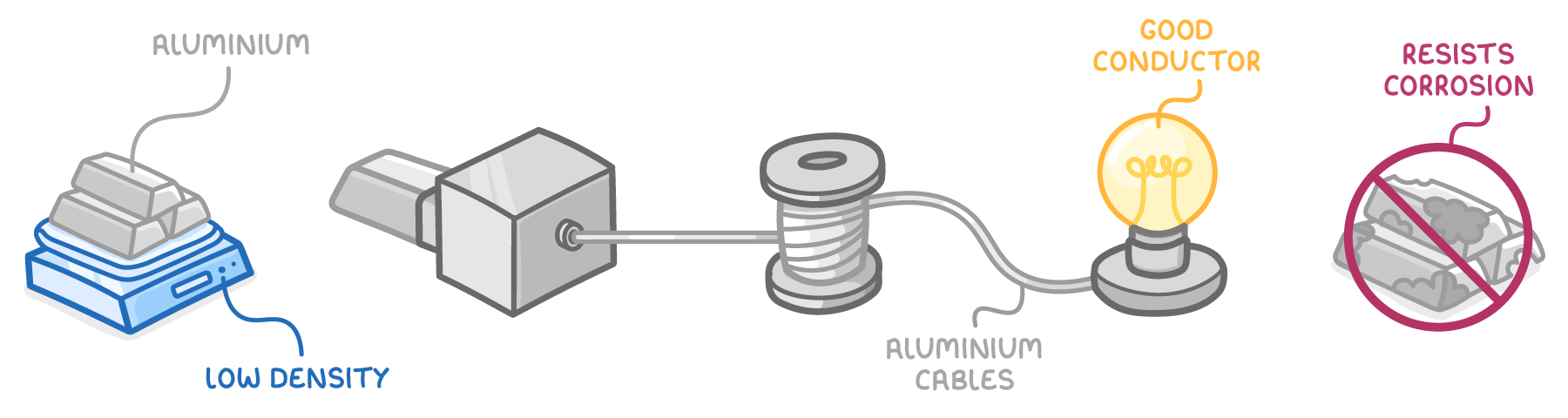
Aluminium - Low density
Aluminium has a low density (light for its size):
- Aircraft - Low density keeps the aircraft's mass down.
- Overhead electrical cables - Low density combined with good electrical conductivity allows cables to hang between pylons without breaking under their own weight.
- Food containers - Resists corrosion, so it doesn't react with food.
Copper - Conductor and ductile
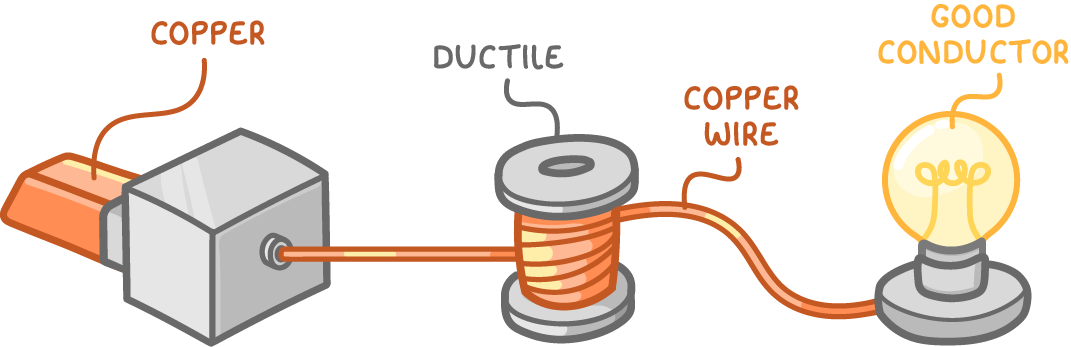
Copper is a very good conductor of heat and electricity, and it's ductile (can be drawn into a wire without snapping):
- Electrical wiring - Good conductivity carries the current efficiently, and ductility allows it to be drawn into thin wires.
- Water pipes and tanks - Malleable enough to bend, hard enough to hold its shape, unreactive with water, and has high thermal conductivity.
Gold - Unreactive
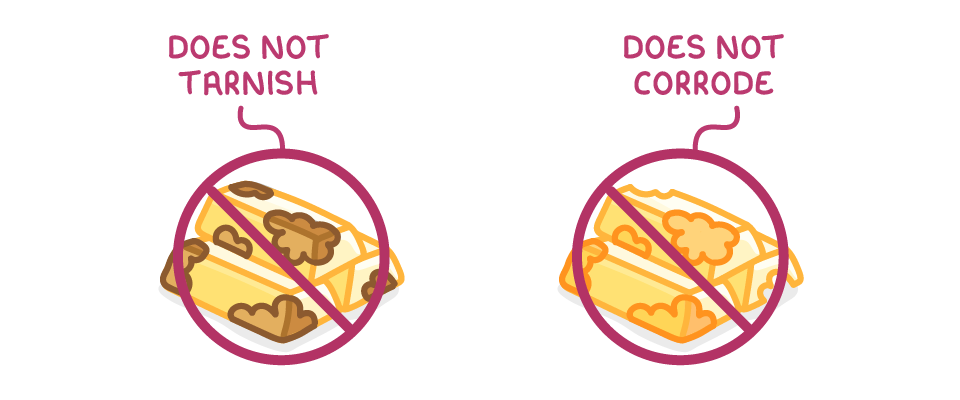
Gold is extremely unreactive, so it does not tarnish or corrode:
- Jewellery - Retains its shiny appearance over time.
- Electrical contacts - Won't tarnish, maintaining a good electrical connection.
Choosing an alloy instead of a pure metal
When a pure metal lacks the required combination of properties, an alloy is used:
- Magnalium - Aluminium with about 5% magnesium. It has a slightly lower density than aluminium, is much stronger, and resists corrosion better. Used in cars and aircraft.
- Brass - An alloy of copper and zinc, harder than pure copper. Used for coins, musical instruments, and the pins of electrical plugs, where copper would be too soft.
Why a polymer suits its job
Plastics are materials made up of polymer molecules, with shared properties that make them widely useful.
Properties polymers share
- Usually cheaper than metals and ceramics.
- Generally strong.
- Low density compared to most metals and ceramics.
- Many are flexible and almost all can be moulded into shape.
- Thermal and electrical insulators.
- Resist corrosion and don't rot.
Individual polymers and their uses
- Poly(ethene) (polythene) - low density, flexible, easy to mould, unreactive, waterproof, and an electrical insulator. Used for carrier bags, bottles, and electrical wire insulation.
- Poly(propene) - Low density, rigid, tough, and easy to mould. Used for packing crates, moulded furniture, and ropes.
- Poly(chloroethene) (PVC) - rigid, hard, strong, unreactive, and fire resistant. Used for drainpipes, water pipes, and window frames.
- Poly(tetrafluoroethene) (PTFE) - tough, strong, high melting point for a polymer, unreactive, and extremely non-stick. Used for non-stick pan coatings, and for waterproof and stain-resistant clothing because water and stains do not stick to it.