2.5 - Chromatography & Rf Values
Paper chromatography
- Chromatography separates the substances in a mixture to count, compare, or identify them.
- Paper chromatography works on any substance that dissolves in the solvent used, such as food colourings and ink dyes.
- It uses two phases:
- Mobile phase - The phase the substances move in (a solvent, such as water or ethanol).
- Stationary phase - The phase that does not move (the paper).
Method
-
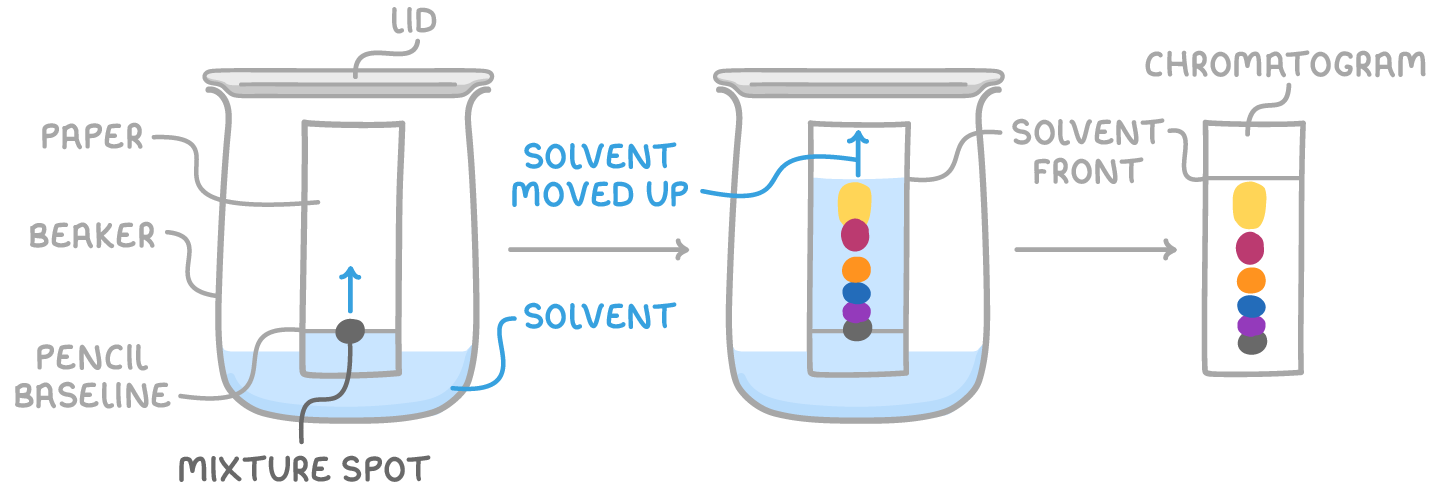
Draw a pencil line near the bottom of the paper and add a spot of the mixture. This line is the baseline. It must be drawn in pencil because pencil doesn't dissolve in the solvent, whereas ink would travel up the paper.
-
Stand the paper in a shallow layer of solvent with the solvent level below the baseline. If the solvent touches the spot directly, the mixture dissolves into the solvent instead of travelling up the sheet.
-
Cover the container with a lid to stop the solvent evaporating. The solvent moves up the paper, carrying the substances in the mixture with it.
-
Take the paper out before the solvent reaches the top, mark the solvent front, and leave it to dry. The solvent front is the furthest point the solvent reaches. It must be marked immediately in pencil because it cannot be seen once the paper dries. The dried sheet is a chromatogram.
Reading a chromatogram
A chromatogram is the finished, dried sheet with its pattern of separated spots.
Why substances separate
- As the solvent moves up the paper, each substance is distributed between the two phases: dissolving in the solvent (mobile phase) and sticking to the paper (stationary phase).
- Two properties determine how far a substance travels:
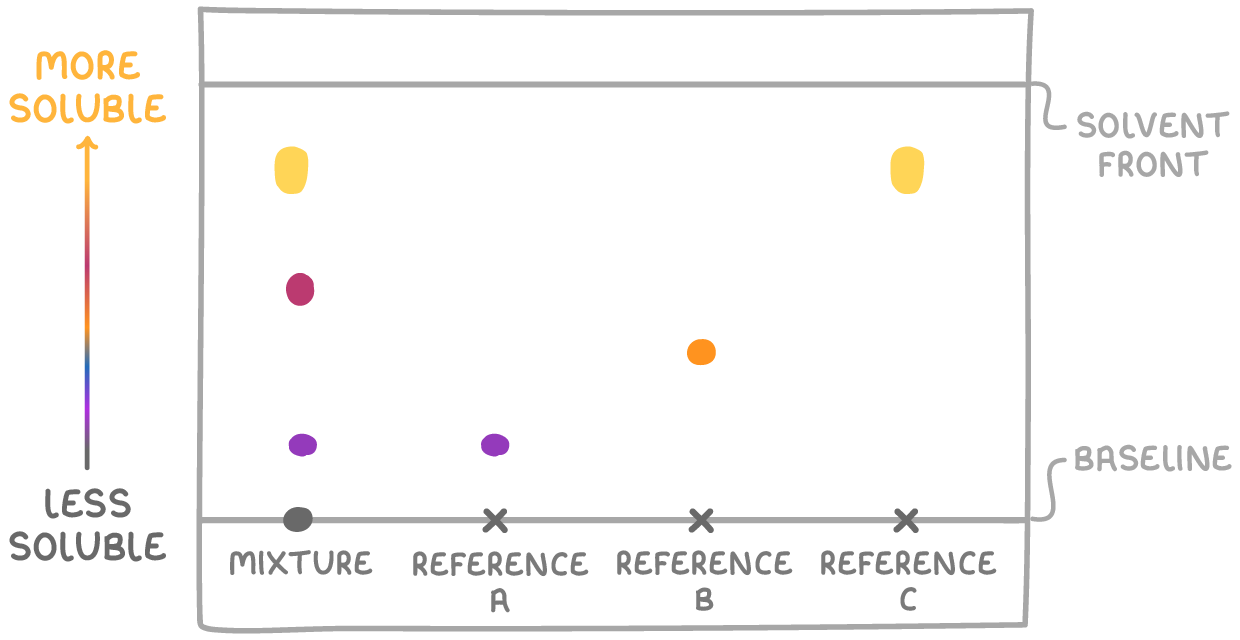
- How soluble it is in the solvent (more soluble substances spend more time in the mobile phase and travel further).
- How strongly it is attracted to the paper (substances more strongly attracted spend more time in the stationary phase and travel a shorter distance).
- Different substances differ in both properties, so they travel different distances and separate into distinct spots.
Interpreting the chromatogram
- Number of substances - Each spot represents at least one substance. A spot that stays on the baseline didn't dissolve in that solvent.
- Purity - A pure substance produces a single spot; a mixture produces more than one spot.
- Identifying substances - A pure reference sample of a known substance is run alongside the mixture. A spot in the mixture level with the reference may be that substance. If no spot aligns with the reference, that substance is not present.
Testing with a second solvent
- Two different substances can travel the same distance in one solvent and appear as a single spot.
- Repeating the run with a different solvent settles this, because the substances will distribute differently in a new solvent.
Rf values
- How far a spot travels depends on how long the chromatogram is run for.
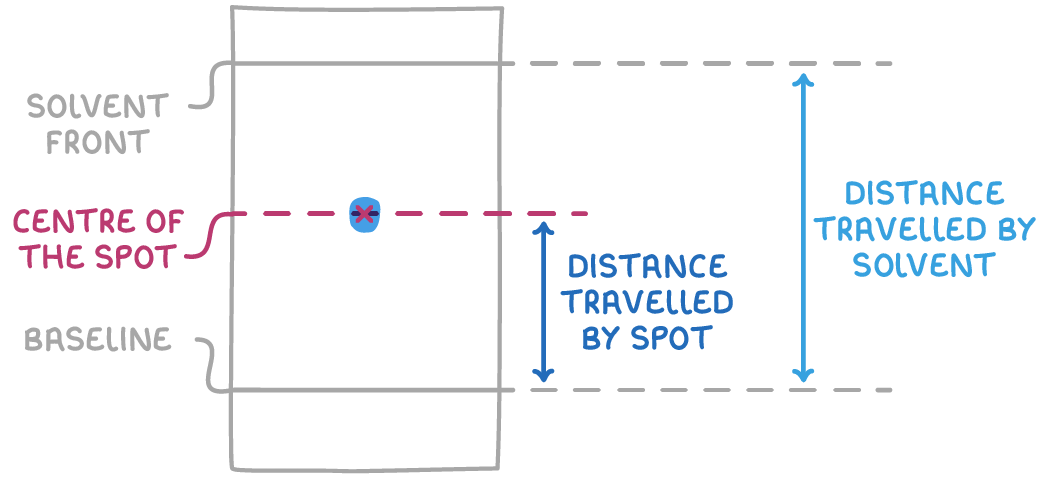
- The value is the ratio of the distance travelled by the substance to the distance travelled by the solvent. It is constant for a given substance under the same conditions.
Formula for Rf value
- Distance travelled by the substance - Measured from the baseline to the centre of the spot.
- Distance travelled by the solvent - Measured from the baseline to the solvent front.
Interpreting the value
- An value is always between 0 and 1.
- An value of 0 means the substance didn't dissolve in the solvent and stayed on the baseline.
- An value has no units because the units of distance cancel out.
Using Rf values for identification
- The same substance has different values in different solvents or with different stationary phases.
- An value can only identify a substance when compared against a known reference run under the exact same conditions, or a published standard value for that solvent and paper.
Worked example - An Rf value
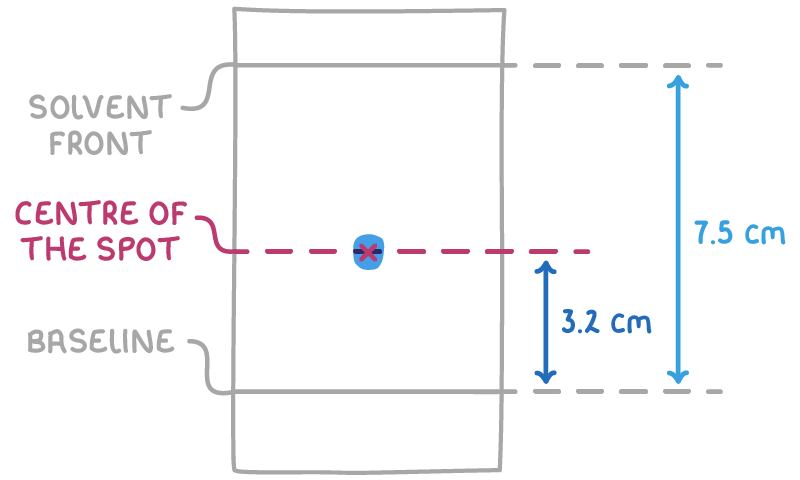
On a chromatogram, one spot has moved 3.2 cm from the baseline (measured to the centre of the spot), and the solvent front is 7.5 cm from the baseline. Calculate the Rf value of that substance.
Step 1 - Identify the values
- Distance travelled by the substance = 3.2 cm (baseline to the centre of the spot)
- Distance travelled by the solvent = 7.5 cm (baseline to the solvent front)
Step 2 - Formula
Step 3 - Substitution and calculation
Both distances are in cm, so the units cancel and a plain number is left.
Step 4 - Round the answer
Each distance was measured to two significant figures, so give the answer to two:
The value sits between 0 and 1, as it must, and 3.2 cm is a little under half of 7.5 cm - so a value a little under 0.5 is the right size.