9.5 - Addition Polymers
What a polymer is
- A polymer is a very large molecule made of many small units (monomers) joined by covalent bonds into a long chain.
- A single polymer molecule can run to thousands of carbon atoms - far larger than the molecules of most substances, which are small molecules of a few atoms each.
- Each carbon atom uses two of its four bonds to join the carbon atoms on either side of it in the chain, leaving two bonds for the atoms attached to its side.
Poly(ethene) and the repeat unit
Poly(ethene) is a chain of carbon atoms joined by single covalent bonds, with two hydrogen atoms on every carbon atom.
The chain is the same short section repeated over and over. This section is the repeat unit - in poly(ethene) it's two carbon atoms with their four hydrogen atoms.
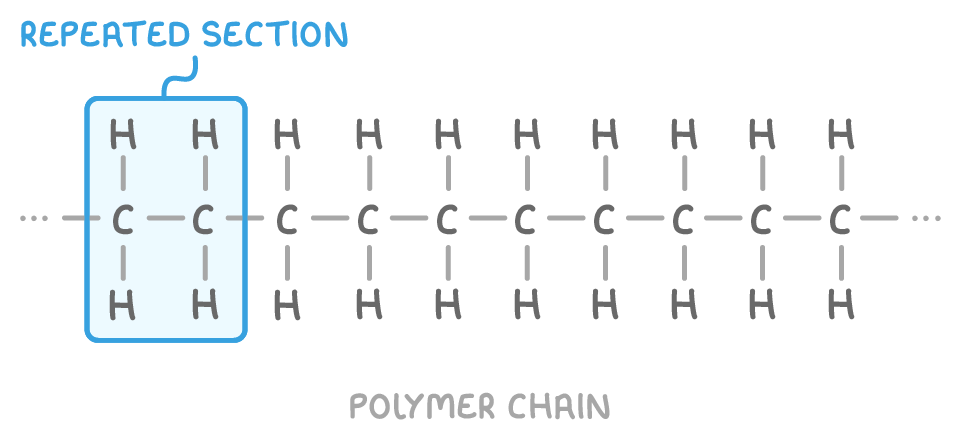
A chain is too long to draw, so a polymer is drawn as its repeat unit:
- The repeat unit is drawn out with a bracket on each side.
- A bond runs out through each bracket (left and right) to show the chain carries on in both directions.
- A letter n goes outside the bottom right of the bracket, standing for the (very large) number of repeat units.

Bonding and why polymers are solids
- Within a polymer molecule the atoms are held by strong covalent bonds.
- Between one molecule and the next there are only intermolecular forces, which are weak for small molecules.
- But a polymer molecule is so long that there are a great many of these forces along its length, and together they add up to a relatively strong attraction between chains.
- That's why polymers are solids at room temperature, where most small-molecule covalent substances are gases or liquids.
Spotting a polymer in a diagram
- Polymer - A very long chain of atoms (usually carbon) with small groups along it, or that chain drawn once as a repeat unit in brackets with n.
- Small molecule - A handful of atoms on their own.
- Giant covalent structure - Bonds carry on in every direction.
Addition polymerisation
- The monomers that make addition polymers are alkenes - molecules with a carbon-carbon double bond.
- That double bond makes an alkene unsaturated, and it's what lets the molecule join up with others.
How the double bond opens
- Under the right conditions the double bond opens: one of the two bonds between the carbon atoms gives way, leaving a single bond, and each carbon atom now has a bond free.
- The free bond on one monomer joins to a carbon atom of the next monomer along, and so on, so many monomers join end to end into one long chain.
- This reaction is called addition polymerisation.
- Nothing is lost and nothing else is made - The polymer is the only product. So the repeat unit has exactly the same kinds of atom, in the same numbers, as the monomer.
- What changes is the bonding: the double bond becomes a single bond, and two new bonds run out of the repeat unit to its neighbours.
Ethene and poly(ethene)
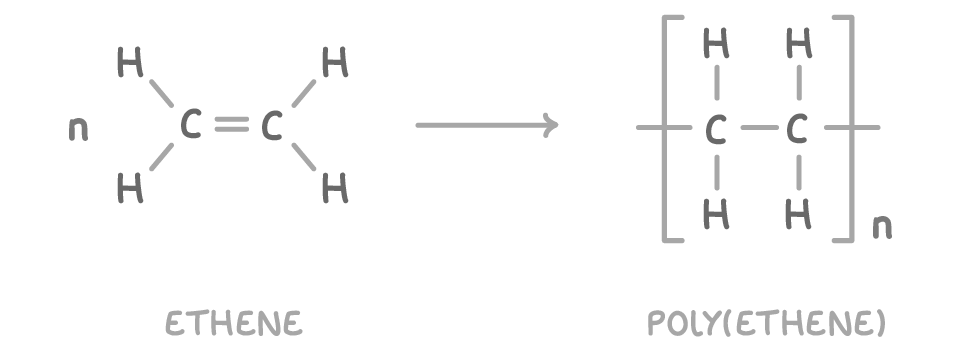
Ethene, C2H4 - The simplest alkene: two carbon atoms joined by a double bond, two hydrogen atoms on each. It polymerises to poly(ethene), whose repeat unit is two carbon atoms joined by a single bond, still with two hydrogen atoms each.
Naming addition polymers
- A polymer takes its name from its monomer: put the monomer's name in brackets with poly in front - ethene gives poly(ethene).
- The formula follows the same pattern: put the monomer's formula in brackets with n after it - C2H4 gives (C2H4)n.
- Read backwards, the name tells you the monomer: poly(ethene) was made from ethene.
High average relative molecular mass
- A polymer molecule is built from so many repeat units that a polymer has a very high relative molecular mass - running into the thousands or millions.
- It's a high average relative molecular mass, because the chains in a sample aren't all the same length: n is large for every chain but not the same number for each.
Monomers polymerised on a large scale
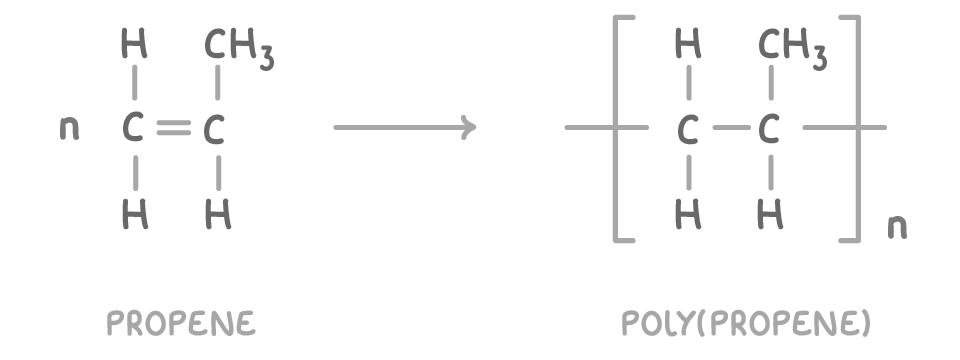
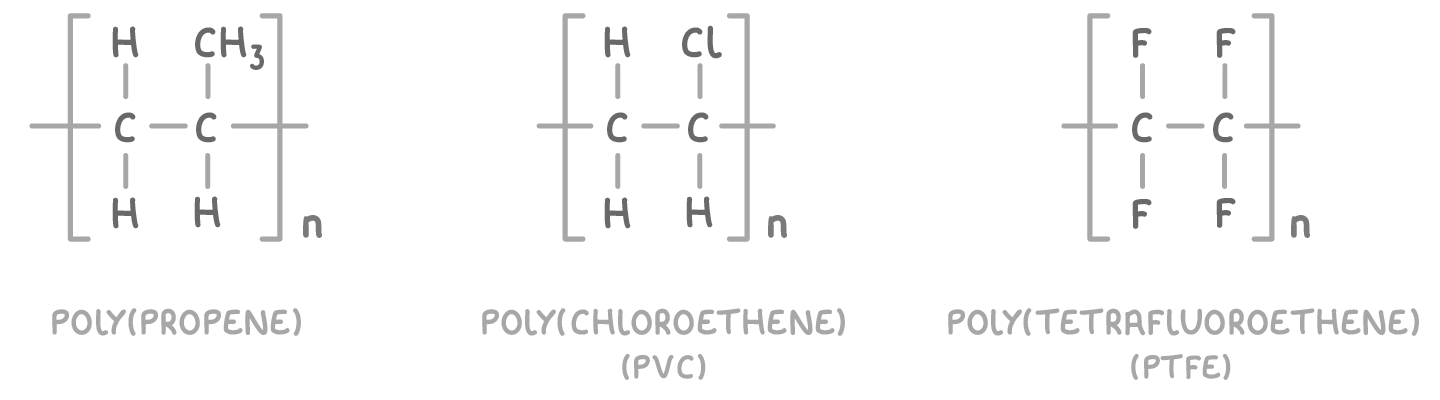
- Propene, C3H6 - Three carbon atoms with a double bond between the first two and a single bond to the third. Gives poly(propene).
- Chloroethene, C2H3Cl - Ethene with one hydrogen atom replaced by chlorine, so one carbon atom carries two hydrogen atoms and the other carries one hydrogen atom and one chlorine atom. Gives poly(chloroethene), usually called PVC.
- Tetrafluoroethene, C2F4 - Ethene with all four hydrogen atoms replaced by fluorine, so each carbon atom carries two fluorine atoms. Gives poly(tetrafluoroethene), usually called PTFE.
Drawing a repeat unit, and back
- A polymer chain is too long to draw, so a polymer is drawn as one repeat unit - the short section of chain that repeats all the way along.
- The repeat unit is drawn out in full, every atom shown and every bond a line, and it's worked out from the alkene monomer the polymer came from.
From the monomer to the repeat unit
-
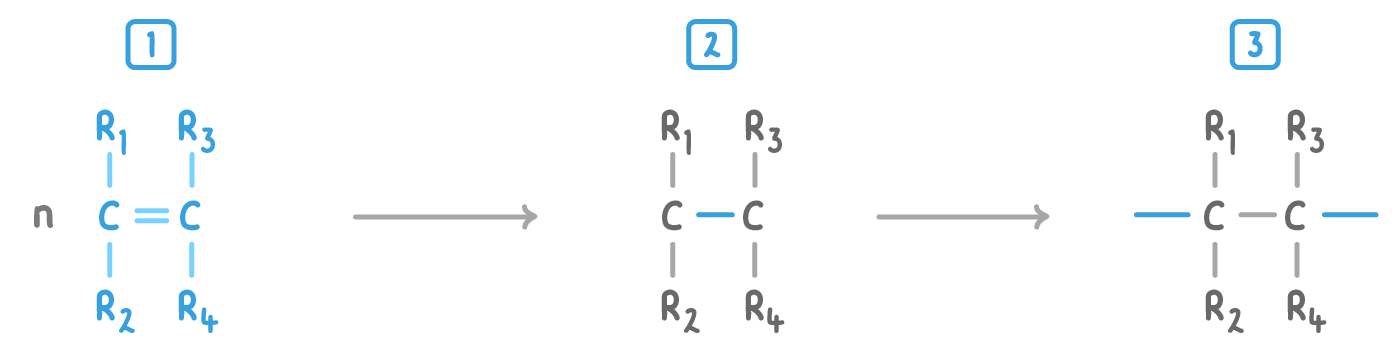
Draw the monomer with its double bond. Put the two doubly bonded carbon atoms side by side, joined by two lines, and draw every group on a line running straight up or down from its carbon atom.
- In ethene, every R is a hydrogen atom, so each carbon atom carries one hydrogen atom above and one below. In propene, one R is a CH3 group and the other three are hydrogen atoms.
-
Change the double bond to a single bond. Redraw the two carbon atoms joined by one line, leaving every group where it was.
-
Draw a bond running out to the left from the left carbon atom, and one out to the right from the right carbon atom. These join this section to the sections either side, and every carbon atom is back to four bonds.
-
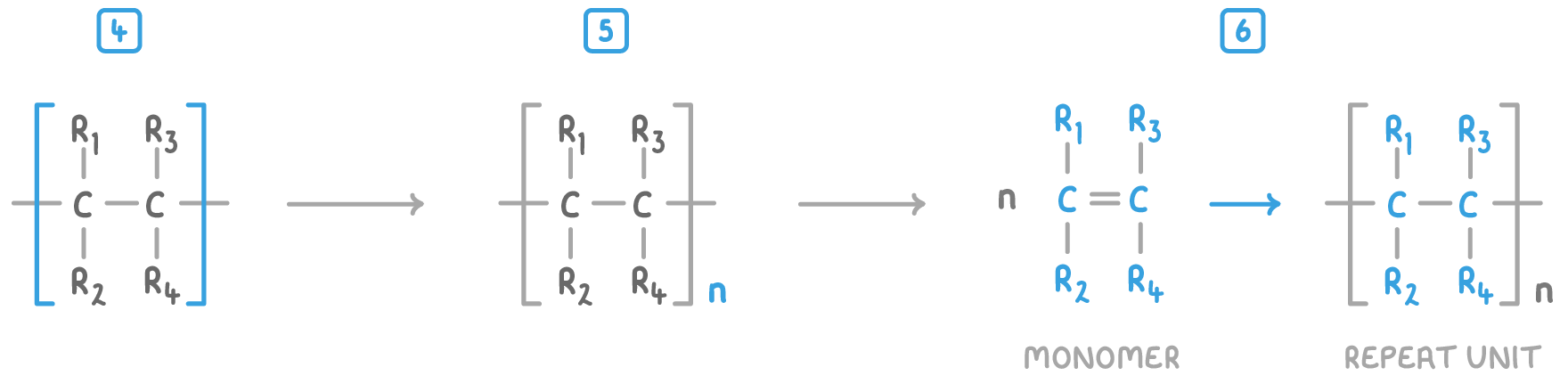
Put a bracket on each side, with the two outward bonds passing through them, to mark off the piece that repeats.
-
Write n just outside the bottom right of the bracket, and n in front of the monomer on the other side of the equation. On the left it says how many monomers react; on the right, how many repeat units long the chain is.
-
Check the repeat unit holds the same atoms as the monomer. No other molecule is made, so every atom of the monomer must be there, in the same numbers.
Common mistakes to avoid
- The repeat unit must not have a double bond - That double bond opened to let the monomers join, so a repeat unit drawn with one has kept a bond that was used up.
- The n is easy to leave off, on either side of the equation.
- Where a group is a run of carbon and hydrogen atoms, gather it up and write it as one group on the end of the line (such as CH3). The line must run to the carbon atom of the group, not to one of its hydrogen atoms.
From the repeat unit back to the monomer
Given a repeat unit, or a length of chain with the repeating section marked:
- Draw out one repeat unit - The two carbon atoms with everything attached and the two bonds through the brackets.
- Rub out the two bonds that run out through the brackets, and the brackets and n with them.
- Change the single bond between the two carbon atoms back to a double bond. That gives each carbon atom back four bonds.
- Leave every other group where it is. What's left is the monomer.
A length of chain is drawn by writing the repeat unit out two or three times side by side, without brackets or n, joining each unit's right carbon atom to the next unit's left carbon atom.
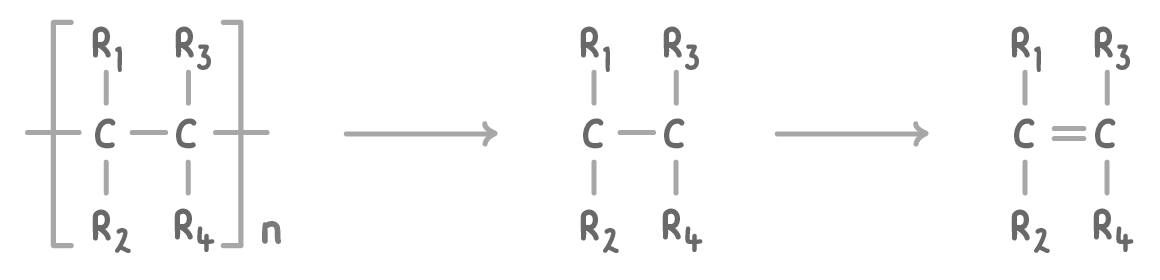
Working back from a repeat unit to its monomer by restoring the double bond.
Worked example - Repeat unit of poly(propene)
Propene, C3H6, is polymerised to poly(propene). Draw the repeat unit of poly(propene).

Step 1 - Draw the monomer with its double bond
Propene is three carbon atoms in a row, with a double bond between the first and second and a single bond from the second to the third. Put the two doubly bonded carbon atoms side by side, with each group on a line running straight up or down.
- First carbon atom: two hydrogen atoms (one up, one down).
- Second carbon atom: one hydrogen atom (down) and the third carbon atom - which brings three hydrogen atoms, so it's gathered up as one CH3 group (up).
- Draw the line from the second carbon atom to the carbon atom of the CH3 group.
Step 2 - Change the double bond to a single bond
The two carbon atoms are now joined by one line. The two hydrogen atoms stay on the first carbon atom; the hydrogen atom and the CH3 group stay on the second, in the same positions.
Step 3 - Draw the outward bonds
Draw a bond out to the left from the left carbon atom and one out to the right from the right carbon atom.
- Left carbon atom: two hydrogen atoms, one to its neighbour, one out to the left - four bonds.
- Right carbon atom: one hydrogen atom, one to the CH3 group, one to its neighbour, one out to the right - four bonds.
Step 4 - Add the brackets
Put a bracket on each side, with the two outward bonds passing through them.
Step 5 - Add the n
Write n just outside the bottom right of the bracket, and n in front of the monomer on the other side of the equation.
Step 6 - Check the atoms match
Propene is C3H6: three carbon atoms and six hydrogen atoms.
- Carbon: two in the chain + one in the CH3 group = 3.
- Hydrogen: two on the first carbon + one on the second + three in the CH3 group = 6.
The two match, so no atom has been gained or lost.