9.9 - Alcohols
The alcohols
- An alcohol is a compound that carries an -OH group joined to a carbon atom.
- That -OH is the alcohols' functional group - the part that decides how the compound reacts, which is why all alcohols behave in much the same way.
Naming the alcohols
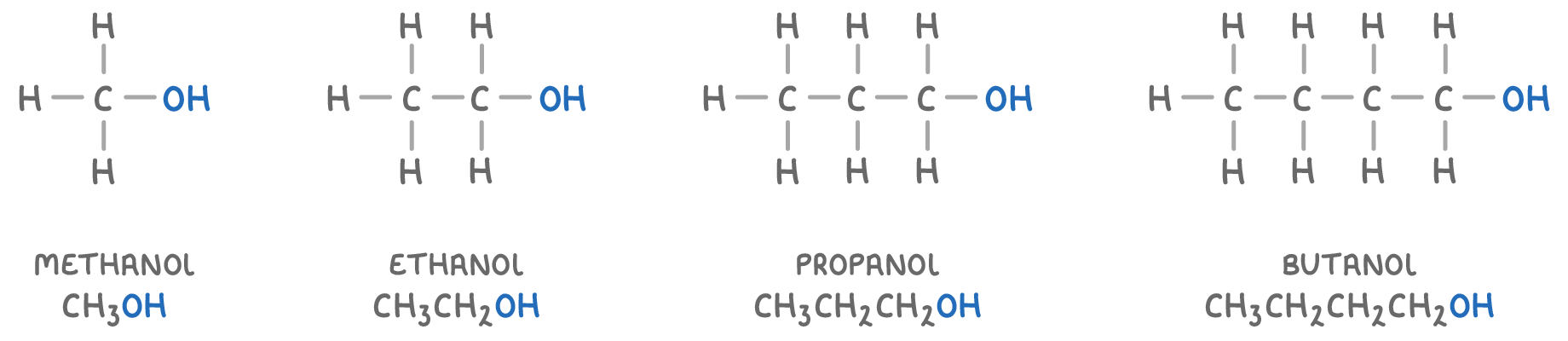
- The stem of the name shows how many carbon atoms are in the chain, and the ending -ol shows it's an alcohol (e.g. ethane becomes ethanol).
- The first four are methanol, ethanol, propanol and butanol, with one, two, three and four carbon atoms.
Formulae keep the -OH visible on purpose, which is why ethanol is written C2H5OH or CH3CH2OH, never C2H6O.
How alcohols react
Complete combustion
Alcohols are flammable. With plenty of air an alcohol burns completely: the carbon is oxidised to carbon dioxide and the hydrogen to water.
ethanol + oxygen → carbon dioxide + water
C2H5OH + 3O2 → 2CO2 + 3H2O
When balancing the equation, remember that the alcohol already contains an oxygen atom that must be counted on the left.
Alcohols as fuels
- Burning a measured mass of alcohol under a set volume of water shows how much energy it releases.
- The longer the carbon chain, the more energy released per gram.
Incomplete combustion
With too little air, incomplete combustion produces carbon (soot) or carbon monoxide, and releases less energy.
Dehydration
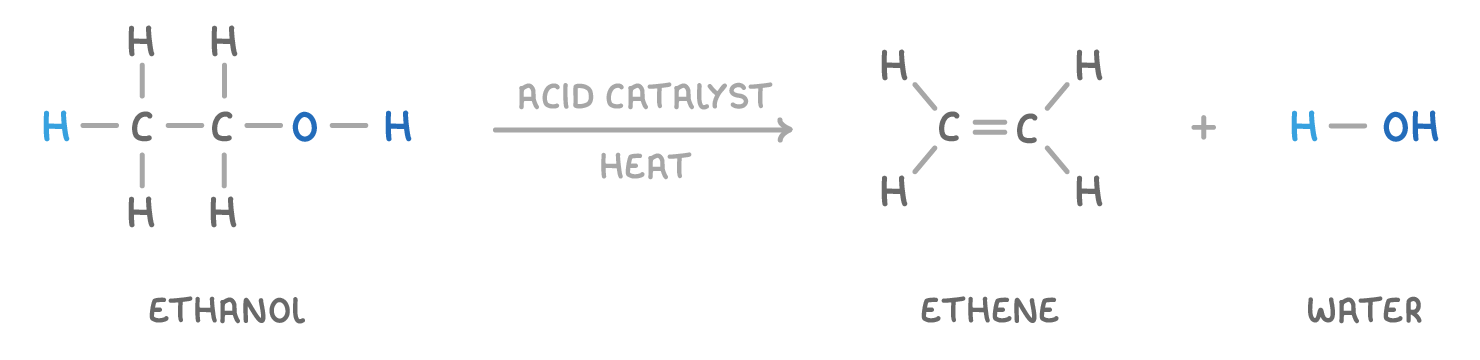
Heating an alcohol with an acid catalyst removes a molecule of water to produce an alkene:
ethanol → ethene + water
C2H5OH → C2H4 + H2O
The -OH group and a hydrogen atom from a neighbouring carbon are removed, forming a carbon-carbon double bond.
Oxidising an alcohol
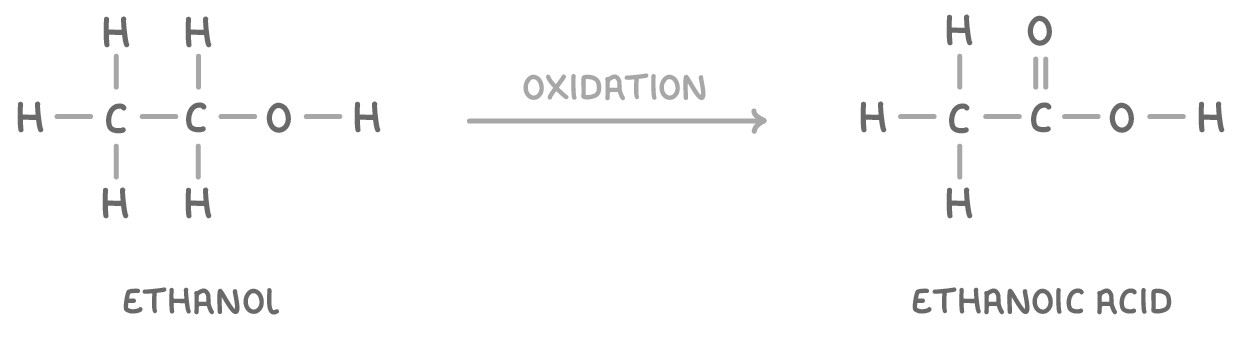
- An alcohol can be oxidised to form a carboxylic acid - an organic acid whose name ends in -oic acid.
- The acid has the same number of carbon atoms as the alcohol it came from:
- ethanol → ethanoic acid
Ethanoic acid is the acid in vinegar.
Two ways it happens
- With an oxidising agent - Warming an alcohol with a chemical oxidising agent converts it to the carboxylic acid quickly.
- With the oxygen of the air (microbial oxidation) - Microorganisms use ethanol as an energy source, oxidising it slowly to ethanoic acid. This is why a bottle of wine left open goes sour.
Making ethanol
Fermentation is how ethanol is produced from plant sugars.
What is mixed, and what comes out
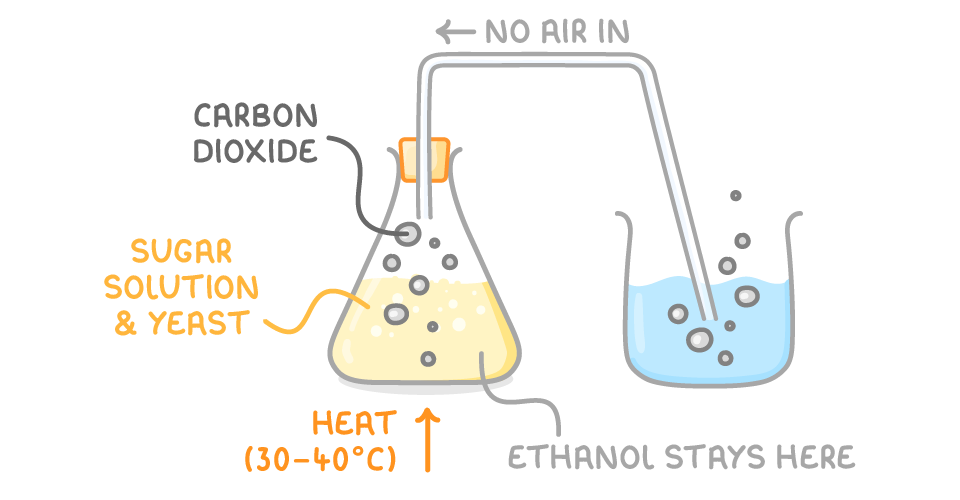
A solution of glucose is mixed with yeast in a warm, sealed container:
glucose → ethanol + carbon dioxide
C6H12O6 → 2C2H5OH + 2CO2
One molecule of glucose gives two molecules of ethanol and two of carbon dioxide.
The conditions, and why each is needed
- Warm, about 30 to 40 °C - Optimum temperature for the yeast enzymes. Higher temperatures denature the enzymes; lower temperatures slow the reaction.
- Slightly acidic - Optimum pH for the enzymes.
- No air (anaerobic) - If air gets in, the ethanol is oxidised to ethanoic acid (vinegar).
Concentrating the product
- Fermentation stops at around 12 to 15% ethanol, because the alcohol kills the yeast.
- To produce higher concentrations, the mixture is concentrated by fractional distillation.