10.8 - Energy Released by Burning a Fuel
The experiment
Aim
To compare how much energy different fuels release when they burn, by using each one to heat the same mass of water.
Background
- Burning a fuel in oxygen is combustion. It's an exothermic reaction, so it gives out energy.
- The fuels compared are usually alcohols with different chain lengths, from methanol up to butanol.
- You can't measure the energy a fuel releases directly, but you can measure the temperature rise it causes in a known mass of water.
- So in this practical you heat the same mass of water with each fuel, and use the mass of fuel burned to compare the energy each one releases per gram.
Variables
- Independent variable - Which alcohol is burned.
- Dependent variable - The mass of fuel burned to raise the temperature of the water by a set amount.
- Control variables - The volume and starting temperature of the water, the temperature rise, the container, and its height above the burner.
Method
- Set up the water - Measure a fixed volume of water into a conical flask or copper can with a measuring cylinder, and clamp it at a fixed height above the bench.
- Weigh the burner - Weigh the spirit burner containing the first fuel, with its lid on.
- Take the starting temperature - Record the temperature of the water.
- Light the burner - Stand it under the flask between draught screens, take the lid off, and light the wick with a splint.
- Heat the water - Stir gently with the thermometer until the temperature has risen by a set amount, such as 40 °C.
- Put the flame out - Put the lid back on the burner, and record the highest temperature the water reaches.
- Weigh the burner again - With its lid on. The drop in mass is the mass of fuel burned.
- Repeat for each fuel - Keep everything else the same, and use a separate burner for each fuel rather than refilling one.
Safety
- Eye protection - Wear it throughout.
- Flammable fuels - Work in a well-ventilated room away from other flames, never refill a burner while a flame nearby is lit, and keep a damp cloth nearby in case a spill catches fire.
- Hot apparatus - Let the flask and burner cool before handling them.
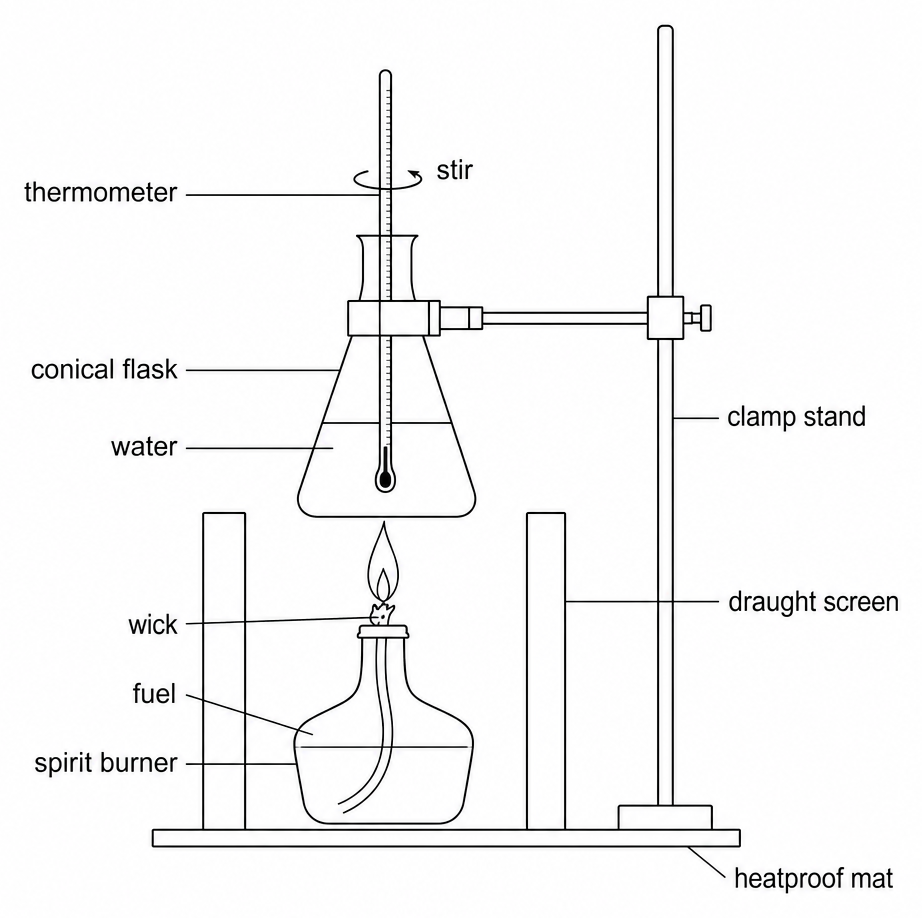
Draught screens either side cut the heat lost from the flame to the room.
Worked example - Energy released by two alcohols
A student burned ethanol, then propanol, each under 100 g of water starting at 20.0 °C. Each time they heated the water until its temperature had risen by 40.0 °C, and weighed the burner before and after.
| Fuel | Mass of burner before in g | Mass of burner after in g |
|---|---|---|
| Ethanol | 85.20 | 84.40 |
| Propanol | 90.50 | 89.90 |
Find the energy each alcohol released per gram, and say how the length of the chain affects it.
Step 1 - Find the mass of each fuel burned
Subtract the mass after from the mass before.
- For ethanol, 85.20 − 84.40 = 0.80 g.
- For propanol, 90.50 − 89.90 = 0.60 g.
Step 2 - Find the energy transferred to the water
Use , where 4.2 J/g °C is the specific heat capacity of water. Both runs heated 100 g of water by 40.0 °C, so the energy is the same for both.
Step 3 - Calculate the energy released per gram
Divide the energy by the mass of fuel burned. For ethanol:
16,800 ÷ 0.80 = 21,000 J/g = 21.0 kJ/g
For propanol:
16,800 ÷ 0.60 = 28,000 J/g = 28.0 kJ/g
Step 4 - Compare the two alcohols
Propanol, the longer-chain alcohol, released more energy per gram (28.0 kJ/g) than ethanol (21.0 kJ/g). So the energy released per gram increases with chain length.
Common exam questions
Question 1
Why is the water often heated in a copper can rather than a glass flask?
Copper is a much better conductor of heat than glass, so more of the energy from the flame passes into the water rather than being held in the walls of the container.
Question 2
Why are draught screens put around the burner and the container?
Moving air carries energy away from the flame before it reaches the container. The screens reduce this loss, so the result is closer to the fuel's true value.
Question 3
Why is the energy per gram found in this experiment always lower than the data-book value?
Some of the energy released heats the container, the thermometer, and the air instead of the water. The losses are similar for each fuel, so the fuels can still be compared.
Question 4
Why is the spirit burner weighed with its lid on, before and after heating?
Without the lid, some fuel could evaporate rather than burn. The mass lost would then be bigger than the mass burned, and the energy per gram would come out too low.
Question 5
How might a student notice incomplete combustion during this experiment, and how does it affect the result?
A smoky yellow flame, or black soot on the container. Less of the fuel's energy is released, so the energy per gram comes out lower than it should.