3.2 - Strong & Weak Acids
Strong and weak acids
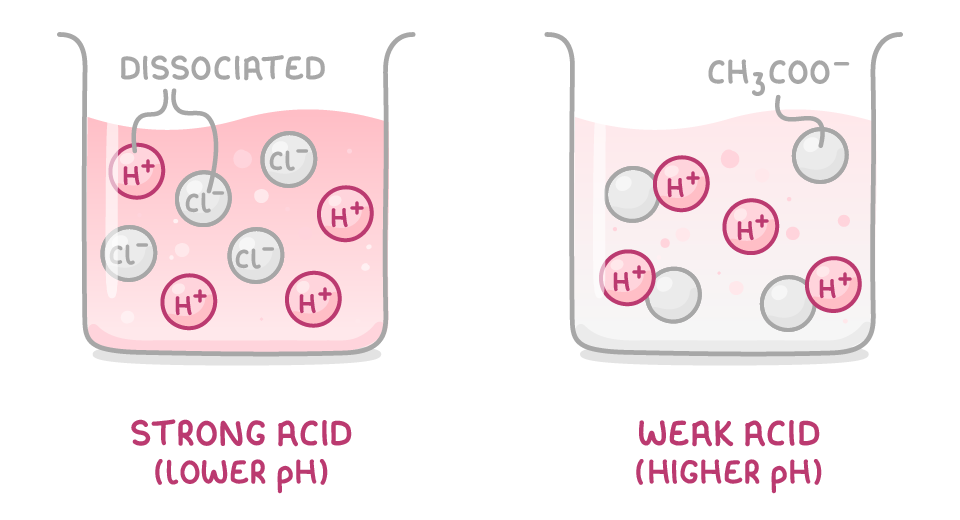
When an acid dissolves in water its particles ionise (dissociate): they split up and release hydrogen ions, H+, into the solution.
Strong acids
- A strong acid is completely ionised in aqueous solution. Every particle dissociates into ions.
- Examples: hydrochloric, nitric, and sulfuric acids.
- HCl(aq) → H+(aq) + Cl-(aq)
Weak acids
- A weak acid is only partially ionised in aqueous solution. Only a small proportion of its particles dissociate into ions.
- Examples: ethanoic, citric, and carbonic acids.
- CH3COOH(aq) ⇌ H+(aq) + CH3COO-(aq)
The reversible arrow (⇌) shows the ionisation is reversible: only a small fraction of the acid dissociates, setting up an equilibrium where most acid molecules stay whole.
Comparing strong and weak acids at the same concentration
- pH - A strong acid has a higher concentration of H+ ions, so it has a lower pH (around pH 0 to 2 for strong acids, pH 2 to 6 for weak acids).
- Rate of reaction - With more H+ ions in solution, a strong acid reacts faster. For example, magnesium fizzes vigorously in hydrochloric acid, but more slowly in ethanoic acid of the same concentration.
Concentration against strength
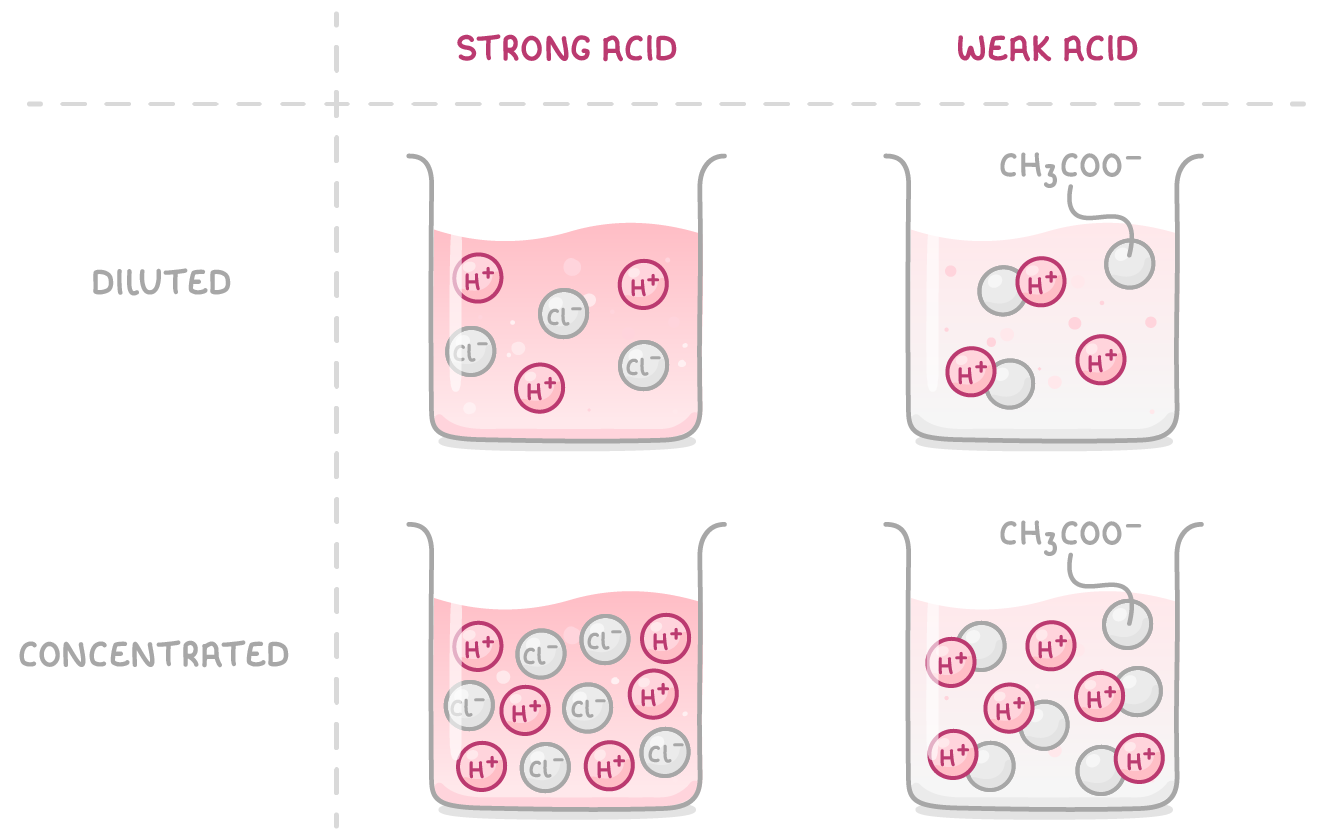
Strong/weak and concentrated/dilute describe different things:
- Strength is the proportion of dissolved acid molecules that ionise in water. It is a property of the acid itself and does not change when water is added.
- Concentration is the amount of acid dissolved in a given volume of solution.
The two are independent
- All four combinations exist: dilute strong, concentrated strong, dilute weak, and concentrated weak.
- Ethanoic acid remains a weak acid even when concentrated, and hydrochloric acid remains a strong acid even when dilute.
Both affect pH
- Both strength and concentration determine the concentration of H+ ions in solution:
- Making any acid more concentrated increases the number of H+ ions in a given volume, so the pH falls.
- A concentrated weak acid can have a lower pH than a very dilute strong acid.
- To compare the strength of two acids by their pH, they must be at the same concentration.
pH and hydrogen-ion concentration
- The pH of a solution is a measure of its hydrogen-ion concentration. The higher the concentration of H+ ions, the lower the pH.
- At pH 7, the concentration of hydrogen ions equals the concentration of hydroxide ions (neutral).
The pH scale is logarithmic
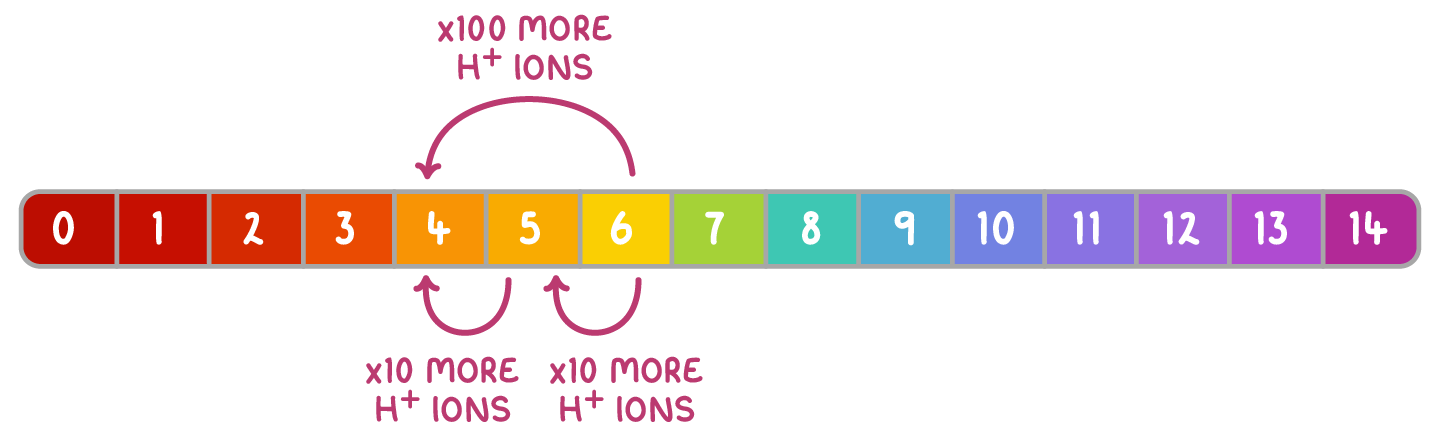
- Each change of 1 on the pH scale represents a tenfold (×10) change in hydrogen-ion concentration.
- If pH falls by 1 unit, the hydrogen-ion concentration increases by a factor of 10.
- If pH rises by 1 unit, the hydrogen-ion concentration decreases to a tenth.
- Changes of more than one unit multiply:
- A fall of 2 pH units = a 100-fold increase (10 × 10)
- A fall of 3 pH units = a 1,000-fold increase (10 × 10 × 10)
Worked example - A change of three pH units
A solution of an acid has a pH of 5. More acid is added and the pH falls to 2. By what factor has the hydrogen-ion concentration changed?
Step 1 - Find the change in pH
- The pH falls by 3 units (from 5 to 2).
- A falling pH means the hydrogen-ion concentration increases.
Step 2 - Calculate the change in hydrogen-ion concentration
A fall of 3 pH units is three tenfold increases:
10 × 10 × 10 = 1,000
Step 3 - State the answer
The hydrogen-ion concentration is 1,000 times greater than it was.
TermDefinition
Strong acidAn acid that is completely ionised in aqueous solution.
Weak acidAn acid that is only partially ionised in aqueous solution.
StrengthHow completely an acid or alkali ionises in water. A strong acid or alkali is completely ionised, and a weak one only partly.
ConcentrationA measure of how much of a substance is present in a given volume, usually how much solute is dissolved in a given volume of solution.
Key points to remember
How were these notes?