1.18 - Empirical & Molecular Formulae
What an empirical formula is
- An empirical formula is the simplest whole-number ratio of the atoms or ions in a compound.
- It's also called the simplest formula.
Giant structures
For a giant structure, the empirical formula is the only formula it has, because there are no separate molecules:
- Silicon dioxide is SiO2 because silicon and oxygen are in a 1:2 ratio.
- Sodium chloride is NaCl because sodium and chloride ions are in a 1:1 ratio.
Molecular substances
- For substances made of separate molecules:
- Molecular formula - The actual number of atoms of each element in one molecule.
- Empirical formula - The simplest whole-number ratio of atoms in the compound.
- Where the subscripts share no common factor, the two formulas are identical (e.g. water is H2O, methane is CH4).
- Where the subscripts share a common factor, divide each subscript by the largest common factor to get the empirical formula:
| Substance | Molecular formula | Empirical formula |
|---|---|---|
| Ethane | C2H6 | CH3 |
| Hydrogen peroxide | H2O2 | HO |
| Benzene | C6H6 | CH |
| Glucose | C6H12O6 | CH2O |
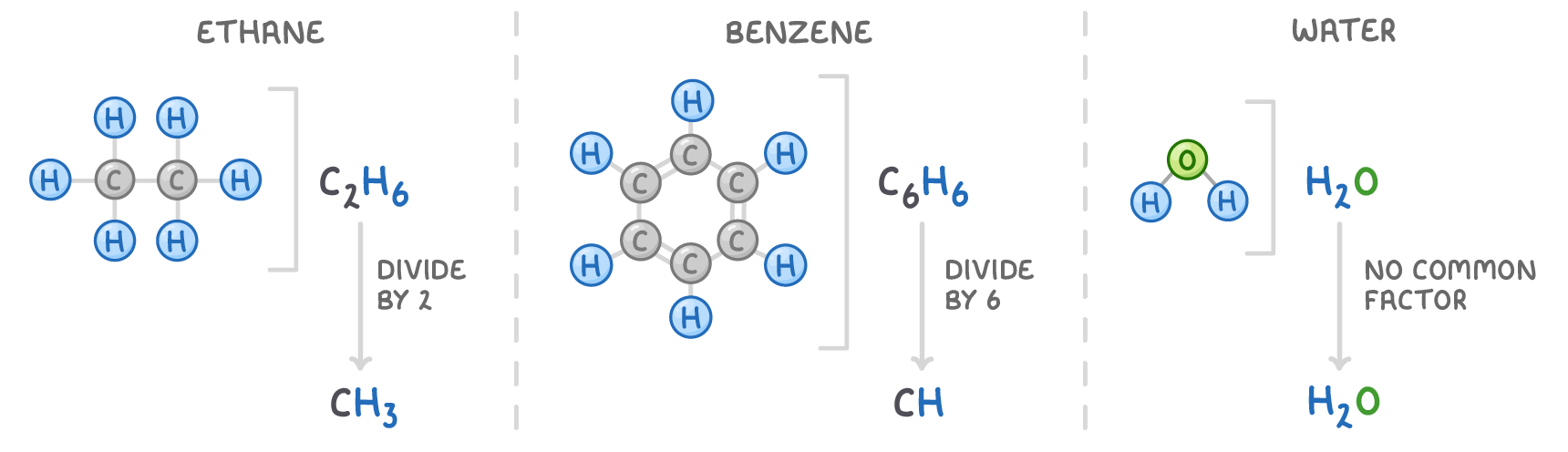
Worked example - Empirical formula of ethane
Ethane has the molecular formula C2H6. Deduce its empirical formula.
Step 1 - Read the number of atoms of each element
- Carbon: 2 atoms
- Hydrogen: 6 atoms
Step 2 - Find the largest whole number that divides both counts
Both 2 and 6 divide exactly by 2.
Step 3 - Divide each count by that number and write as subscripts
- Carbon: 2 ÷ 2 = 1
- Hydrogen: 6 ÷ 2 = 3
A subscript of 1 isn't written, so the empirical formula of ethane is CH3.
Empirical formula from masses or percentages
- An empirical formula can be calculated from the mass of each element in a sample.
- Dividing each mass by that element's relative atomic mass gives a value proportional to the number of atoms present.
Formula for relative number of atoms
The four-step method
- Divide the mass of each element by its relative atomic mass.
- Divide each answer by the smallest of them.
- If any numbers aren't whole, multiply all of them by the same factor so they all become whole (e.g. multiply by 2 for a value ending in 0.5, by 3 for 0.33).
- Write the numbers as subscripts, leaving out any subscript of 1.
Using percentages
- If composition is given as percentages, treat each percentage as a mass in grams in a 100 g sample.
- If one element's mass or percentage is missing, subtract the known amounts from the total (100% or total mass).
Worked example - Empirical formula from masses
A compound contains 5.4 g of aluminium and 4.8 g of oxygen. Deduce its empirical formula. Relative atomic masses: Al = 27, O = 16.
Step 1 - Divide each mass by its relative atomic mass
- Aluminium: 5.4 ÷ 27 = 0.200
- Oxygen: 4.8 ÷ 16 = 0.300
Step 2 - Divide each answer by the smallest
The smallest is 0.200.
- Aluminium: 0.200 ÷ 0.200 = 1.00
- Oxygen: 0.300 ÷ 0.200 = 1.50
Step 3 - Multiply so all become whole numbers
Multiply both by 2 to make them whole:
- Aluminium: 1.00 × 2 = 2
- Oxygen: 1.50 × 2 = 3
Step 4 - Write the numbers as subscripts
The empirical formula is Al2O3.
From an empirical to a molecular formula
- An empirical formula gives the ratio of atoms, not the number in a single molecule.
- To find the molecular formula, you also need the compound's relative formula mass (or relative molecular mass).
Formula for n
Where:
- = Number of empirical formula units in one molecule
- = Relative formula mass
The three-step method
- Calculate the relative formula mass of the empirical formula.
- Divide the compound's relative formula mass by it to get n.
- Multiply every subscript in the empirical formula by n.
If , the molecular formula and the empirical formula are the same.
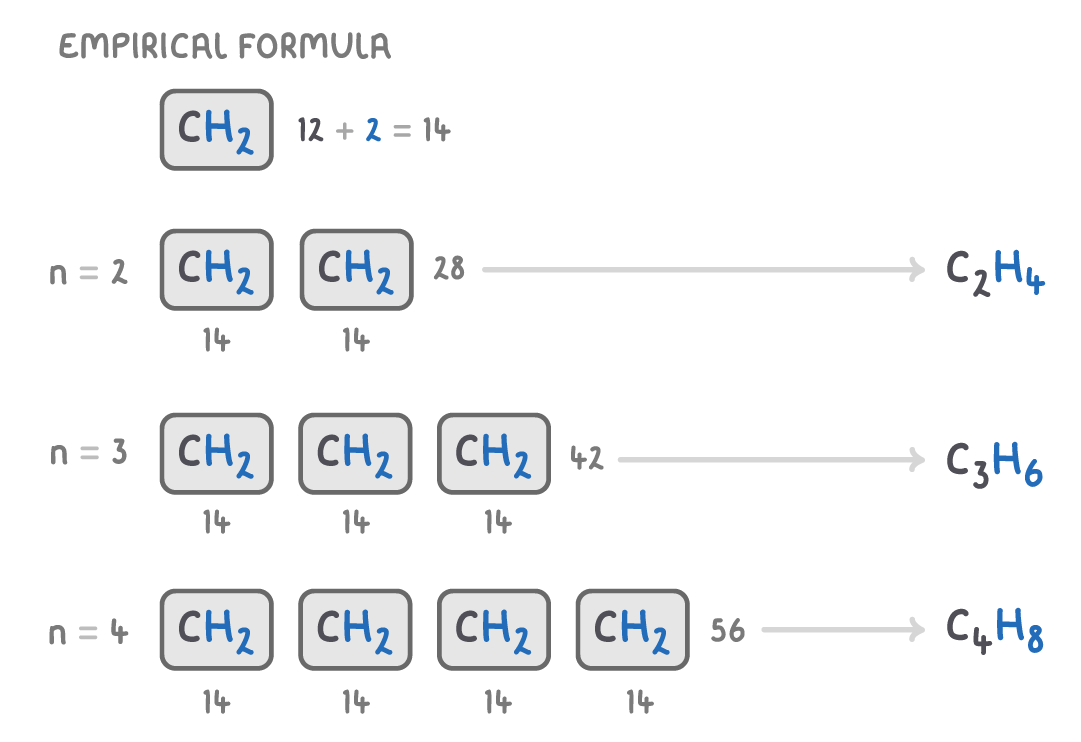
Worked example - Molecular formula from an Mr
A compound has the empirical formula CH2O and a relative formula mass of 180. Deduce its molecular formula. Relative atomic masses: C = 12, H = 1, O = 16.
Step 1 - Work out the relative formula mass of the empirical formula
Relative formula mass of CH2O = 12 + (2 × 1) + 16 = 30
Step 2 - Divide the compound's relative formula mass by it to get n
Step 3 - Multiply every subscript by n
- Carbon: 1 × 6 = 6
- Hydrogen: 2 × 6 = 12
- Oxygen: 1 × 6 = 6
The molecular formula is C6H12O6.