9.6 - Condensation Polymers
Condensation polymerisation
- A condensation polymer is a polymer formed when monomers join together with the loss of a small molecule, usually water.
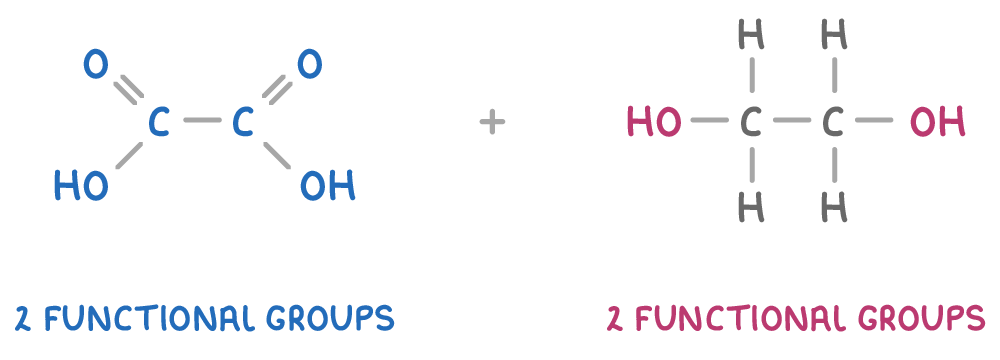
- Each monomer carries two functional groups - One at each end - so it can react at both ends to continue the polymer chain.
- A functional group is the atom or group of atoms that decides how a molecule reacts.
How the monomers are arranged
- Two different monomers, each carrying two of the same functional group. The two monomers alternate along the chain.
- A single monomer carrying two different functional groups (one at each end) polymerising head to tail.
Water is formed as a product
- Every time two monomer ends join, a molecule of water is lost.
- Condensation polymerisation produces two products: the polymer and water.
- The repeat unit contains fewer atoms than the monomers, because atoms leave to form water.
Addition and condensation polymerisation compared
| Addition polymerisation | Condensation polymerisation | |
|---|---|---|
| Monomers | One kind, with a carbon-carbon double bond (C=C) | Usually two kinds, each with two of the same functional group; or one kind with two different groups |
| What reacts | The C=C double bond opens | A functional group at one end reacts with a functional group on the next monomer |
| Products | One product: the polymer | Two products: the polymer and water |
| Repeat unit | Contains all the atoms of the monomer | Contains fewer atoms than the monomers, because water is lost |
A polyester's repeat unit
Two monomers build a polyester, each carrying a reactive group at both ends:
- Dicarboxylic acid - Carries a carboxylic acid group, -COOH, at each end.
- Diol - Carries an alcohol group, -OH, at each end.
Building the repeat unit
- Write the two monomers side by side - Acid on the left, diol on the right, with the reacting ends facing each other.
- Remove the -OH from the acid end and the H from the diol's -OH. These atoms leave as a molecule of water.
- Join what's left. The carbon from the -COOH bonds to the oxygen from the -OH, forming the ester link (-CO-O-).
- Repeat at the two outer ends - Another water molecule is lost, leaving open bonds pointing outwards to show the chain continues.
- Put brackets round the repeat unit with the open bonds passing through them, and write a subscript n outside the closing bracket.
- Add the balancing numbers - Write n in front of each monomer and 2n in front of H2O, because two water molecules are lost per repeat unit.
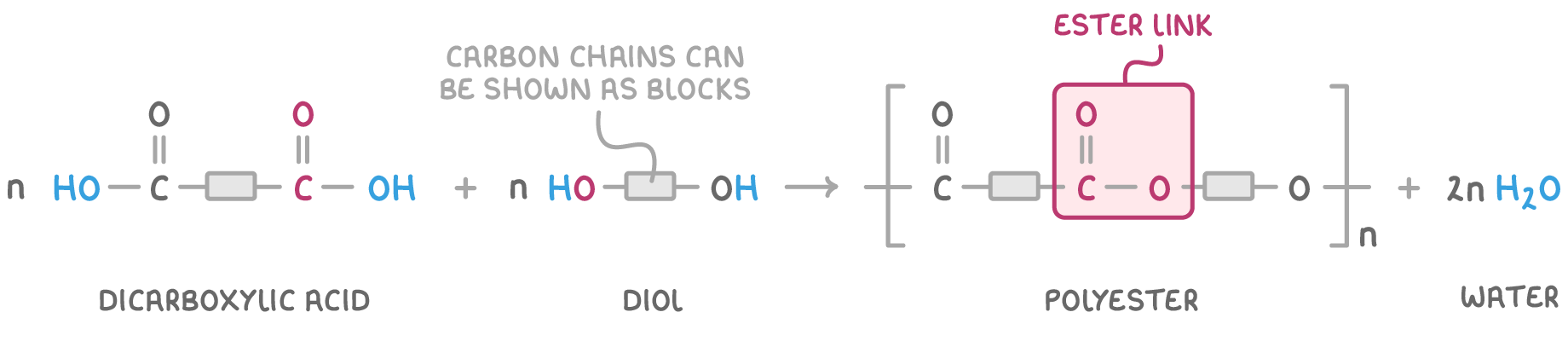
The grey blocks stand for the carbon chains between the functional groups.
For hexanedioic acid, HOOC-(CH2)4-COOH, and ethanediol, HO-CH2-CH2-OH:
n HOOC-(CH2)4-COOH + n HO-CH2-CH2-OH → [-CO-(CH2)4-CO-O-CH2-CH2-O-]n + 2n H2O
For ethanedioic acid, HOOC-COOH, and ethanediol:
n HOOC-COOH + n HO-CH2-CH2-OH → [-CO-CO-O-CH2-CH2-O-]n + 2n H2O
Working back to the monomers
- Find the ester links (-CO-O-) inside the repeat unit.
- Break each link between the carbon and the single-bonded oxygen, separating the C=O group from the -O- atom.
- Add back the water atoms - Add an -OH to the C=O piece (rebuilding -COOH), and an -H to the oxygen piece (rebuilding -OH).
- Do the same to the outer ends, then remove the brackets and the n.
Worked example - A polyester's repeat unit
A dicarboxylic acid, HOOC-CH2-COOH, is polymerised with a diol, HO-CH2-CH2-CH2-OH. Write the repeat unit of the polyester and the equation for the reaction.
Step 1 - Write the monomers side by side
Put the acid on the left and the diol on the right, so the acid's right-hand -COOH faces the diol's left-hand -OH.

The coloured -OH and -H are the ones that leave as water.
Step 2 - Remove water at the facing ends
Take the -OH off the facing acid end and the H off the facing -OH of the diol to form water.
Step 3 - Join what's left
The carbon from the -COOH bonds to the oxygen from the diol to form the ester link, -CO-O-:
HOOC-CH2-CO-O-CH2-CH2-CH2-OH
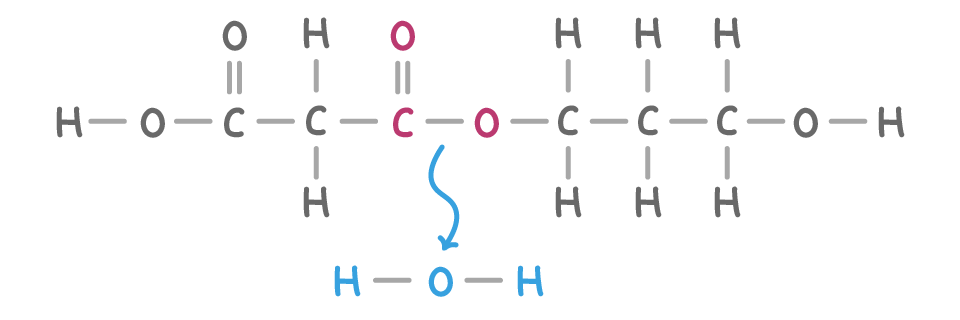
Step 4 - Do the same at the two outer ends
Remove the -OH from the left-hand end of the acid and the H from the right-hand end of the diol as a second water molecule, leaving open bonds at both ends.
Step 5 - Bracket the repeat unit
Place brackets around the repeat unit with the open bonds passing through them, and add the subscript n.
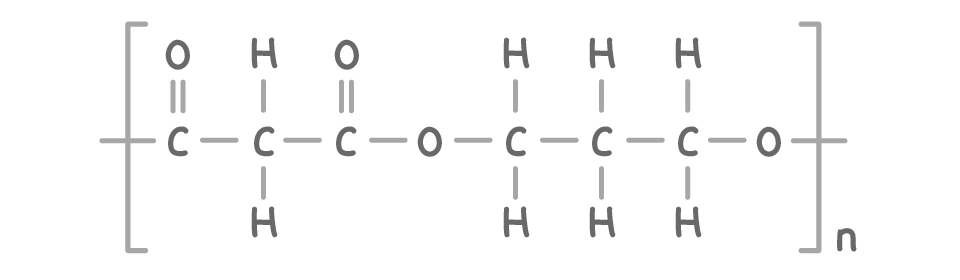
Step 6 - Add the balancing numbers and write the equation
Write n before each monomer and 2n before H2O:
Repeat unit: [-CO-CH2-CO-O-CH2-CH2-CH2-O-]n
Equation: n HOOC-CH2-COOH + n HO-CH2-CH2-CH2-OH → [-CO-CH2-CO-O-CH2-CH2-CH2-O-]n + 2n H2O