10.5 - Change in pH When a Base Is Added to an Acid
The experiment
Aim
To find out how the pH of dilute hydrochloric acid changes as a base is added to it, a little at a time, until the acid is neutralised and the mixture becomes alkaline.
Background
- An acid in solution releases hydrogen ions. The more concentrated the hydrogen ions, the lower the pH.
- A base removes hydrogen ions in neutralisation, so adding more and more base raises the pH, from acidic, through neutral at pH 7, to alkaline.
- You can't see the hydrogen ions being used up, but you can measure the pH with universal indicator paper or a pH probe.
- So in this practical you add calcium hydroxide, a solid base, to hydrochloric acid in small measured amounts, and measure the pH after each addition.
Variables
- Independent variable - The total mass of calcium hydroxide added.
- Dependent variable - The pH of the mixture.
- Control variables - The volume and concentration of the hydrochloric acid, the size of each spatula measure, and stirring after every addition.
Method
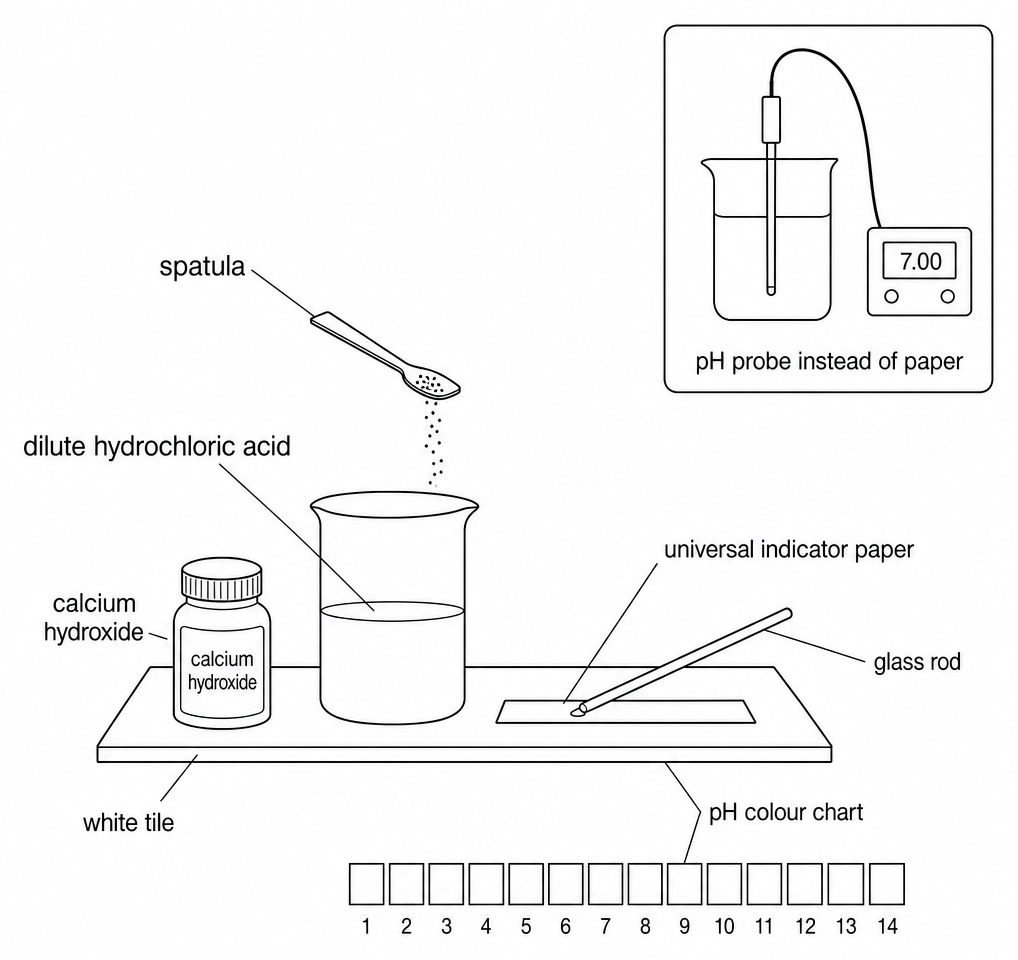
- Measure the acid - Measure a fixed volume of dilute hydrochloric acid into a beaker with a measuring cylinder.
- Weigh the base - Weigh out several spatula measures of calcium hydroxide powder, or weigh each one as you add it. Calcium oxide also works, because it reacts with the water to form calcium hydroxide.
- Record the starting pH - Use a glass rod to put a drop of the acid on universal indicator paper on a white tile, and match the colour to the pH chart. Or dip a pH probe into the acid and read it.
- Add the base - Add one spatula measure of calcium hydroxide and stir well.
- Test the pH again - Use a fresh piece of indicator paper each time, so the last colour doesn't affect the new one, or wait for the probe reading to settle.
- Repeat until the pH stops changing - Add one measure at a time, and record the total mass added and the pH after each addition.
Safety
- Eye protection - Dilute hydrochloric acid and calcium hydroxide powder are both irritants, so keep the powder away from your face and wash off any spills at once.
- Spilled powder - Wipe it up straight away, since it's slippery once damp.
Worked example - Neutralising acid with a base
A student added calcium hydroxide powder to 25 cm3 of dilute hydrochloric acid, one spatula measure at a time, testing the pH with universal indicator paper after each addition.
| Mass of calcium hydroxide added in g | 0 | 0.5 | 1.0 | 1.5 | 2.0 | 2.5 | 3.0 |
|---|---|---|---|---|---|---|---|
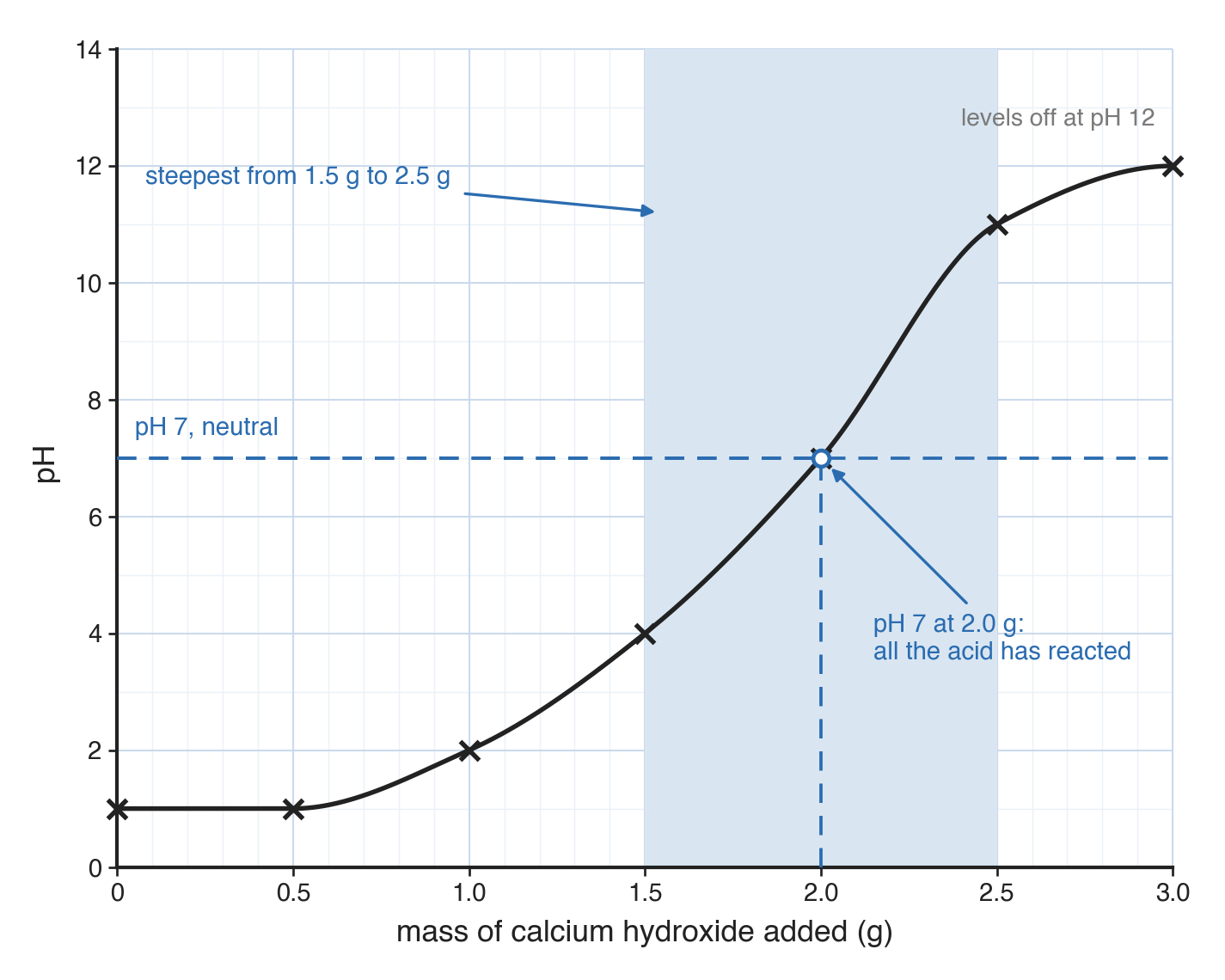
| pH | 1 | 1 | 2 | 4 | 7 | 11 | 12 |
Plot the results, state where the acid was exactly neutralised, and explain why the pH does not keep rising after that point.
Step 1 - Plot the graph
Plot pH on the y-axis against the mass of calcium hydroxide added on the x-axis. Draw a smooth curve through the points, rather than joining them with straight lines.
Step 2 - Find where the acid was neutralised
The pH reaches 7 when 2.0 g has been added, so all the acid had been neutralised at 2.0 g. The curve is steepest either side of this point, from 1.5 g to 2.5 g. Once the acid is nearly used up, a small mass of base makes a large difference to the pH.
Step 3 - Explain why the curve levels off at both ends
At the start there's a large excess of acid. The first additions of base only neutralise a small fraction of the hydrogen ions, so the pH barely changes.
At 2.0 g, all the acid has reacted and the solution is neutral, because calcium chloride is a neutral salt. Past that point the pH goes on rising, from 7 to 11, as the excess calcium hydroxide dissolves. Calcium hydroxide is only slightly soluble, so from about 2.5 g the solution is saturated with it, and adding more solid doesn't raise the concentration of hydroxide ions any further, so the pH levels off.
Common exam questions
Question 1
Why is universal indicator paper used rather than a single indicator such as phenolphthalein?
A single indicator only shows whether the solution is above or below one particular pH. Universal indicator gives a colour for a whole range of pH values, so it shows how the pH is changing.
Question 2
Why is the mixture stirred after each addition of calcium hydroxide?
So the powder mixes evenly and reacts with the acid before the pH is measured, rather than the reading being taken next to powder that hasn't reacted yet.
Question 3
Suggest one improvement to make the pH readings more accurate.
Use a pH probe instead of universal indicator paper. A probe gives a number, rather than a colour that has to be matched to a chart by eye.
Question 4
Why is calcium hydroxide added as a powder rather than as a solution?
Its mass can be measured out in small steps, so the pH can be followed stage by stage. Calcium hydroxide is also only slightly soluble, so a solution of it couldn't deliver much base in each addition.
Question 5
Write the ionic equation for the neutralisation in this experiment, including state symbols.
H+(aq) + OH-(aq) → H2O(l)