9.12 - Ceramics & Composites
Glass and clay ceramics
- A ceramic is a solid that is not a metal and is not built from carbon compounds, and has a high melting point.
- Ceramics are stiff, hard-wearing, brittle, and insulators of heat and electricity.
- They do not corrode or rot.
The two main types are glass and clay ceramics:
- Glass - Usually transparent, can be shaped while hot, and brittle when thin.
- Clay ceramics - Include pottery and bricks. A clay brick has a high compressive strength, so it can support heavy loads without breaking.
Composites
- A composite is made of one material embedded in another:
- The reinforcement - Fibres or fragments of the first material.
- The matrix (or binder) - A second material surrounding them and holding them in place.
- The combination has properties neither material has on its own, allowing composites to be designed for specific uses.
- Their main drawback is cost.
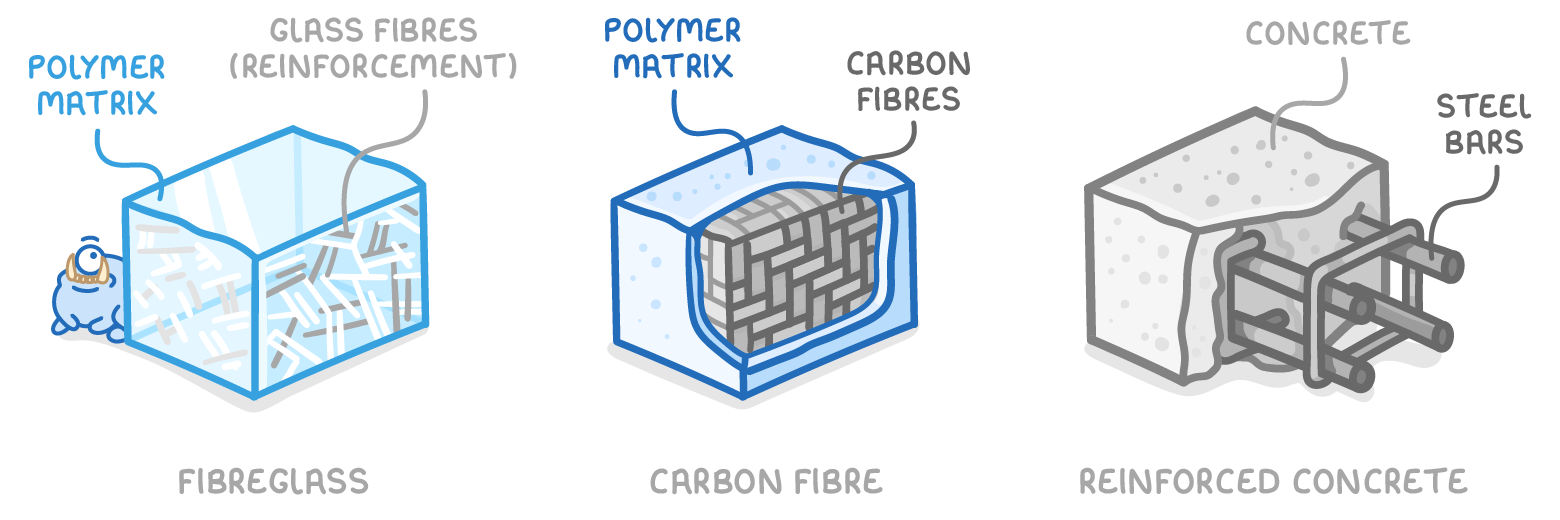
| Composite | Made of | Properties and uses |
|---|---|---|
| Fibreglass | Glass fibres in a polymer matrix | Low density and strong - boats, skis, surfboards |
| Carbon fibre | Carbon fibres in a polymer matrix | Very strong and light - aircraft and sports cars |
| Reinforced concrete | Steel bars set into concrete | Strong in both compression and tension - building construction |
TermDefinition
CeramicA hard, non-metal solid with a high melting point that is not made from carbon compounds, such as glass or brick.
CompositeA material made of one material embedded in another, combining properties neither has on its own.
Key points to remember
How were these notes?