5.1 - Transition Metals
What the transition metals are like
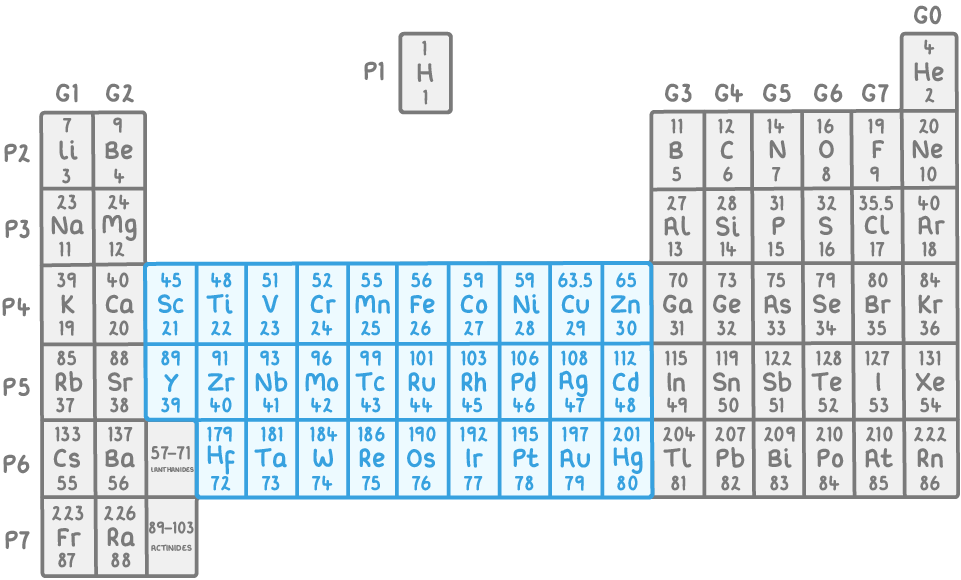
- The transition metals (also called transition elements) are the block of metals in the centre of the periodic table, between Group 2 and Group 3.
- Most metals in the periodic table belong to this block, including iron, copper, chromium, manganese, cobalt, nickel, silver, and gold.
Typical metal properties
They behave as typical metals: relatively hard, strong, and shiny, and good conductors of heat and electricity.
How they compare with Group 1 metals
- High melting points - Iron melts at about 1,540 °C, while sodium melts at only 98 °C (mercury is the exception, being a liquid at room temperature).
- High densities - Copper is 9.0 g/cm3 and iron 7.9 g/cm3, against 0.9 g/cm3 for potassium.
- Stronger and harder - Group 1 metals are soft enough to be cut with a knife.
- Far less reactive - They react only slowly with water and oxygen, and slowly or not at all with the halogens. Copper doesn't react with water at all, and iron rusts slowly, whereas alkali metals react vigorously with cold water and lose their shine within seconds in air.
Coloured compounds and catalysts
- Compounds of the transition metals are coloured, which sets them apart from most other metal compounds.
- The colour comes from the metal ion itself: transition metal ions are coloured, so most compounds containing one are coloured too - both as a solid and when dissolved in solution. There are exceptions: anhydrous copper(II) sulfate is white, and turns blue only when water is added.
Which colour depends on the ion
- The colour depends on which transition metal ion the compound contains:
- Compounds containing Fe2+ ions are usually pale green.
- Compounds containing Fe3+ ions are orange-brown.
- Compounds containing Cu2+ ions are typically blue.
- Across the block: chromium(III) is green, manganese(II) is pale pink, manganate(VII) is deep purple, cobalt(II) is pink, and nickel(II) is green.
Catalytic activity
- Many transition metals, and many of their compounds, are useful as catalysts.
- A catalyst is a substance that speeds up a chemical reaction without being used up by it.
- A transition metal can act as a catalyst either as the element itself or in one of its compounds - iron is the standard example.
TermDefinition
Transition metalsThe block of metals in the centre of the periodic table, between Group 2 and Group 3.
CatalystA substance that speeds up a chemical reaction without being changed or used up.
Key points to remember
How were these notes?