9.7 - Reuse & Recycling
Why we reduce, reuse and recycle
- Most manufactured goods come from raw materials taken from the Earth, which are in limited supply (finite), such as metal ores.
- Extracting raw materials is damaging and expensive:
- Uses large amounts of energy to extract and process them, mostly from burning fossil fuels.
- Damages the environment through quarrying and mining, which scar the landscape, destroy habitats, and produce waste.
Three ways to conserve raw materials
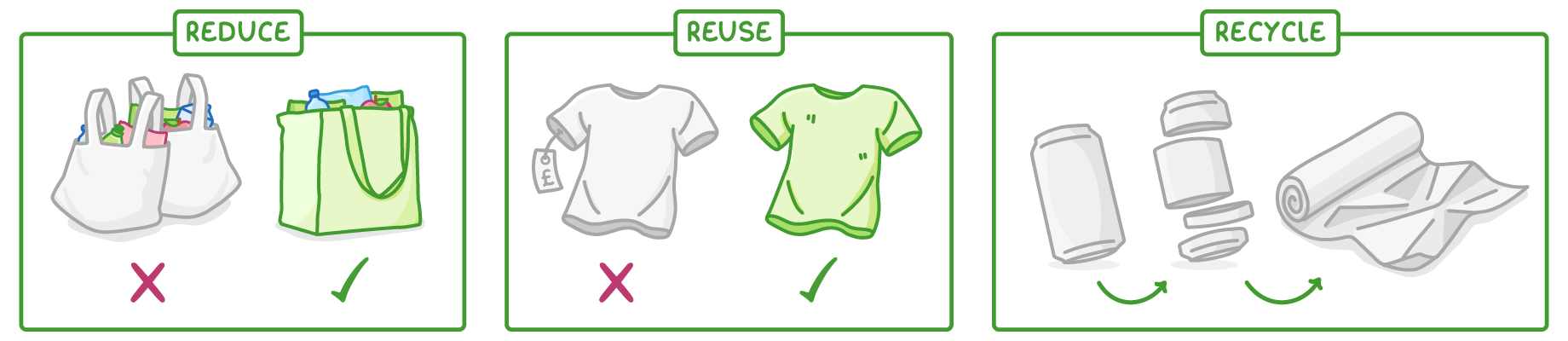
- Reducing - Using less of a material in the first place, saving raw resources, energy, and environmental damage.
- Reusing - Using a product again in its current form, requiring far less energy than recycling because it isn't broken down or reprocessed.
- Recycling - Breaking down a used product into its raw material to make something new.
All three approaches conserve finite resources, save energy, and reduce waste sent to landfill.
The economic case
- Processes that use less energy cost less to run, especially for materials that are expensive to extract.
- Recycling is an industry that creates jobs in collecting, sorting, and reprocessing waste.
- Recycling isn't always worth doing: the cost of collecting and reprocessing must be weighed against the cost of making the material from scratch.
Recycling metals, and reusing glass
- Extracting metals from ores requires large amounts of energy and causes environmental damage.
- Recycling metals avoids most of this:
- Uses a fraction of the energy needed for extraction.
- Conserves limited supplies of ores.
- Cuts down on waste sent to landfill.
How metals are recycled
- Sort the scrap metal.
- The sorting required depends on the product: items requiring a pure metal must be carefully separated, while others can use a mixture.
- Melt it down.
- Scrap steel can be added directly to the molten iron from a blast furnace, reducing the amount of iron that needs extracting from iron ore.
- Cast or reform it into new products.
Aluminium
- Extracting aluminium requires mining about 4 tonnes of ore for every tonne of metal, followed by electrolysis using large amounts of electricity.
- Recycling aluminium uses only about 5% of that energy, saving roughly 95% of the energy, four kilograms of ore per kilogram of metal, and substantial waste.
- This makes aluminium one of the most cost-effective metals to recycle.
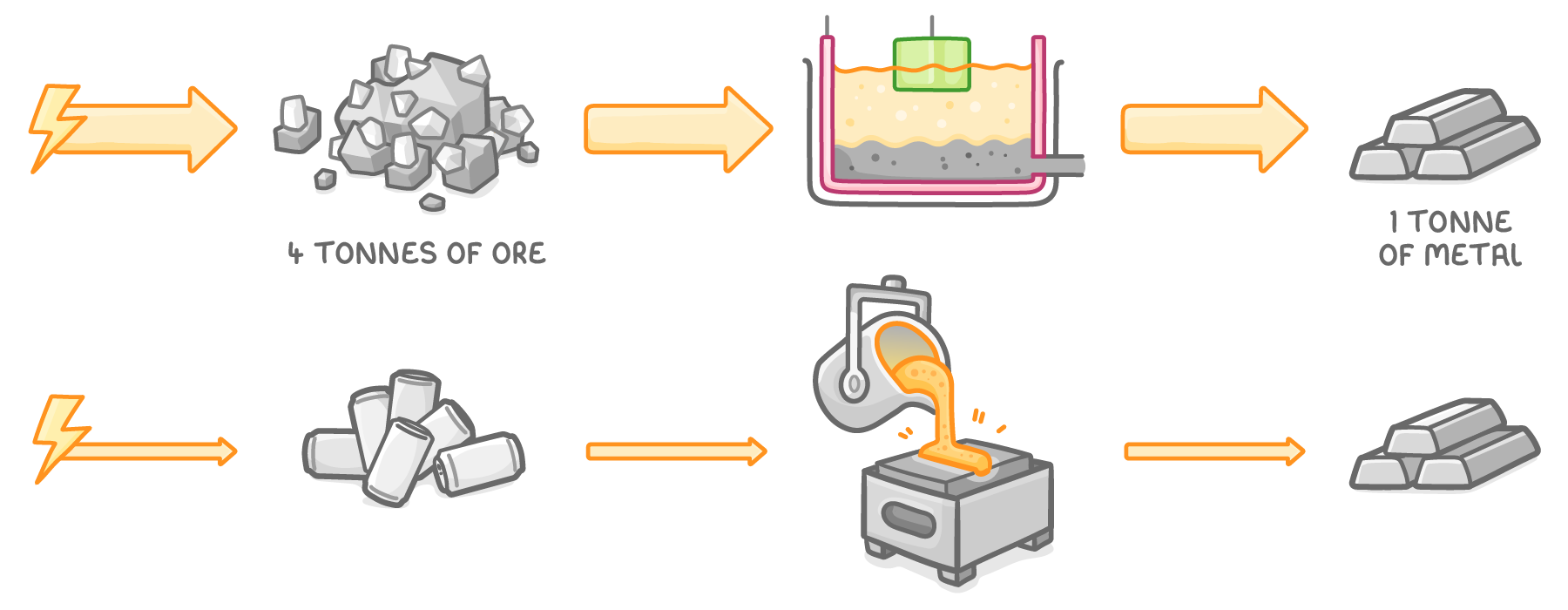
Top: extracting aluminium from ore. Bottom: recycling cans, using far less energy.
Glass - Reused or recycled
- Reuse - Glass bottles can be collected, washed, and refilled without being melted down, using almost no energy.
- Recycling - Glass that can't be reused is:
- Separated by colour and type.
- Crushed and melted to be remoulded into new bottles, jars, or glass wool for insulation.
The problem with plastic waste
- Addition polymers are chemically unreactive and cannot be broken down by microbes; they are non-biodegradable.
- Because they don't rot, discarded plastics persist in the environment for centuries, creating over two million tonnes of plastic waste each year in the UK alone.
Three main problems
- Landfill - Large volumes of plastic are buried because mixed plastics are difficult and expensive to separate. They occupy valuable space indefinitely.
- Accumulation in oceans - Plastic litter washed into rivers and seas accumulates, harming marine ecosystems and wildlife.
- Toxic gases from burning - Burning plastics releases useful energy, but produces harmful emissions:
- Plastics containing chlorine, such as PVC, release hydrogen chloride gas, which must be removed from the exhaust gases.
- Complete combustion produces carbon dioxide, a greenhouse gas that contributes to global warming.
Recycling plastics, and whether it is worth it
- Plastics are made from crude oil, a finite resource that is becoming increasingly scarce and expensive.
- Recycling plastics conserves crude oil for uses where no substitutes exist.
Why recycling plastics is difficult
- Different polymers must be separated by type before melting and remoulding.
- Sorting is labour-intensive and expensive; if unsorted plastics are melted together, the resulting material has poor properties.
- Plastics can only be recycled a limited number of times, as the polymer chains degrade and lose strength each time they're melted.
Advantages and disadvantages of recycling plastics
| Advantages | Disadvantages |
|---|---|
| Reduces non-biodegradable waste in landfill sites. | Sorting different plastics by type is difficult and expensive. |
| Reduces toxic and greenhouse gases released by incineration. | Mixing different polymers results in a lower-quality material. |
| Uses less energy and water than producing new plastics. | Polymers degrade with each recycling cycle, limiting how often they can be reused. |
| Conserves finite crude oil reserves. | Melting plastics can release harmful fumes. |
TermDefinition
Reducing (waste)Using less of a material in the first place.
ReusingUsing a product again in its current form without breaking it down.
RecyclingBreaking down a used product into its raw materials to make something new.
Non-biodegradableNot able to be broken down by microorganisms in the environment.
Key points to remember
How were these notes?