5.10 - Chemical Cells
A chemical cell and its voltage
- A chemical cell uses a chemical reaction to produce electricity.
- While the reaction runs, the cell produces a voltage (also called a potential difference) across its two terminals.
- Connect the cell into a circuit and this voltage pushes a current round it.
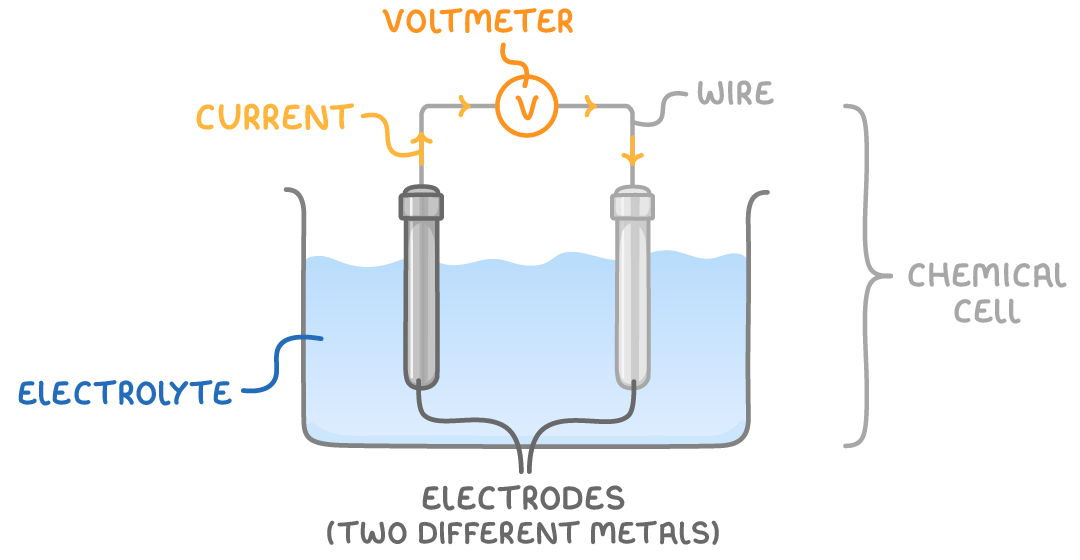
- A voltmeter placed across the cell reads the size of the voltage it produces.
The simplest cell
- Stand two strips of different metals in an electrolyte, and join them with a wire.
- The metal strips are the cell's electrodes, the electrolyte is what they dip into, and the wire completes the circuit.
- Reactions between the electrodes and the electrolyte set up a charge difference between the two electrodes.
- The two metals must be different. Two strips of the same metal react with the electrolyte identically, so no charge difference builds up and the voltmeter reads nothing.
What decides the size of the voltage
- The two metals used as electrodes - What matters is the difference in reactivity between them: the bigger the difference in reactivity, the bigger the voltage.
- The electrolyte - Different electrolytes contain different ions, which react differently with the electrodes and change the voltage.
Why a cell goes flat
- A cell doesn't produce electricity forever, because a chemical reaction uses up what it's made from.
- As the cell is used, its reactants are steadily turned into products.
- Once one reactant is completely used up, the reaction stops, so the voltage falls away and the current stops.
TermDefinition
Chemical cellA device that uses a chemical reaction to produce electricity.
ElectrodeA solid conductor, such as a metal or graphite rod, through which electric current enters or leaves an electrolyte.
ElectrolyteA molten ionic compound or a solution containing ions that are free to move, so it conducts electricity.
Key points to remember
How were these notes?