1.5 - The Modern Periodic Table
Ordered by increasing atomic number
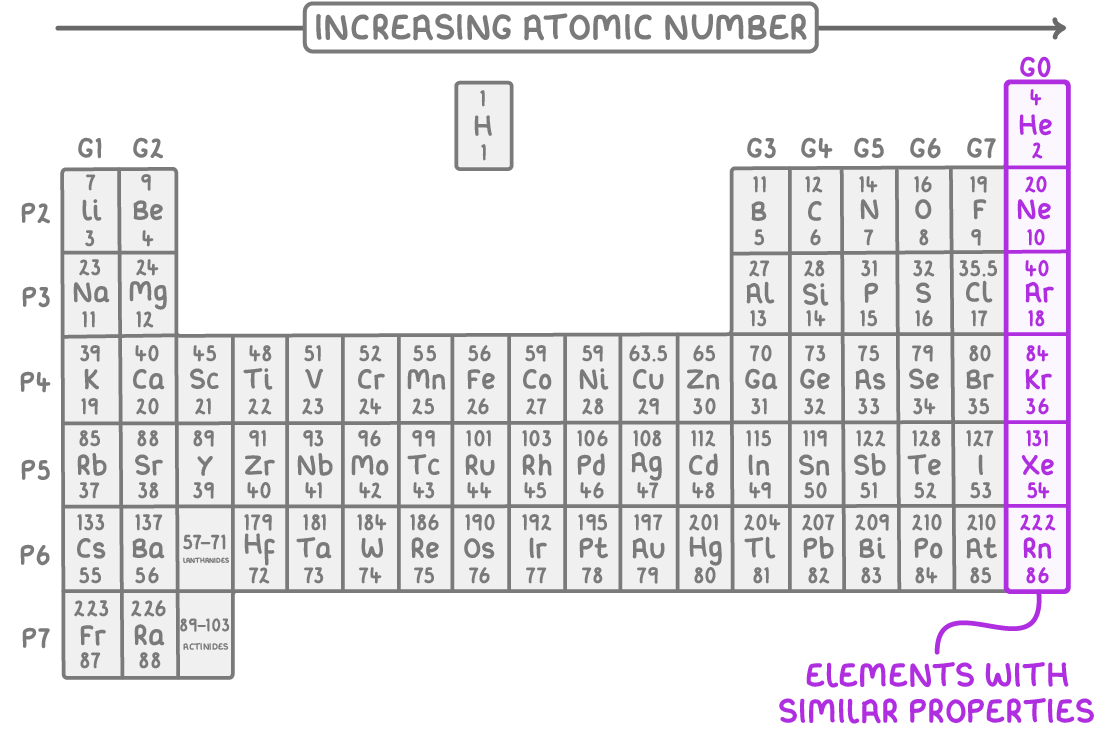
- The elements in the periodic table are placed in order of increasing atomic number (the number of protons in an atom).
- It's read left to right along each row, then down to the start of the next row (hydrogen is 1, helium is 2, lithium is 3, and so on).
- Atomic number is also called proton number.
Why the order matters
- Arranging the elements by atomic number causes similar chemical properties to recur at regular intervals.
- Properties that repeat regularly like this are described as periodic.
- The table is laid out so that elements with similar properties line up beneath one another in columns.
Groups, periods and the named groups
Groups - The vertical columns
- The vertical columns are called groups.
- Elements in the same group have similar chemical properties because they have the same number of electrons in their outer shell.
- Groups are numbered from Group 1 to Group 7, and the far-right column is Group 0.
Periods - The horizontal rows
- The horizontal rows are called periods, numbered from period 1 at the top downwards.
- A new row begins each time the pattern of properties repeats.
- Period 1 contains only two elements: hydrogen and helium.
Named groups and blocks
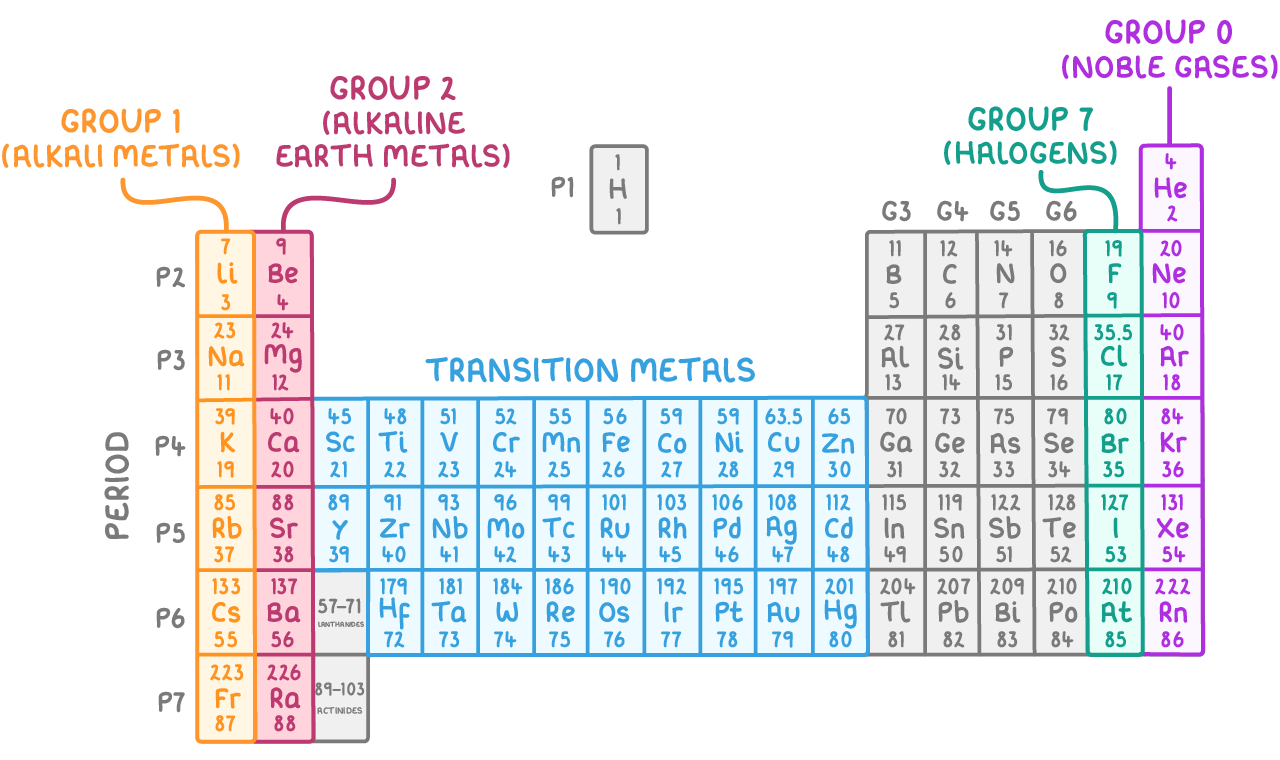
- Group 1 - The alkali metals (reactive metals)
- Group 2 - The alkaline earth metals (reactive metals)
- Group 7 - The halogens (reactive non-metals)
- Group 0 - The noble gases (unreactive non-metals)
- Transition metals - The large block of metals located between Group 2 and Group 3
TermDefinition
Atomic numberThe number of protons in the nucleus of an atom.
GroupA vertical column in the periodic table containing elements with the same number of outer-shell electrons.
PeriodA horizontal row in the periodic table.
Alkali metalsThe metals in Group 1 of the periodic table, which each have one electron in their outer shell.
Alkaline earth metalsThe reactive metals in Group 2 of the periodic table.
HalogensThe non-metal elements in Group 7 of the periodic table, which each have seven electrons in their outer shell.
Noble gasesThe unreactive non-metal elements in Group 0 (also called Group 8 or VIII) of the periodic table, which have a full outer shell of electrons.
Transition metalsThe block of metals in the centre of the periodic table, between Group 2 and Group 3.
Key points to remember
How were these notes?