10.11 - Identifying Ions in an Unknown Compound
The technique - Flame tests
Aim
To identify the metal ion in an unknown ionic compound from the colour it gives a Bunsen flame.
Background
- Each metal ion gives a flame its own colour, such as yellow for sodium, lilac for potassium, and orange-red for calcium.
- A mixture of metal ions gives a mixture of colours, so one ion's colour can hide another's. Sodium's yellow is bright enough to hide every other colour.
- You can't see which metal ion is in a compound, but you can see the colour it gives the flame.
- So in this practical you hold a little of the sample in a blue Bunsen flame, record the colour, and compare it with the colours given by known compounds.
Method
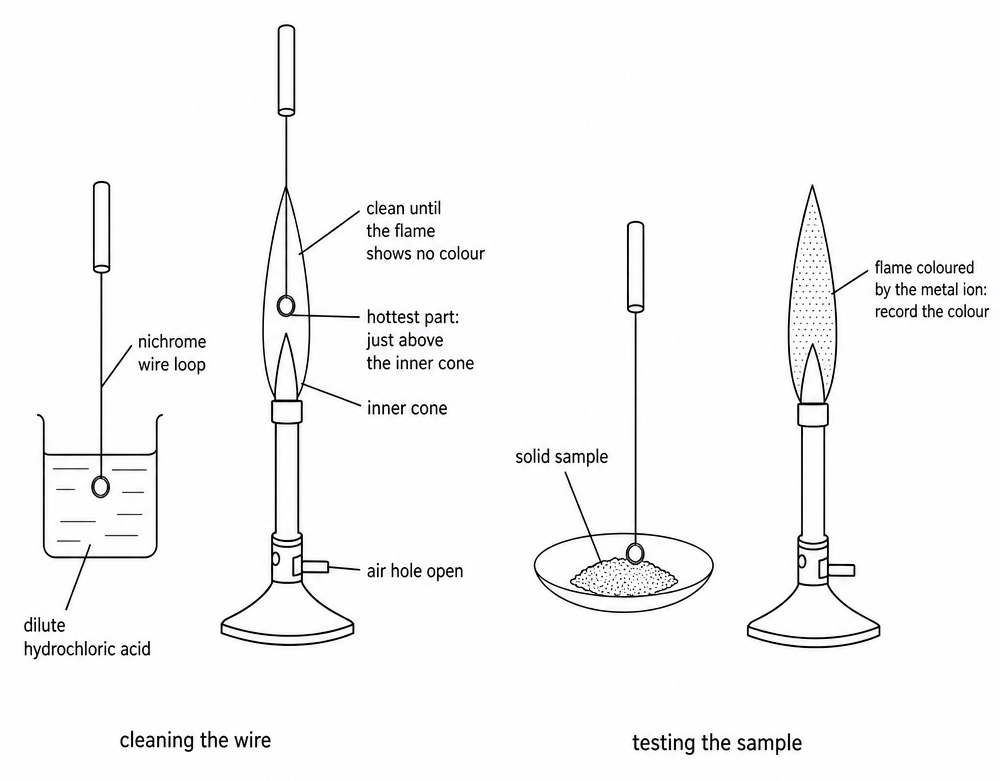
- Clean the wire - Dip a nichrome wire loop in dilute hydrochloric acid and hold it in the flame until the flame shows no colour, or rub it bright with emery paper. A fresh damp wooden splint, used once and thrown away, works as well.
- Pick up the sample - Dip the loop into the solid, or a solution of it, so a little clings on.
- Hold it in the flame - With the air hole open, hold the loop just above the tip of the inner cone, which is the hottest part of the flame.
- Record the colour - In a results table with one row for each sample.
- Test each known sample - Clean the wire before every test, and keep any sodium compound off your hands and the apparatus.
- Test the unknown last - And compare its colour directly with the known samples.
Safety
- Eye protection - Wear it throughout.
- Hot wire - The wire and the end of a splint get hot, so let them cool on a heatproof mat.
- Dilute acid only - Never clean the wire with concentrated hydrochloric acid, which is corrosive.
- Bunsen burner - Keep hair and loose clothing away from the flame.
The technique - Further cation and anion tests
Aim
To identify the metal ion in an unknown compound using sodium hydroxide solution, and its negative ion using tests for carbonate, sulfate, and halide ions.
Background
- Many metal hydroxides are insoluble, so adding sodium hydroxide solution to a solution of the metal ion forms a precipitate. Its colour helps identify the ion.
- Carbonate, sulfate, and halide ions each give a gas or a precipitate with a particular reagent.
- You can't see the ions in a solution, but you can see a precipitate form, or a gas turn limewater milky.
- So in this practical you add each reagent to a fresh portion of the sample, and use what you see to identify the ions.
Method
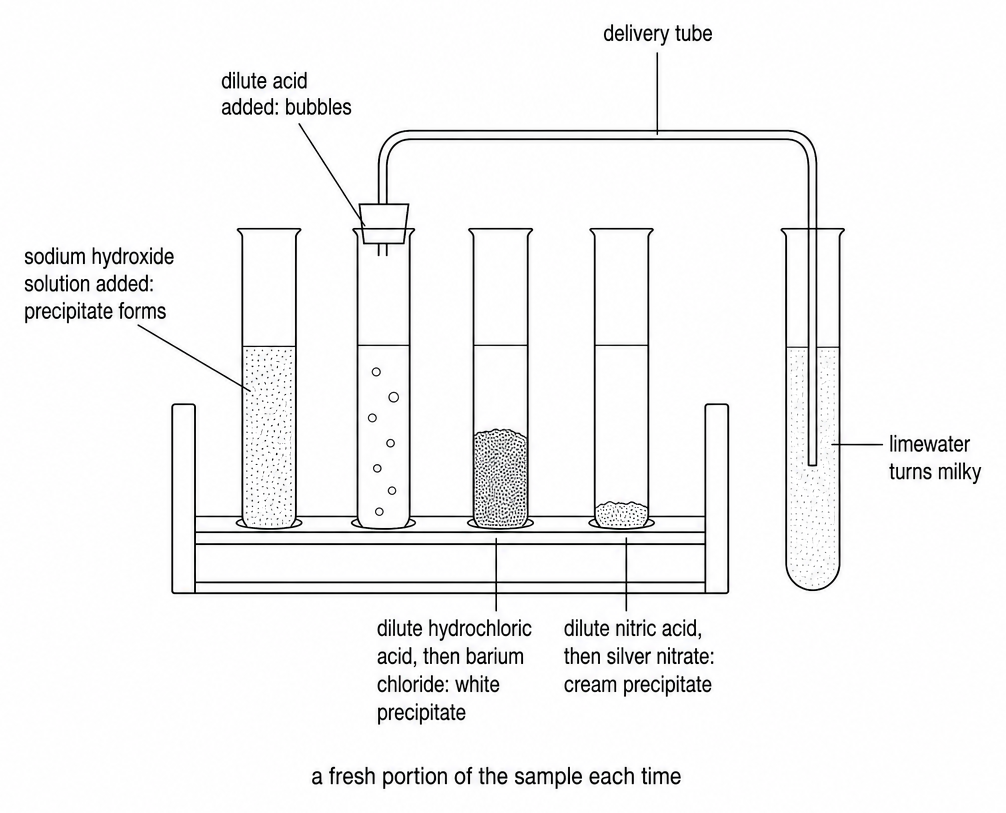
- Use a fresh portion for each test - Use a clean test tube each time, so reagent left from one test can't interfere with the next.
- Sodium hydroxide, for metal ions - Add a few drops and record the colour of the precipitate. If it's white, keep adding sodium hydroxide until it's in excess, and record whether the precipitate dissolves.
- Ammonia solution, to tell zinc from aluminium - Add ammonia solution until it's in excess. Zinc hydroxide dissolves in excess ammonia, but aluminium hydroxide doesn't, although both dissolve in excess sodium hydroxide.
- Dilute acid, for carbonate ions - Add dilute acid. If it fizzes, pass the gas into limewater, which turns milky if the gas is carbon dioxide.
- Barium chloride, for sulfate ions - Add dilute hydrochloric acid first, to remove any carbonate ions that would also give a precipitate, then add barium chloride solution. A white precipitate shows sulfate ions.
- Silver nitrate, for halide ions - Add dilute nitric acid, then silver nitrate solution. A white precipitate shows chloride ions, cream shows bromide, and yellow shows iodide.
Safety
- Eye protection - Wear it throughout, and add reagents a few drops at a time.
- Ammonia solution - It gives off an irritating vapour, so use it in a well-ventilated room.
- Barium chloride - Barium compounds are toxic, so avoid skin contact and wash your hands afterwards.
- Silver nitrate - It stains skin and clothing, so wipe up spills at once.
Common exam questions
Question 1
Why must the wire be cleaned before every flame test?
Any metal ion left on the wire from an earlier test gives its own flame colour, which mixes with the new sample's colour.
Question 2
Why must the air hole be open, giving a blue flame rather than a yellow one?
A yellow flame has a colour of its own, which could be mistaken for the sample's colour or hide it.
Question 3
Why must the acid added before silver nitrate be nitric acid rather than hydrochloric acid?
Hydrochloric acid contains chloride ions, so it would give a white precipitate with silver nitrate whether or not the sample contained chloride ions.
Question 4
A student adds sodium hydroxide solution to a sample and sees a white precipitate. Why can't they yet say which metal ion is present?
Several metal ions give a white precipitate with sodium hydroxide. Adding excess sodium hydroxide and seeing whether the precipitate dissolves narrows it down.
Question 5
Plan how you would show that an unknown solid contains potassium ions and bromide ions.
Hold some of the solid on a clean wire in a blue flame. A lilac flame shows potassium ions. Dissolve another portion in water, add dilute nitric acid, then silver nitrate solution. A cream precipitate shows bromide ions.