5.3 - Concentration of Solutions
Concentration and the g/dm3 formula
- A solution forms when a substance dissolves in a liquid:
- Solute - The substance that dissolves
- Solvent - The liquid it dissolves in
- Solution - The mixture of solute and solvent
- Concentration is a measure of how much solute is dissolved in a given volume of solution.
- More solute in the same volume makes a solution more concentrated; more solvent for the same solute makes it more dilute.
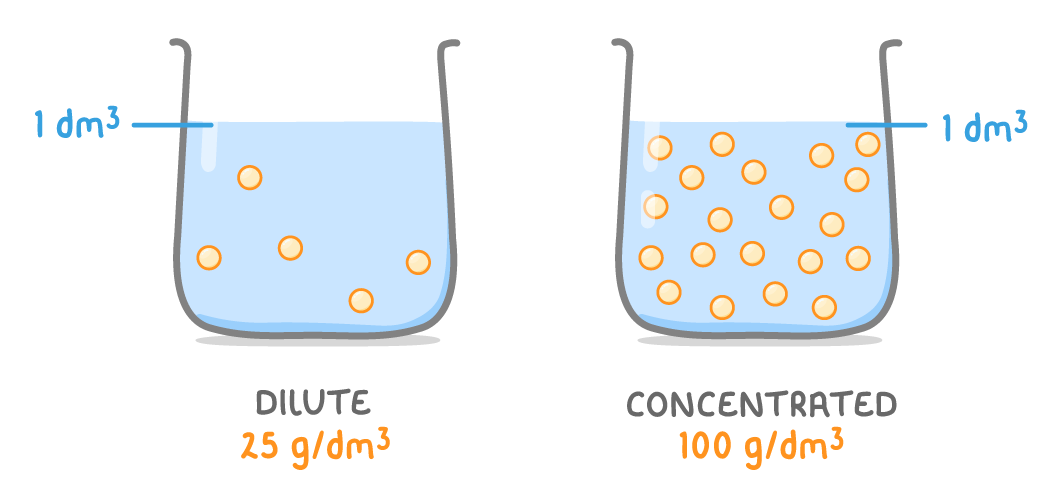
Measuring volume in dm3
- 1 dm3 = 1,000 cm3 = 1 litre
- To convert cm3 to dm3, divide by 1,000.
Formula for concentration in g/dm3
Where:
- Concentration is in grams per cubic decimetre (g/dm3)
- Mass of solute is in grams (g)
- Volume of solution is in cubic decimetres (dm3)
Worked example - Mass of solute in a solution
A solution of sodium chloride has a concentration of 12.5 g/dm3. Calculate the mass of sodium chloride dissolved in 175 cm3 of this solution.
Step 1 - Identify the values
- Concentration = 12.5 g/dm3
- Volume of solution = 175 cm3
Step 2 - Convert the volume to dm3
The concentration is a mass per cubic decimetre, so the volume must also be in dm3 (1,000 cm3 = 1 dm3):
175 cm3 = 175 ÷ 1,000 = 0.175 dm3
Step 3 - Rearrange the formula
Mass of solute = concentration × volume of solution
Step 4 - Substitution and calculation
Mass of solute = 12.5 × 0.175 = 2.1875 g
Step 5 - Round the answer
The concentration and volume are both given to three significant figures, so:
Mass of sodium chloride = 2.19 g
Concentration in mol/dm3
- Concentration is also measured as the amount of solute, in moles, in each cubic decimetre of solution (mol/dm3).
- More solute in the same volume makes a solution more concentrated; more solvent for the same solute makes it more dilute.
Measuring volume in dm3
- 1 dm3 = 1,000 cm3 = 1 litre
- To convert cm3 to dm3, divide by 1,000.
Formula for concentration in mol/dm3
Where:
- Concentration is in moles per cubic decimetre (mol/dm3)
- Amount of solute is in moles (mol)
- Volume of solution is in cubic decimetres (dm3)
Worked example - Concentration in mol/dm3 from a mass
5.00 g of sodium hydroxide, NaOH, is dissolved in water and the solution is made up to a total volume of 300 cm3. Calculate the concentration of the solution in mol/dm3.
Step 1 - Identify the values
- Mass of sodium hydroxide = 5.00 g
- Volume of solution = 300 cm3
Step 2 - Convert the mass to an amount in moles
Relative atomic masses (periodic table): Na = 23, O = 16, H = 1, so of NaOH = 23 + 16 + 1 = 40. Amount = mass ÷ :
amount of NaOH = 5.00 ÷ 40 = 0.125 mol
Step 3 - Convert the volume to dm3
1,000 cm3 = 1 dm3:
300 cm3 = 300 ÷ 1,000 = 0.300 dm3
Step 4 - Substitution and calculation
Concentration = 0.125 ÷ 0.300 = 0.41666... mol/dm3
Step 5 - Round the answer
The mass and volume are both given to three significant figures, so:
Concentration = 0.417 mol/dm3
Converting between mol/dm3 and g/dm3
- A concentration in mol/dm3 gives the moles of solute in 1 dm3 of solution; a concentration in g/dm3 gives the mass in grams in that same 1 dm3.
- The relative formula mass () of the solute links the two quantities.
The two steps
- Work out the relative formula mass () of the solute.
- Multiply or divide by the relative formula mass:
- mol/dm3 → g/dm3 - Multiply by the relative formula mass
- g/dm3 → mol/dm3 - Divide by the relative formula mass
Both numbers describe the same solution, so the volume doesn't change during the conversion.
Worked example - Concentration converted to g/dm3
A solution of sulfuric acid, H2SO4, has a concentration of 0.115 mol/dm3. Give its concentration in g/dm3.
Step 1 - Work out the relative formula mass
Relative atomic masses (periodic table): H = 1, S = 32, O = 16.
of H2SO4 = (2 × 1) + 32 + (4 × 16) = 98
Step 2 - Substitution and calculation
This goes from mol/dm3 to g/dm3, so multiply by the relative formula mass. Each cubic decimetre holds 0.115 mol, and each mole has a mass of 98 g:
concentration in g/dm3 = 0.115 × 98 = 11.27 g/dm3
Step 3 - Round the answer
The concentration is given to three significant figures, so:
Concentration = 11.3 g/dm3