9.11 - Nanoparticles
Nanoparticle size and surface area to volume ratio
- A nanoparticle is a structure between 1 and 100 nanometres (nm) across - roughly the size of a few hundred atoms.
- Nanotechnology is the use and control of structures of that size.
- A nanometre is a billionth of a metre: 1 nm = 1 × 10⁻⁹ m.
How nanoparticles compare in size
- Nanoparticles are smaller than the two categories used to classify particulate matter in air:
- Fine particles (PM2.5) - Diameters between 100 and 2,500 nm.
- Coarse particles (PM10) - Diameters between 2,500 and 10,000 nm (often referred to as dust).
- A single atom is about 0.1 nm (1 × 10⁻¹⁰ m) across, so nanoparticles are roughly 10 to 1,000 times larger than an individual atom.
Surface area to volume ratio
- The surface area to volume ratio is a particle's surface area divided by its volume.
- As particles decrease in size, their surface area to volume ratio increases.
- As the side length of a cube decreases by a factor of 10, its surface area to volume ratio increases by a factor of 10.
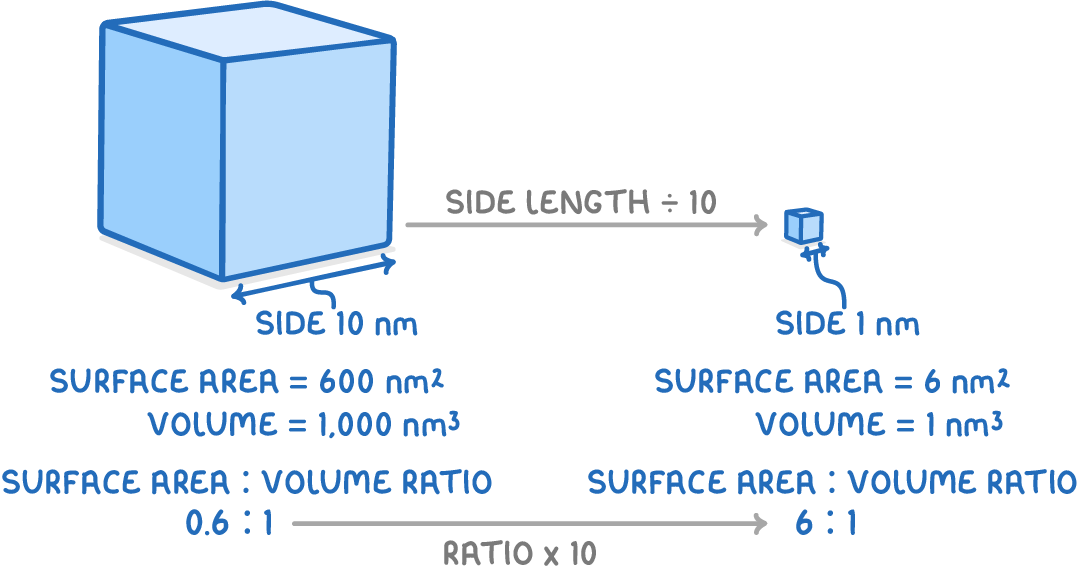
Why this matters
- Because so much of a nanoparticle is exposed at its surface, a much higher proportion of its atoms can interact with surroundings.
- Nanoparticles can show different properties from the same material in bulk - including reactivity, strength, or electrical conductivity.
- A much smaller mass of nanoparticulate material is often needed to achieve the same effect as bulk material (e.g. as catalysts).
Uses and risks of nanoparticles
Nanoparticles have a very high surface area to volume ratio, meaning smaller quantities are often needed compared to bulk materials.
Uses of nanoparticles
- Catalysts - Far less material is needed to expose the same reactive surface area.
- Medicine - Nanoparticles are absorbed into the body more readily and can deliver drugs directly to target cells.
- Electronics - Used in miniature electrical circuits and computer chips because some conduct electricity efficiently.
- Cosmetics and sun creams - Titanium dioxide nanoparticles provide better UV protection and skin coverage without leaving a visible white mark.
- Antibacterial products - Silver nanoparticles have antibacterial properties and are added to wound dressings, surgical masks, and deodorants.
- Composite materials - Added to materials to make them stronger and lighter without significantly adding mass.
Risks of nanoparticles
- The long-term health and environmental effects are not yet fully understood.
- Their high reactivity and tiny size may allow them to:
- Pass through the skin and enter the bloodstream, where they could damage cells in the body.
- Cause lung damage or inflammation if inhaled.
- Accumulate inside living organisms rather than breaking down safely.
- Wash into waterways and damage aquatic ecosystems.
- Because these risks aren't fully known, products containing nanoparticles require careful safety testing and clear labelling.
TermDefinition
NanoparticleA structure between 1 and 100 nanometres across, containing roughly a few hundred atoms.
NanometreA unit of length equal to one billionth of a metre.
Fine particlesTiny solid particles in the air (particulate matter) with a diameter between 100 and 2,500 nanometres.
Coarse particlesParticulate matter (tiny solid particles in the air) with a diameter between 2,500 and 10,000 nanometres, often called dust.
Surface area to volume ratioThe size of an object's outer surface compared with the amount of space inside it.
Key points to remember
How were these notes?