6.2 - Group 7 - The Halogens
The halogens and their trends
- The elements in Group 7 are non-metals called the halogens.
- Every halogen atom has seven electrons in its outer shell, so they all have similar chemical properties.
- Halogens exist as diatomic molecules (pairs of atoms joined by a single covalent bond): F2, Cl2, Br2, I2.
- All halogens are toxic and are handled in a fume cupboard.
Appearance at room temperature
- Fluorine (F2) - Pale yellow gas.
- Chlorine (Cl2) - Pale yellow-green gas.
- Bromine (Br2) - Red-brown liquid that gives off an orange vapour.
- Iodine (I2) - Dark grey crystalline solid that sublimes to a purple vapour when heated.
Trends going down the group
- Melting and boiling points increase - The state at room temperature changes from gas (fluorine, chlorine) to liquid (bromine) to solid (iodine).
- Relative molecular mass and density increase - Each halogen molecule is heavier than the one above it.
- Colour darkens - From pale yellow to dark grey/black.
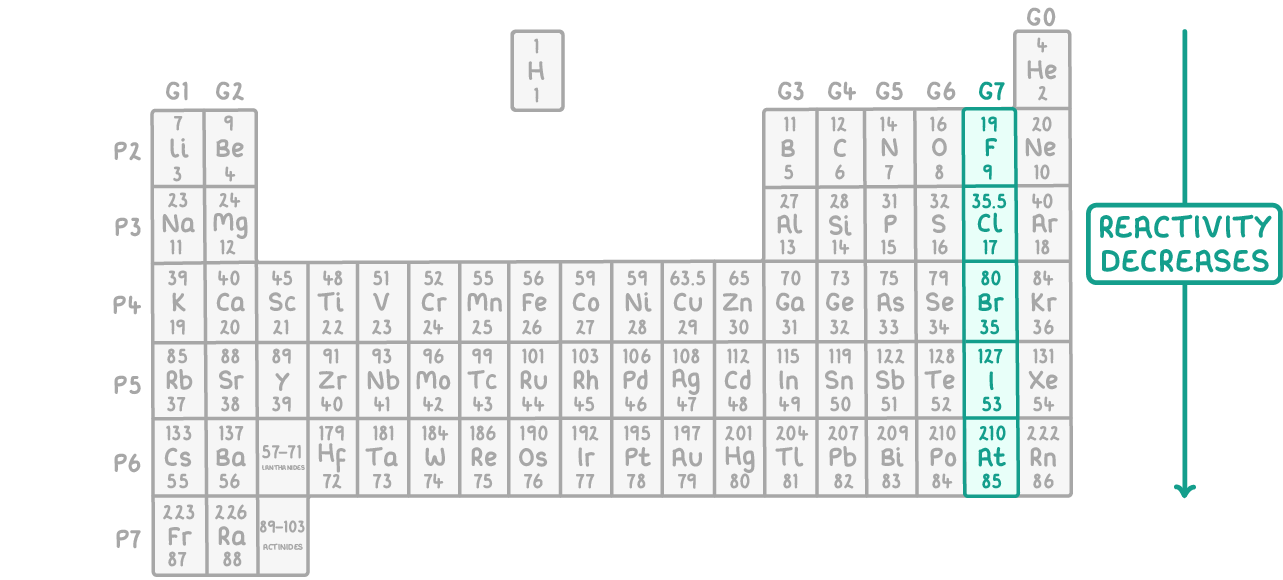
- Reactivity decreases - Fluorine at the top is the most reactive, and astatine at the bottom is the least reactive.
Predicting properties of an unknown halogen
Because properties change steadily down the group, you can predict unknown properties from the trend: Astatine is below iodine, so it is predicted to be a black solid with a higher melting point and lower reactivity than iodine.
Why reactivity decreases down Group 7
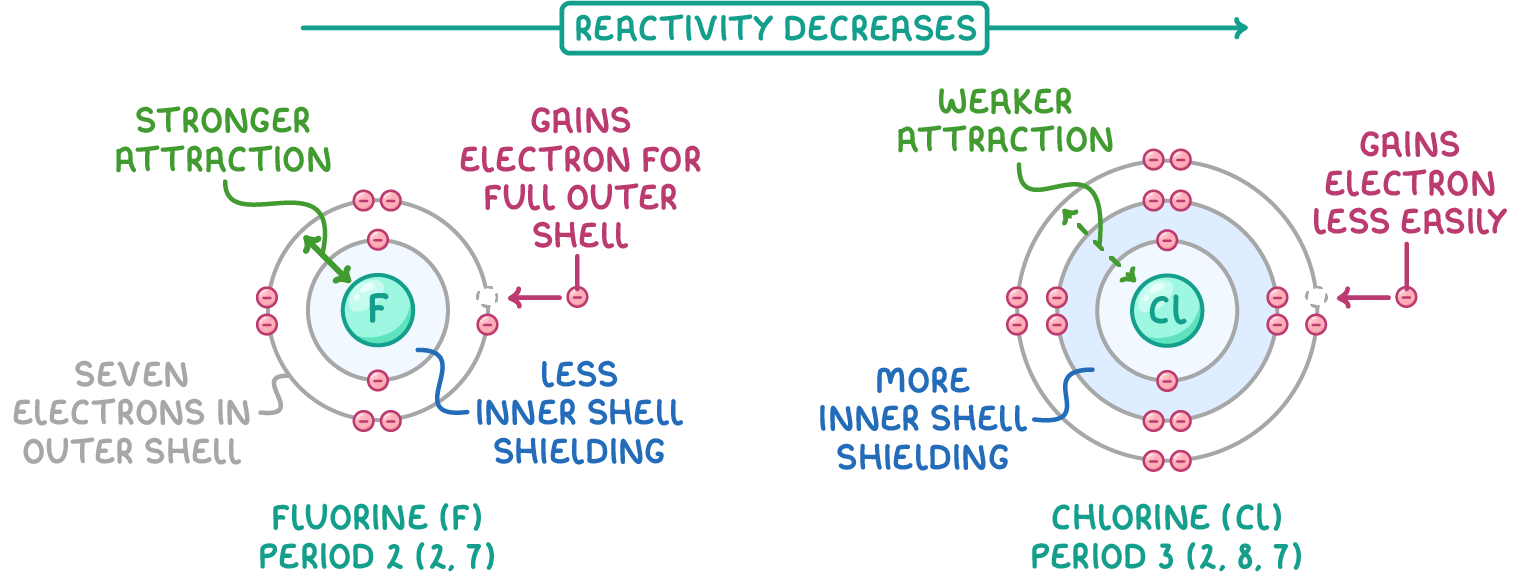
- A halogen atom has seven outer electrons and reacts by gaining one electron to form a stable 1- halide ion.
- The more easily an atom attracts an incoming electron into its outer shell, the more reactive the halogen is.
Two factors make it harder to attract an electron down the group
- Atomic radius increases - Down the group, atoms have more electron shells, so the outer shell is further from the nucleus. The electrostatic attraction between the positive nucleus and the incoming electron is weaker.
- Shielding increases - There are more inner electron shells between the nucleus and the outer shell, which shield the incoming electron from the attraction of the nucleus.
Conclusion
Down Group 7, the incoming electron is attracted less strongly and gained less easily, so reactivity decreases. Fluorine attracts an electron most easily and is the most reactive.
The reactions of the halogens
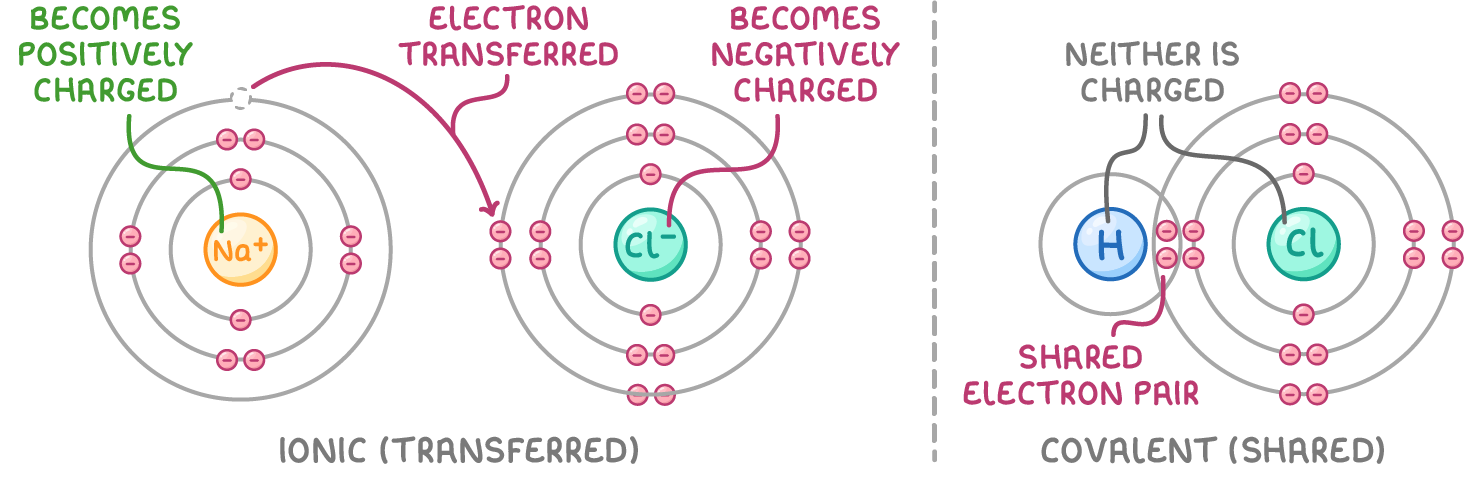
- Halogens react with metals to form metal halides.
- The halogen atom gains one electron to form a 1- halide ion (F-, Cl-, Br-, I-).
- The metal atom loses electrons to form a positive ion, so the resulting compound is ionic.
- Metal halides are typically white solids.
Reactions with alkali metals
Halogens react vigorously with Group 1 alkali metals to form ionic salts:
2Na(s) + Cl2(g) → 2NaCl(s) sodium + chlorine → sodium chloride
2K(s) + Br2(l) → 2KBr(s) potassium + bromine → potassium bromide
Reactions with hydrogen
- Halogens react with hydrogen to form hydrogen halides (HF, HCl, HBr, HI).
- These are covalent, simple molecular compounds:
- H2(g) + Cl2(g) → 2HCl(g)
- hydrogen + chlorine → hydrogen chloride
Hydrogen halides are gases that dissolve in water to form acidic solutions (for example, hydrogen chloride dissolves to form hydrochloric acid).
Displacement reactions of the halogens
A displacement reaction occurs when a more reactive halogen displaces a less reactive halogen from an aqueous solution of its halide salt.
Testing halogen reactivity
Adding an aqueous halogen solution to an aqueous halide solution produces a colour change if displacement occurs:
| Reactants | KCl solution (colourless) | KBr solution (colourless) | KI solution (colourless) |
|---|---|---|---|
| Chlorine water | No reaction | Orange solution (Br2 formed) | Brown solution (I2 formed) |
| Bromine water | No reaction | No reaction | Brown solution (I2 formed) |
| Iodine solution | No reaction | No reaction | No reaction |
Key equations
- Chlorine displaces bromine:
- chlorine + potassium bromide → bromine + potassium chloride
- Cl2(aq) + 2KBr(aq) → Br2(aq) + 2KCl(aq)
- Chlorine displaces iodine:
- chlorine + potassium iodide → iodine + potassium chloride
- Cl2(aq) + 2KI(aq) → I2(aq) + 2KCl(aq)
- Bromine displaces iodine:
- bromine + potassium iodide → iodine + potassium bromide
- Br2(aq) + 2KI(aq) → I2(aq) + 2KBr(aq)
These results confirm that reactivity decreases down the group: chlorine > bromine > iodine.
Displacement as a redox reaction
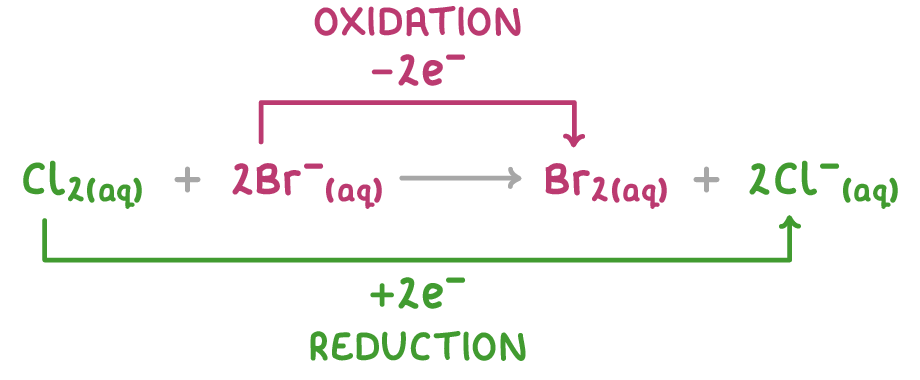
Halogen displacement reactions are redox reactions involving electron transfer. Looking at the ionic equation for chlorine displacing bromide:
Cl2(aq) + 2Br-(aq) → Br2(aq) + 2Cl-(aq)
- Chlorine is reduced - Each chlorine atom gains an electron to form a chloride ion (Cl2 + 2e- → 2Cl-).
- Bromide is oxidised - Each bromide ion loses an electron to form bromine (2Br- → Br2 + 2e-).