5.4 - Titrations
What a titration is, and the equipment
- A titration finds the volume of one solution that reacts exactly with a measured volume of another.
- For an acid and an alkali, it finds how much acid neutralises a known volume of alkali, or how much alkali neutralises a known volume of acid.
- One of the two solutions is a standard solution - a solution whose concentration has been worked out accurately beforehand.
- The titration measures the volume of the other solution that reacts with it, so the unknown concentration can be calculated.
Apparatus
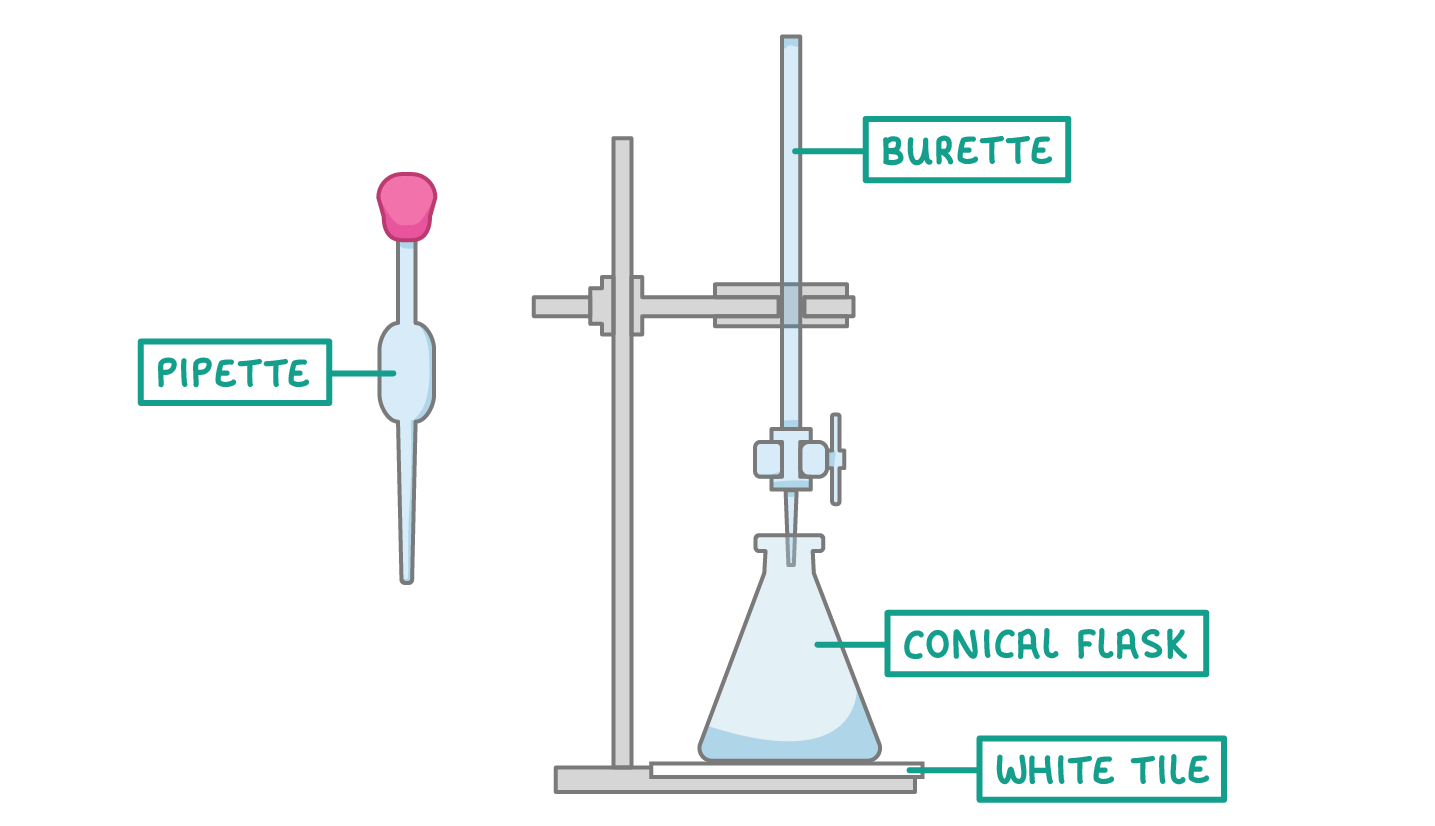
- Volumetric pipette - Measures out one fixed volume very accurately (e.g. 25.0 cm3). It's filled using a pipette filler, never by mouth.
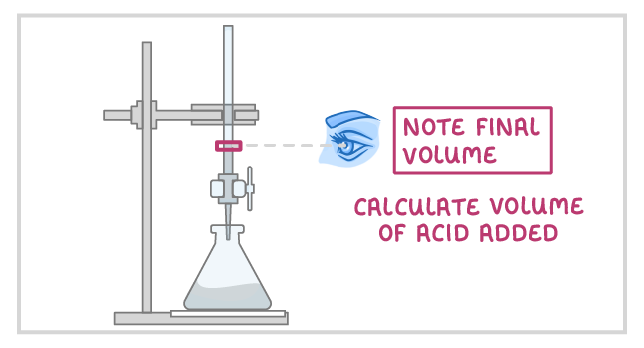
- Burette - Measures whatever volume is run out of it, and its tap lets solution be added a drop at a time. Every reading is taken at eye level from the bottom of the meniscus.
- Conical flask - Holds the solution the pipette delivers; its shape lets the contents be swirled without splashing.
- White tile - Placed under the flask to make the colour change much easier to see.
The titration method
A titration can be run with either the acid or the alkali in the conical flask. In the steps below, the alkali is in the flask and the acid is added from the burette.
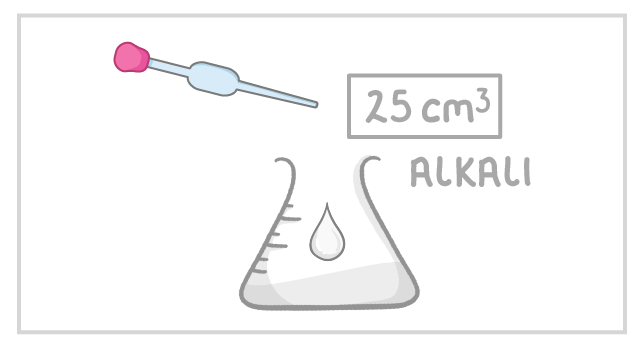
- Use the pipette to add 25.0 cm3 of alkali to a clean conical flask.
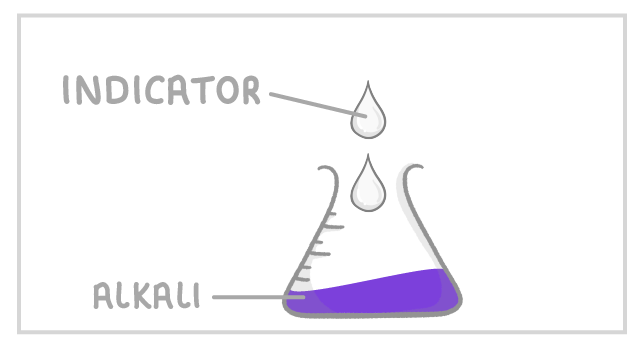
- Add a few drops of indicator, and stand the conical flask on a white tile.
- Fill the burette with acid and record the initial reading.
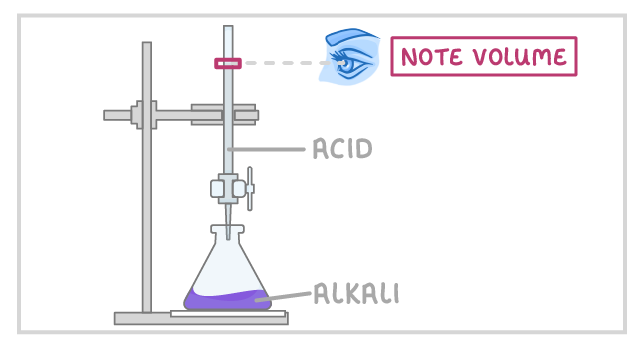
- Add the acid from the burette to the alkali in the conical flask, swirling the flask throughout to mix.
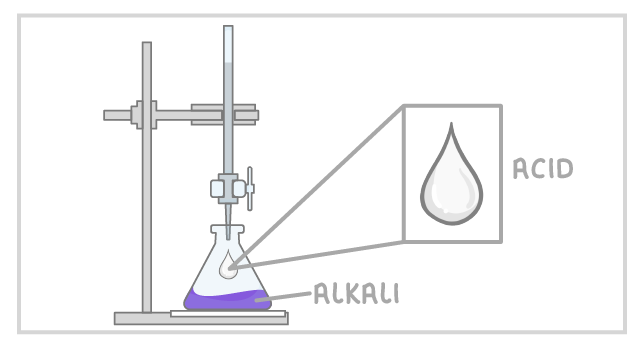
- Close the tap as soon as the end point is reached - the acid has just neutralised the alkali and the indicator changes colour.
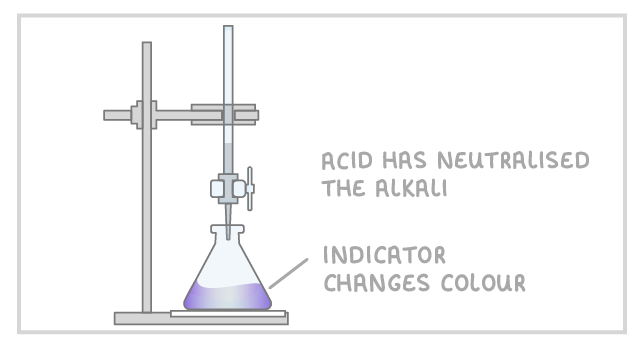
- Record the final reading. The volume of acid added is the titre (final reading minus initial reading).
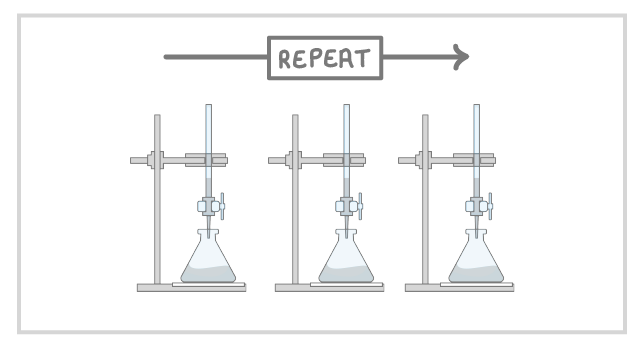
- Repeat until you get concordant titres (within 0.1 cm3 to 0.2 cm3 of each other), then calculate their mean.
Why repeating matters
- The first run is a rough titration, to find roughly where the end point is. On later runs, the acid is added quickly to within a couple of cm3 of the rough titre, then drop by drop. Its titre isn't used in the mean.
- Repeating the titration and averaging the concordant runs reduces the effect of random errors, giving a mean titre closer to the true value.
- Any anomalous run that doesn't agree stands out and can be discarded.
Indicators and the end point
- The reaction gives no visible sign of its own that it has finished, so an indicator is added to the flask.
- The end point is the point at which the indicator just changes colour - the acid has exactly neutralised the alkali, with no excess of either.
Choosing an indicator
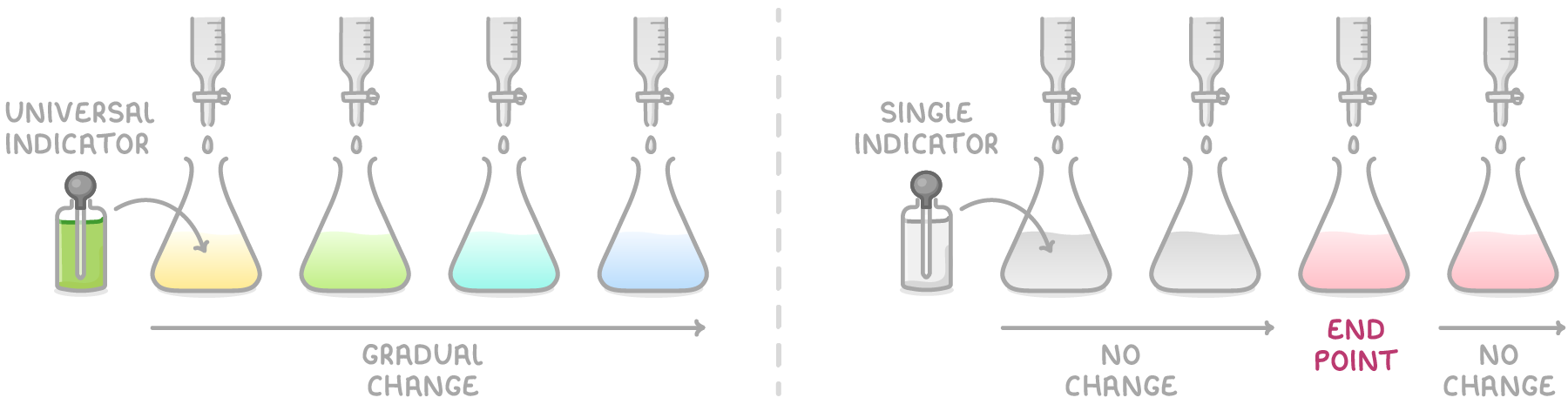
- A titration indicator must give a sharp, sudden colour change at a single point, on the addition of one drop.
- Universal indicator is not used in titrations because it's a mixture of dyes that changes colour gradually across a wide pH range, making it impossible to identify an exact end point.
- Suitable single indicators include methyl orange (red in acid, yellow in alkali) and phenolphthalein (colourless in acid, pink in alkali). Thymolphthalein (colourless in acid, blue in alkali) works the same way.
- Only a single indicator is used, because two dyes changing at slightly different points would smear the change across a range of volumes.
TermDefinition
TitrationA technique that finds the volume of one solution that reacts exactly with a measured volume of another.
Standard solutionA solution whose concentration has been worked out accurately beforehand.
TitreThe volume of solution delivered from a burette during a titration.
ConcordantDescribes titration results (titres) that agree closely with each other, usually to within 0.10 cm3 to 0.20 cm3.
End pointThe point at which a reaction is just complete. In a titration it is shown by the indicator just changing colour.
Key points to remember
How were these notes?