7.4 - Acidic, Basic & Amphoteric Oxides
Acidic and basic oxides
- An oxide is a compound of an element with oxygen.
- Metal oxides are basic - They neutralise acids to form a salt and water (e.g. CuO, CaO, MgO).
- Most non-metal oxides are acidic - They neutralise alkalis to form a salt and water (e.g. CO2, SO2).
- An element's position in the periodic table predicts the type of oxide it forms: metals on the left form basic oxides, while non-metals on the right form acidic oxides.

Solubility and pH
- An oxide only shows an acidic or alkaline pH if it dissolves in water.
- Most basic oxides are insoluble in water (e.g. CuO, MgO), so they don't form alkaline solutions, but they still neutralise acids.
- Soluble metal oxides react with water to form alkaline solutions:
- metal oxide + water → metal hydroxide
- Na2O(s) + H2O(l) → 2NaOH(aq)
Soluble non-metal oxides react with water to form acidic solutions:
CO2(g) + H2O(l) → H2CO3(aq)
Amphoteric oxides
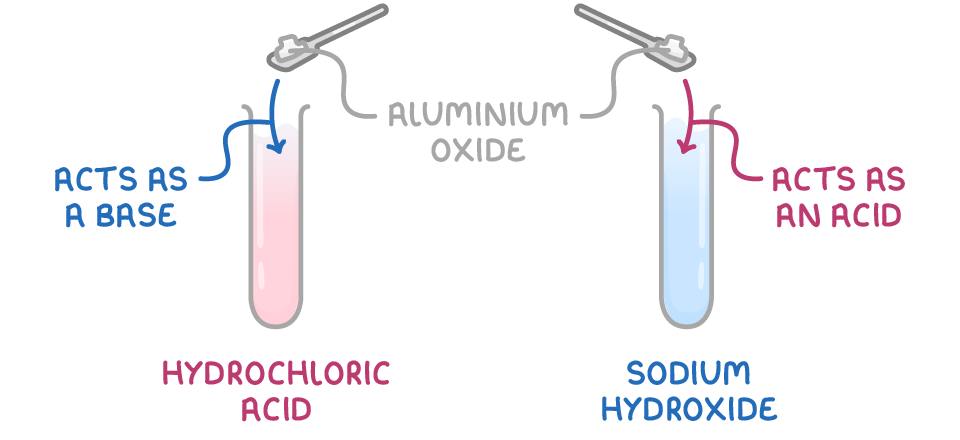
- An amphoteric oxide reacts with both acids and bases to produce a salt and water.
- The two main examples are aluminium oxide (Al2O3) and zinc oxide (ZnO).
Aluminium oxide
- Reacting with an acid (behaving as a base):
- Al2O3(s) + 6HCl(aq) → 2AlCl3(aq) + 3H2O(l)
- Reacting with a base (behaving as an acid):
- Al2O3(s) + 2NaOH(aq) → 2NaAlO2(aq) + H2O(l)
Position in the periodic table
- Zinc oxide is also amphoteric and reacts with acids and bases in the same way.
- Amphoteric oxides are formed by some metals, such as aluminium and zinc.
TermDefinition
OxideA compound of oxygen with one other element.
Basic oxideA metal oxide that neutralises acids to form a salt and water. Those that dissolve in water give alkaline solutions.
Acidic oxideA non-metal oxide that neutralises bases to form a salt and water. Those that dissolve in water give acidic solutions.
Amphoteric oxideAn oxide that reacts with both acids and bases to produce a salt and water.