11.8 - Carboxylic Acids
The carboxylic acids
- Carboxylic acids are a homologous series - a family built on the same pattern: they share a general formula, each member differs from the next by a CH2 unit, and they all have similar chemical properties.
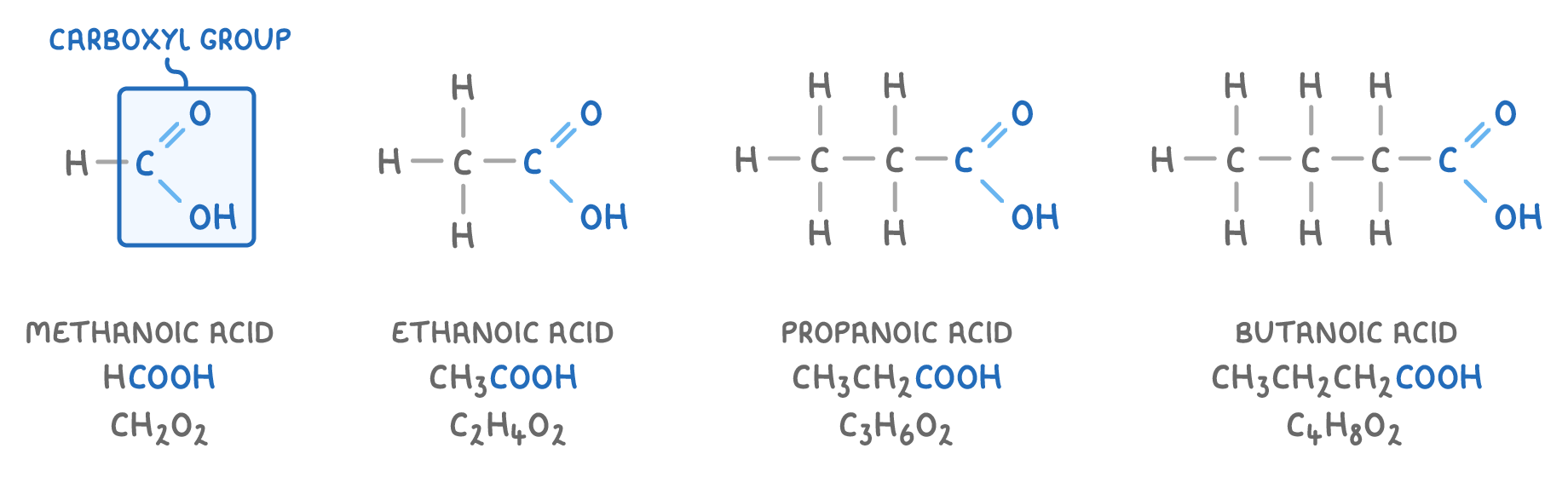
- They all share the functional group -COOH, the carboxyl group:
- A carbon atom joined to two oxygen atoms - one by a double bond, the other by a single bond.
- That second oxygen carries a hydrogen atom on a single bond.
- The carbon uses its fourth bond to join to the rest of the chain.
- It's the hydrogen atom on that oxygen that makes the compound an acid.
Naming carboxylic acids
- All names end in -oic acid, and the prefix says how many carbon atoms the molecule has: meth- (1), eth- (2), prop- (3), but- (4).
- The carbon atom in the carboxyl group is counted in - Ethanoic acid has two carbon atoms in all, one of them the carbon of the COOH.
The first four members
- Written on one line, the four atoms of the group are kept together at the end as COOH, so the group can be seen at a glance.
- The molecular formula gives the totals and hides the group. For example, C2H5COOH and C3H6O2 are the same molecule written two different ways.
- All four acids are liquids at room temperature and pressure.
Where they turn up
- Vinegar is a dilute solution of ethanoic acid in water, which gives it its sharp taste and smell.
- Carboxylic acids are used in foods (as flavours and preservatives) and in personal care products such as soaps.
What carboxylic acids do
- Carboxylic acids are a family of organic acids. A solution of one behaves the way any other acid solution behaves.
- When dissolved in water, a carboxylic acid forms an acidic solution.
- It's acidic because the acid releases hydrogen ions, H+, into the water.
- Because it contains hydrogen ions, the solution has a pH below 7 and turns universal indicator red, orange or yellow.
The salts these acids make, and how they are named
- Reactions of carboxylic acids produce a salt, where the acidic hydrogen is replaced by a metal ion:
- The first part of the name is the metal.
- The second part comes from the acid, with -oic acid replaced by -oate (e.g. ethanoic acid makes ethanoates).
- The salt is an ionic compound containing a carboxylate ion, such as the ethanoate ion, CH3COO-:
- Sodium ethanoate is CH3COONa (or NaCH3COO) - one Na+ balances one CH3COO-.
- Magnesium ethanoate is (CH3COO)2Mg - One Mg2+ requires two CH3COO- ions.
Reaction with a metal
Adding a metal to a carboxylic acid solution produces bubbles of gas and an increase in temperature:
carboxylic acid + metal → a salt + hydrogen
ethanoic acid + magnesium → magnesium ethanoate, (CH3COO)2Mg, + hydrogen
The hydrogen gas burns with a squeaky pop.
Reaction with a carbonate
Adding a carbonate to a carboxylic acid solution produces fizzing as the solid dissolves:
carboxylic acid + carbonate → a salt + water + carbon dioxide
ethanoic acid + sodium carbonate → sodium ethanoate, CH3COONa, + water + carbon dioxide
The carbon dioxide gas turns limewater milky.
Reaction with a base
Neutralising a carboxylic acid with a metal oxide or metal hydroxide releases heat without producing gas:
carboxylic acid + metal oxide (or hydroxide) → a salt + water
ethanoic acid + sodium hydroxide → sodium ethanoate, CH3COONa, + water
What the three reactions have in common
- A metal gives a salt and hydrogen. A base gives a salt and water. A carbonate gives a salt, water and carbon dioxide.
- These are the standard reactions of any acid.