11.13 - Naturally Occurring Polymers
Amino acids and the protein chain
A protein is a naturally occurring polymer, and its monomers are amino acids.
The structure of an amino acid
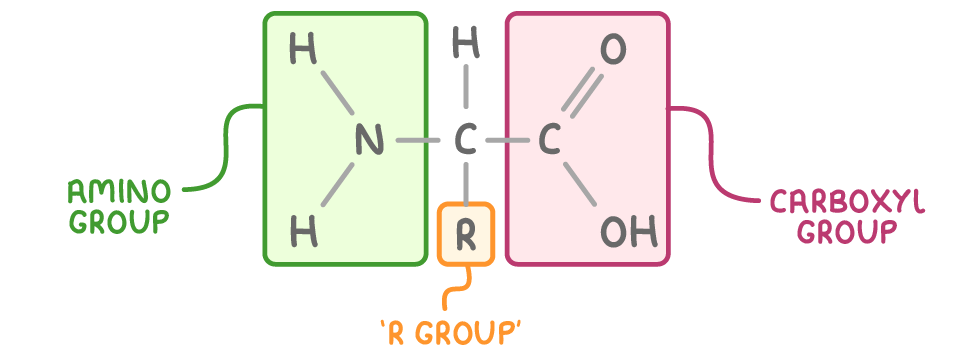
- An amino acid carries two different functional groups:
- An amino group, -NH2, which is basic.
- A carboxyl group, -COOH, which is acidic.
- Between the two groups sits a central carbon atom, bonded to a hydrogen atom and a side chain (R group).
- Every amino acid follows this pattern, differing only in its side chain.
- The simplest amino acid is glycine, whose side chain is a single hydrogen atom (H2NCH2COOH).
How amino acids join into a chain
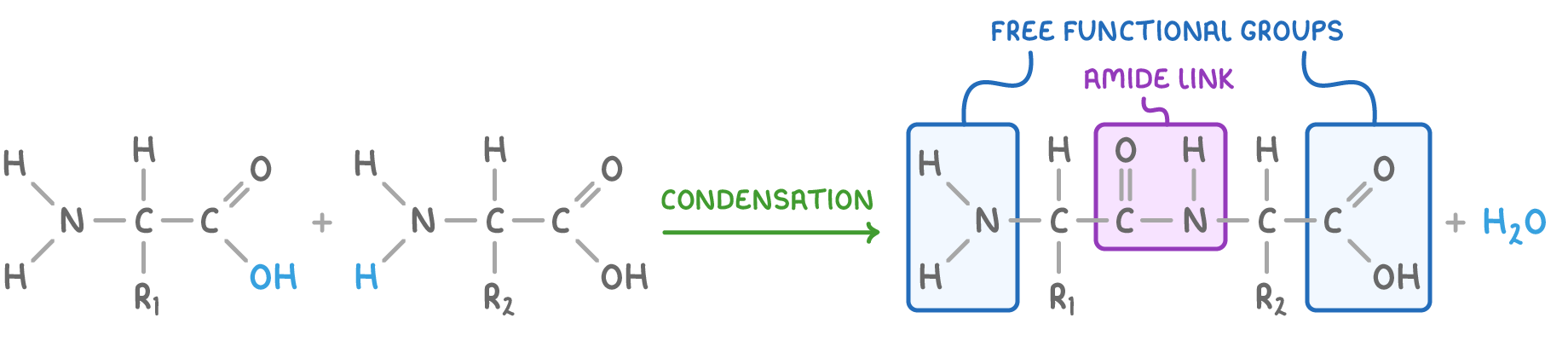
Amino acids join by condensation polymerisation:
- The carboxyl group of one amino acid reacts with the amino group of the next.
- The -OH of the carboxyl group and a hydrogen atom from the amino group are lost together as a molecule of water.
- A covalent bond forms between the carbon atom of the carboxyl group and the nitrogen atom of the amino group.
- Each end of the joined molecule still has a free functional group, allowing more amino acids to join on and extend the chain.
Amide links and the polypeptide chain
- The link formed between the carbon atom and the nitrogen atom is called an amide link (or peptide link).
- A polymer held together by amide links is a polyamide, making proteins natural polyamides.
- A chain of joined amino acids is called a polypeptide, and a protein is made of one or more polypeptide chains.
- Combining different amino acids in different orders gives proteins their specific structures and functions.
TermDefinition
ProteinA naturally occurring polymer built from amino acid monomers.
Amino acidA small molecule that acts as the monomer for proteins.
PolypeptideA polymer chain made of joined amino acids.