3.12 - Water of Crystallisation
Hydrated and anhydrous substances
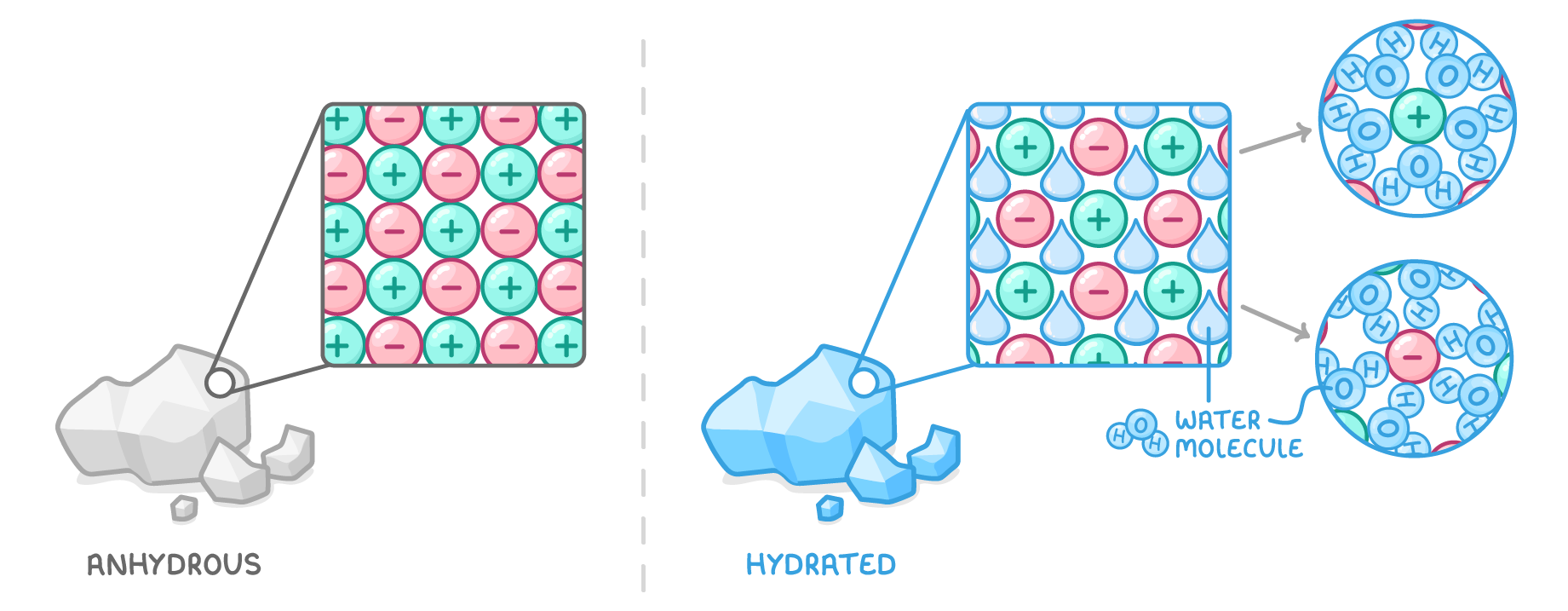
- Some solids have water built into their crystals. In these solids, water molecules are fitted into the lattice alongside the ions.
- Each water molecule is attracted to the surrounding ions and held in place.
- The water isn't damp on the surface - it's chemically combined as a fixed part of the solid.
Hydrated vs anhydrous
- Hydrated - A substance whose crystals contain water of crystallisation.
- Anhydrous - A substance containing no water at all.
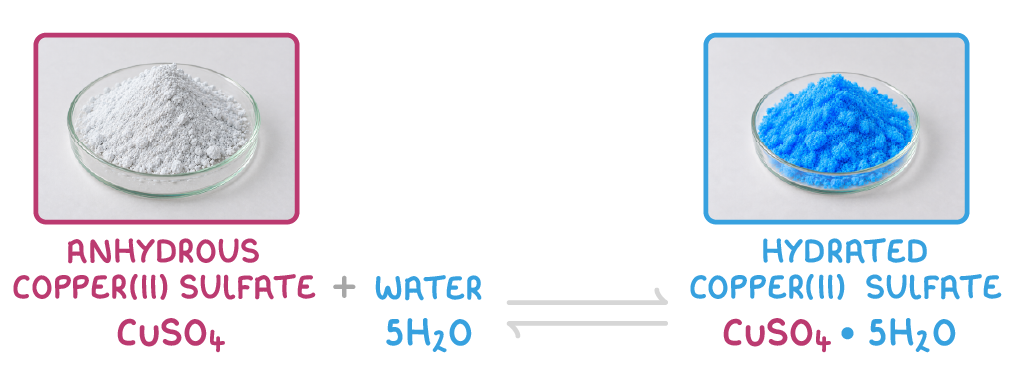
- Hydrated and anhydrous copper(II) sulfate are the same salt, with and without that water: the hydrated form is blue and the anhydrous form is white.
Water counts towards the mass
Because the water is part of the solid, it's included in the mass of the crystals when weighed on a balance.
Water of crystallisation and the dot notation
- Water held in a crystal lattice is called water of crystallisation.
- One mole of a hydrated substance always holds a fixed whole number of moles of water, recorded after a dot in the formula.
- Hydrated copper(II) sulfate is CuSO4·5H2O - five moles of water for every one mole of copper(II) sulfate.
- That number is the degree of hydration:
- Cobalt(II) chloride, CoCl2·6H2O → degree of hydration 6
- Barium chloride, BaCl2·2H2O → degree of hydration 2
- Anhydrous barium chloride, with no water of crystallisation, is BaCl2
Water in the relative formula mass
- Water of crystallisation counts towards the compound's relative formula mass ().
- Add up the relative atomic masses from the periodic table, reading the dot as "plus that many lots of H2O".
- For CuSO4·5H2O (: Cu = 64, S = 32, O = 16, H = 1):
The percentage by mass of water is found by dividing the mass of the water () by the total , then multiplying by 100:
The degree of hydration from a mass loss
- Driving all the water out gives the mass of the anhydrous salt left and the mass of the water lost.
- Use these masses to find the degree of hydration () in a formula like MgSO4·H2O by converting them into moles.
The five steps
Step 1 - Calculate the mass of anhydrous salt and the mass of water lost by subtracting the container's mass from the readings.
Step 2 - Calculate the amount of water in moles:
Step 3 - Calculate the amount of anhydrous salt in moles:
Step 4 - Divide the amount of water by the amount of anhydrous salt to find :
Step 5 - Round to the nearest whole number and write it into the formula.
Points to watch
- The in Step 3 is for the anhydrous salt, worked out from the anhydrous formula.
- Round to the nearest whole number in Step 5 to account for small experimental errors.
- If given percentage compositions instead of masses, divide each percentage by its corresponding .
Worked example - Finding n in a hydrate
A sample of hydrated sodium sulfate, Na2SO4·nH2O, is heated in a crucible to constant mass, leaving anhydrous sodium sulfate, Na2SO4. Use the masses below to find n and write the formula of the hydrated salt.
| Reading | Mass |
|---|---|
| Empty crucible | 20.000 g |
| Crucible and Na2SO4·nH2O | 36.046 g |
| Crucible and Na2SO4, after heating to constant mass | 27.100 g |
Step 1 - Mass of anhydrous salt and water lost
Mass of Na2SO4·nH2O = 36.046 - 20.000 = 16.046 g
Mass of Na2SO4 = 27.100 - 20.000 = 7.100 g
Mass of water = 16.046 - 7.100 = 8.946 g
Step 2 - Amount of water
of H2O = (2 × 1) + 16 = 18
Step 3 - Amount of anhydrous salt
of Na2SO4 = (2 × 23) + 32 + (4 × 16) = 142
Step 4 - Divide to find n
Step 5 - Round and write the formula
Rounding 9.94 to the nearest whole number gives 10.
So n = 10, and the formula of the hydrated salt is Na2SO4·10H2O.