4.8 - Strong & Weak Acids
Strong and weak acids
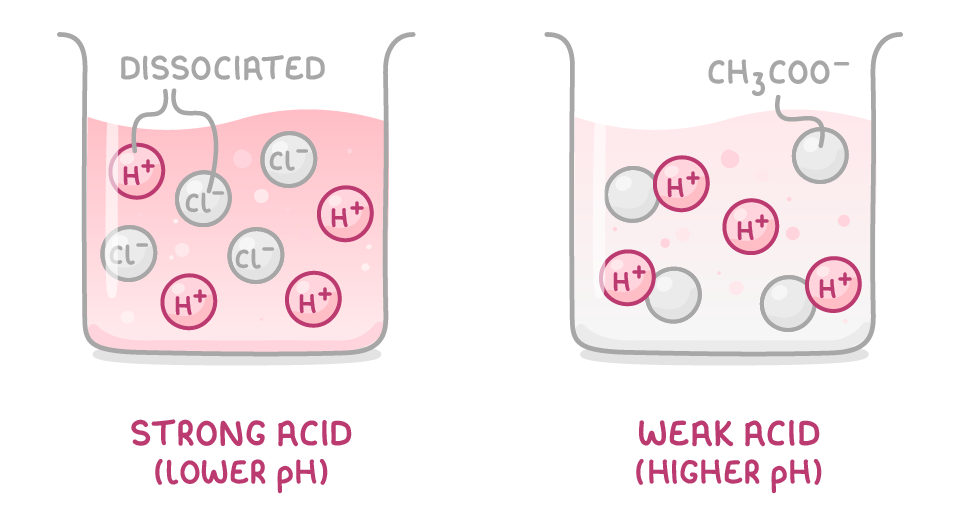
When an acid dissolves in water its particles ionise (dissociate): they split up and release hydrogen ions, H+, into the solution.
Strong acids
- A strong acid is completely ionised in aqueous solution. Every particle dissociates into ions.
- Examples: hydrochloric, nitric, and sulfuric acids.
- HCl(aq) → H+(aq) + Cl-(aq)
Weak acids
- A weak acid is only partially ionised in aqueous solution. Only a small proportion of its particles dissociate into ions.
- Examples: ethanoic, citric, and carbonic acids.
- CH3COOH(aq) ⇌ H+(aq) + CH3COO-(aq)
The reversible arrow (⇌) shows the ionisation is reversible: only a small fraction of the acid dissociates, setting up an equilibrium where most acid molecules stay whole.
Comparing strong and weak acids at the same concentration
- pH - A strong acid has a higher concentration of H+ ions, so it has a lower pH (around pH 0 to 2 for strong acids, pH 2 to 6 for weak acids).
- Rate of reaction - With more H+ ions in solution, a strong acid reacts faster. For example, magnesium fizzes vigorously in hydrochloric acid, but more slowly in ethanoic acid of the same concentration.
Concentration against strength
Strong/weak and concentrated/dilute describe different things:
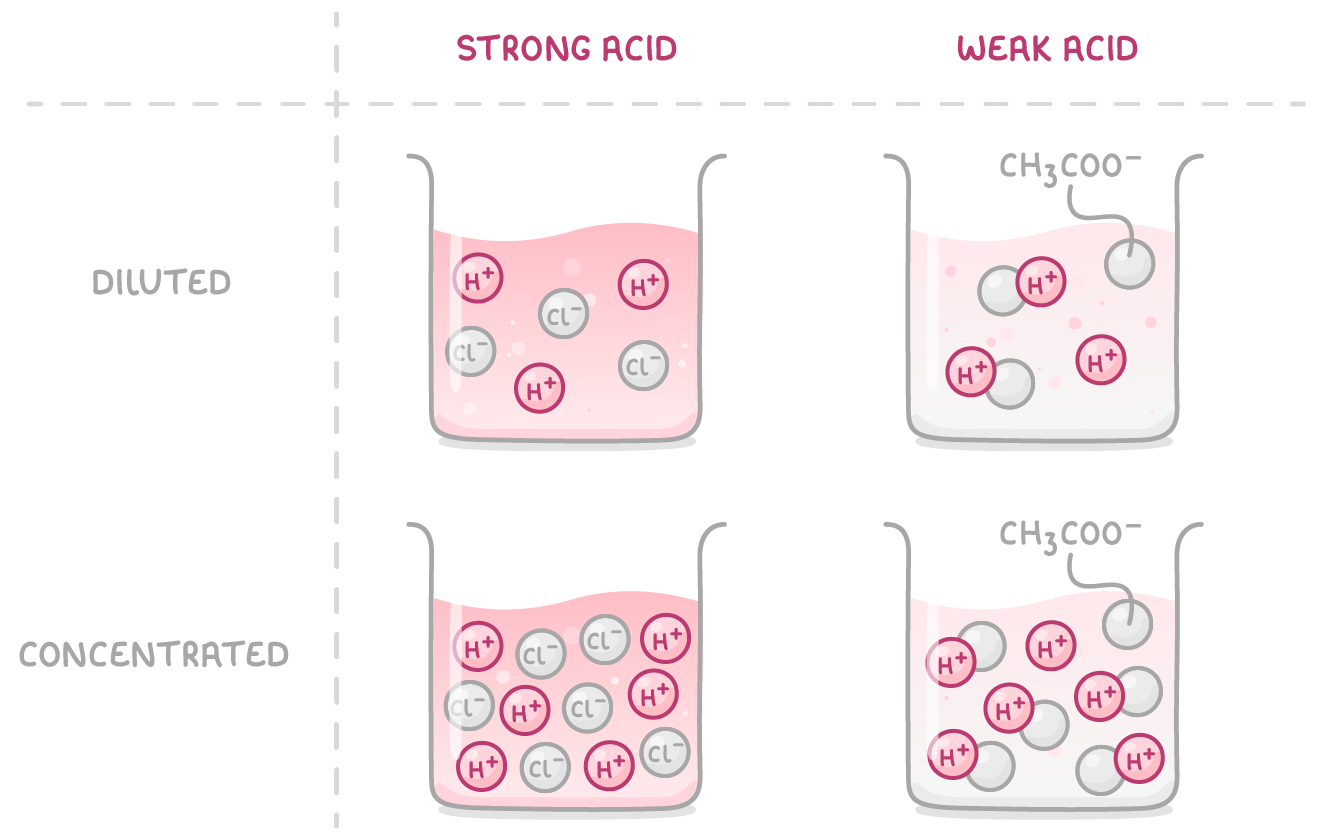
- Strength is the proportion of dissolved acid molecules that ionise in water. It is a property of the acid itself and does not change when water is added.
- Concentration is the amount of acid dissolved in a given volume of solution.
The two are independent
- All four combinations exist: dilute strong, concentrated strong, dilute weak, and concentrated weak.
- Ethanoic acid remains a weak acid even when concentrated, and hydrochloric acid remains a strong acid even when dilute.
Both affect pH
- Both strength and concentration determine the concentration of H+ ions in solution:
- Making any acid more concentrated increases the number of H+ ions in a given volume, so the pH falls.
- A concentrated weak acid can have a lower pH than a very dilute strong acid.
- To compare the strength of two acids by their pH, they must be at the same concentration.
pH and hydrogen-ion concentration
- The pH of a solution is a measure of its hydrogen-ion concentration. The higher the concentration of H+ ions, the lower the pH.
- At pH 7, the concentration of hydrogen ions equals the concentration of hydroxide ions (neutral).
The pH scale is logarithmic
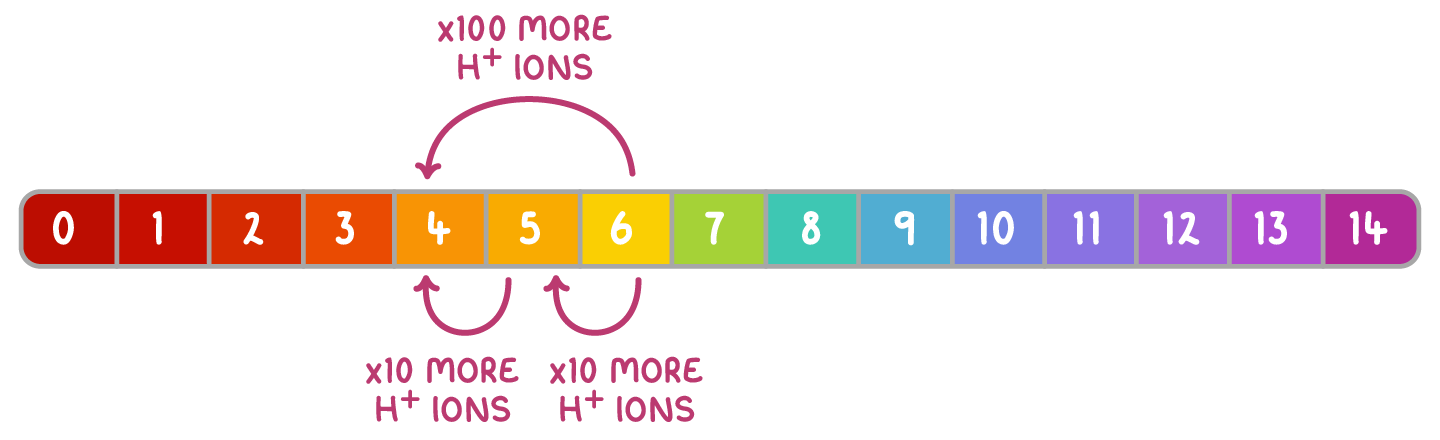
- Each change of 1 on the pH scale represents a tenfold (×10) change in hydrogen-ion concentration.
- If pH falls by 1 unit, the hydrogen-ion concentration increases by a factor of 10.
- If pH rises by 1 unit, the hydrogen-ion concentration decreases to a tenth.
- Changes of more than one unit multiply:
- A fall of 2 pH units = a 100-fold increase (10 × 10)
- A fall of 3 pH units = a 1,000-fold increase (10 × 10 × 10)
Worked example - A change of three pH units
A solution of an acid has a pH of 5. More acid is added and the pH falls to 2. By what factor has the hydrogen-ion concentration changed?
Step 1 - Find the change in pH
- The pH falls by 3 units (from 5 to 2).
- A falling pH means the hydrogen-ion concentration increases.
Step 2 - Calculate the change in hydrogen-ion concentration
A fall of 3 pH units is three tenfold increases:
10 × 10 × 10 = 1,000
Step 3 - State the answer
The hydrogen-ion concentration is 1,000 times greater than it was.
TermDefinition
Strong acid
Weak acid
Strength
Concentration