10.1 - Finite Resources & Sustainability
Natural, finite and renewable resources
- Natural resources come from the Earth, sea, and air.
- They provide food, timber, clothing, and fuels for warmth, shelter, and transport.
- Agriculture provides conditions to grow and harvest natural resources (e.g. crops, livestock, and timber).
- Synthetic products can supplement or replace natural resources:
- Rubber is naturally tapped from tree sap, but synthetic polymers now replace it in tyres.
- Cotton is a natural fibre, and synthetic fibres are used alongside it in clothing.
Renewable vs finite resources
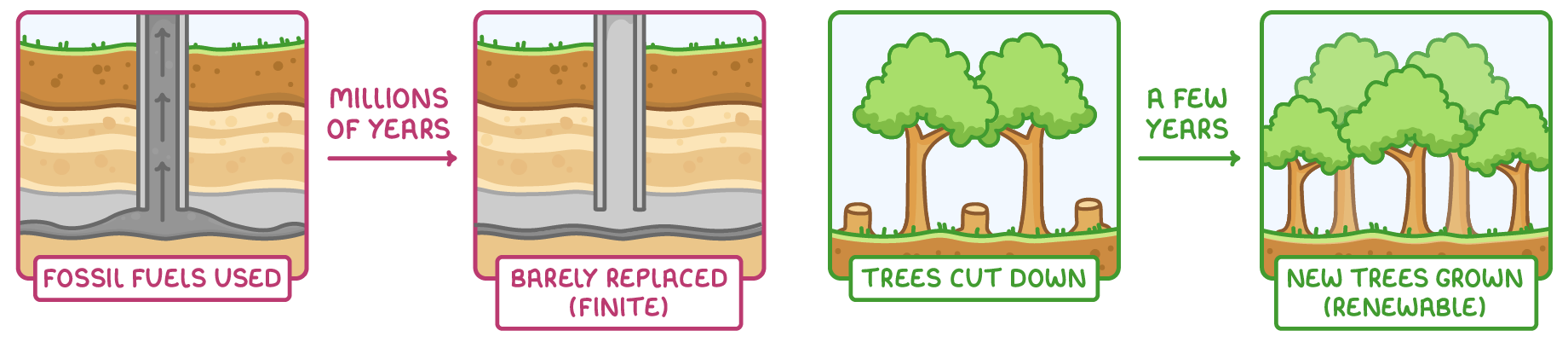
- Renewable resources form at least as fast as they're used, so they will not run out (e.g. timber, fresh water, food crops, solar and wind energy).
- Finite resources (or non-renewable resources) aren't formed quickly enough to replace what is used, so they will eventually run out (e.g. fossil fuels, nuclear fuels, and metal ores dug from the ground).
- Finite resources from the Earth, oceans, and atmosphere are processed to provide energy and useful materials.
Sustainable development
- Sustainable development is development that meets the needs of current generations without compromising the ability of future generations to meet their own needs.
- To be sustainable:
- Finite resources must not be used up so quickly that there's little left for future generations.
- Environmental damage must not be so great that it harms the lives of future generations.
The role of chemistry
- Chemists improve agricultural and industrial processes and develop new products.
- They develop routes that use fewer finite resources, require less energy, and produce less waste and environmental damage.
Worked example - Reading resource data
The table gives data for two natural resources, A and B. Which is renewable, and which is finite?
| Resource | Energy density | Time taken to form |
|---|---|---|
| A | 14.5 to 17.7 MJ/kg | 1 year |
| B | 40.1 to 44.8 MJ/kg | 108 years |
Step 1 - Identify the quantities and units
- Energy density is given in MJ/kg.
- Time taken to form is given in years.
Step 2 - Read off the values
- Resource A: 14.5 to 17.7 MJ/kg, 1 year.
- Resource B: 40.1 to 44.8 MJ/kg, 108 years.
Step 3 - Compare orders of magnitude
An order of magnitude is a factor of 10.
- Resource B takes 108 (100,000,000) years to form.
- Comparing 108 years to 1 year is a difference of eight orders of magnitude.
- Both energy densities are in the tens (the same order of magnitude).
Step 4 - Determine the category for each resource
- A resource taking 1 year to form is replaced as fast as it's used, so it's renewable.
- A resource taking 100,000,000 years to form is used up much faster than it's replaced, so it's finite.
Answer: Resource A is renewable and Resource B is finite.
TermDefinition
Renewable resource
Finite resource
Sustainable development