7.11 - Naturally Occurring Polymers
DNA, a natural polymer
DNA (deoxyribonucleic acid) is a naturally occurring polymer found in every living thing and many viruses, and is essential for life.
Structure of DNA
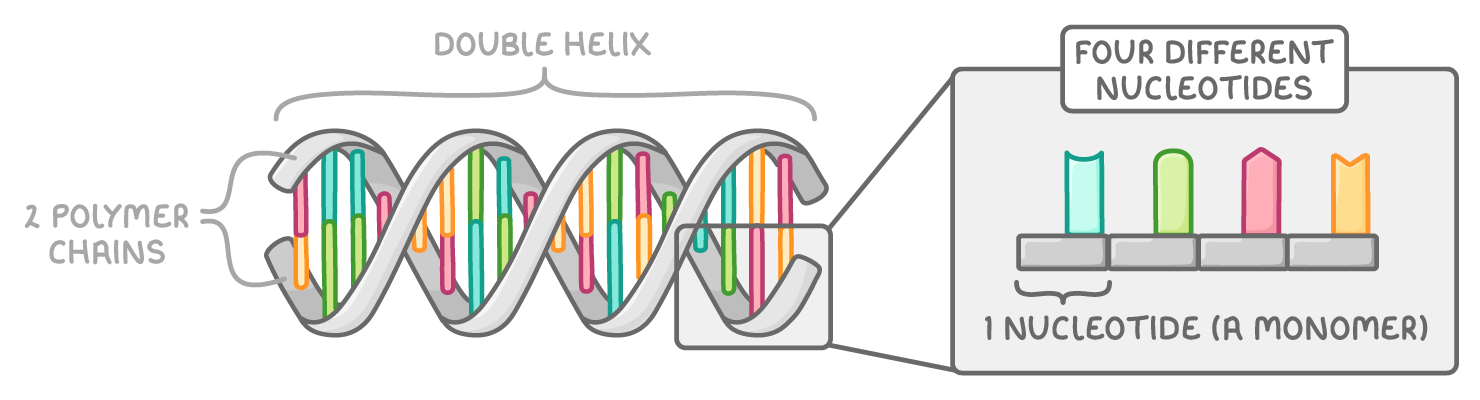
- DNA is built from monomers called nucleotides, and there are four different ones.
- A DNA molecule consists of two polymer chains held together and twisted into a double helix.
- The order of the nucleotides along the chain acts as a code that holds genetic instructions for how a living thing develops and functions.
- A short length of chain carrying one of these instructions is called a gene.
Starch, cellulose and proteins
Polymers built from sugars
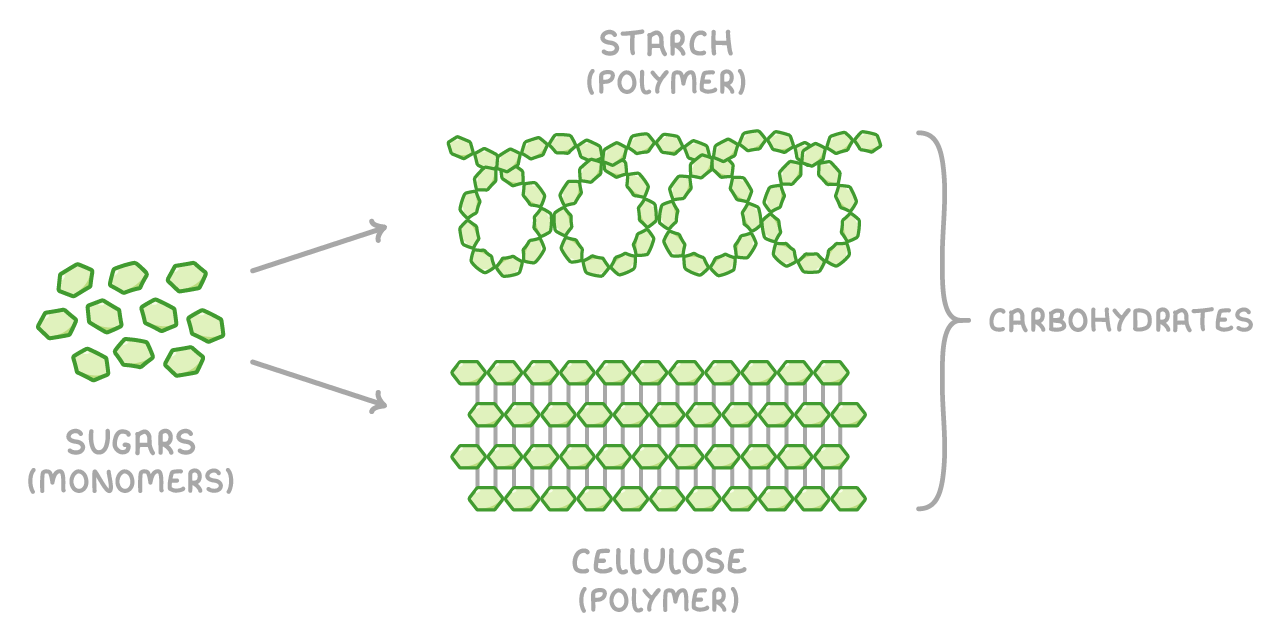
- Sugars are small molecules made of carbon, hydrogen, and oxygen.
- Sugars are carbohydrates, and so are the polymers built by joining many sugar molecules end to end, including:
- Starch - Used by living things to store energy.
- Cellulose - Used to build plant cell walls, giving plants strength and structure.
Polymers built from amino acids
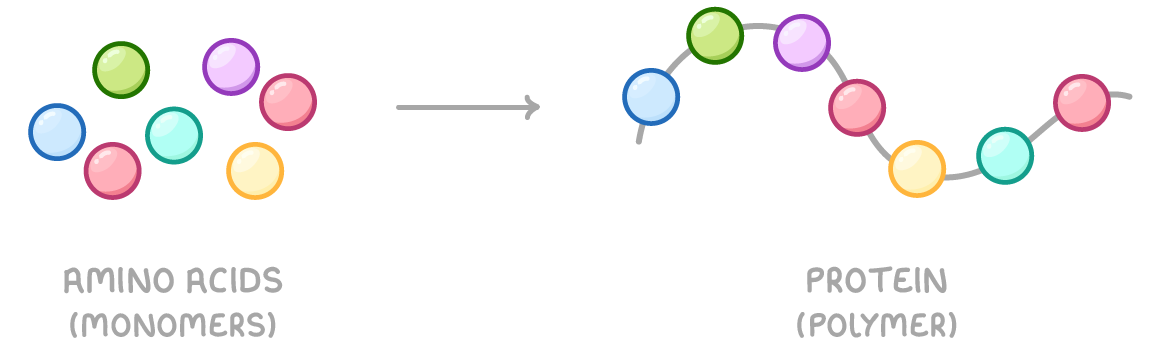
- Amino acids are small molecules that join end to end to form proteins.
- Joining different amino acids in different orders produces many different proteins, which carry out a wide range of functions in living things.
Amino acids and the protein chain
A protein is a naturally occurring polymer, and its monomers are amino acids.
The structure of an amino acid
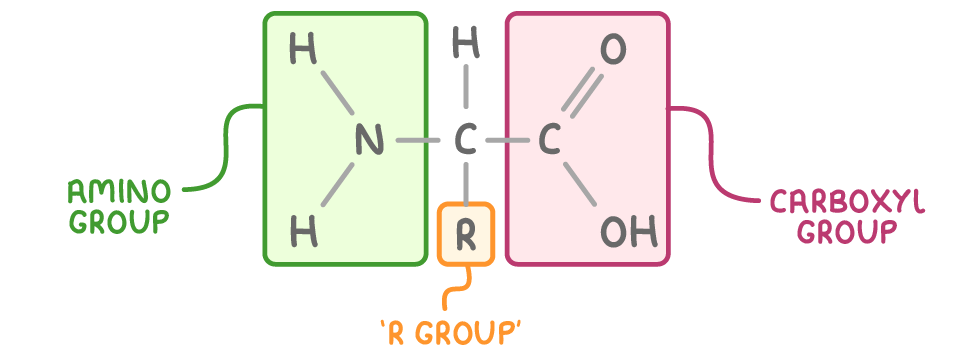
- An amino acid carries two different functional groups:
- An amino group, -NH2, which is basic.
- A carboxyl group, -COOH, which is acidic.
- Between the two groups sits a central carbon atom, bonded to a hydrogen atom and a side chain (R group).
- Every amino acid follows this pattern, differing only in its side chain.
- The simplest amino acid is glycine, whose side chain is a single hydrogen atom (H2NCH2COOH).
How amino acids join into a chain
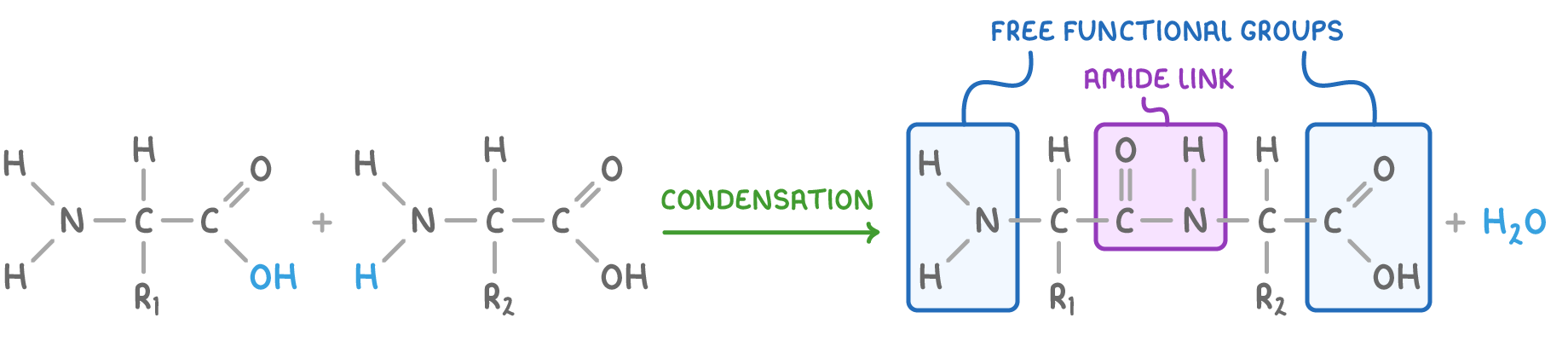
Amino acids join by condensation polymerisation:
- The carboxyl group of one amino acid reacts with the amino group of the next.
- The -OH of the carboxyl group and a hydrogen atom from the amino group are lost together as a molecule of water.
- A covalent bond forms between the carbon atom of the carboxyl group and the nitrogen atom of the amino group.
- Each end of the joined molecule still has a free functional group, allowing more amino acids to join on and extend the chain.
Amide links and the polypeptide chain
- The link formed between the carbon atom and the nitrogen atom is called an amide link (or peptide link).
- A polymer held together by amide links is a polyamide, making proteins natural polyamides.
- A chain of joined amino acids is called a polypeptide, and a protein is made of one or more polypeptide chains.
- Combining different amino acids in different orders gives proteins their specific structures and functions.
TermDefinition
DNA
Nucleotide
Gene
Carbohydrate
Protein
Amino acid
Polypeptide