1.4 - Elements, Compounds & Mixtures
Elements, compounds and mixtures
Every substance is an element, a compound, or a mixture.
Elements
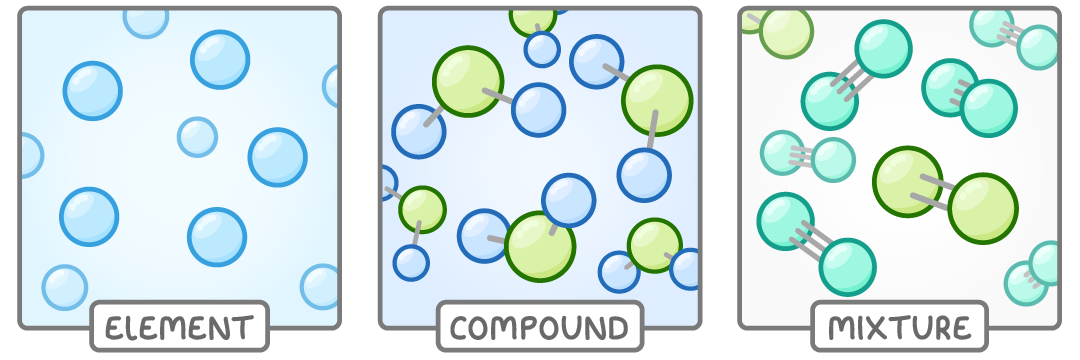
- An element is a substance made of only one type of atom.
- It can't be broken down into anything simpler by chemical means.
- There are about 100 different elements, all shown in the periodic table.
- The atoms in an element can exist as separate atoms (e.g. helium) or joined in pairs (e.g. oxygen gas, O2).
Compounds
- A compound is a substance made of two or more different elements chemically combined in fixed proportions.
- The atoms are held together by chemical bonds, so separating a compound back into its elements requires a chemical reaction.
- A compound has a fixed chemical formula (e.g. H2O always has two hydrogen atoms for every oxygen atom).
- A compound's properties are very different from the elements it's made from:
- Iron is a magnetic metal and sulfur is a yellow powder.
- Heated together, they react to form iron sulfide - a dull grey solid that isn't magnetic.
Mixtures
- A mixture contains two or more substances that are not chemically combined.
- There are no chemical bonds between the substances, so each keeps its own properties.
- The parts of a mixture can be separated by physical means (such as filtration or distillation) without a chemical reaction.
- Air and sea water are examples of mixtures.
Molecules
- A molecule is a particle made of two or more atoms joined together by covalent bonds.
- A molecule containing two atoms is a diatomic molecule.
- The atoms in a molecule can be the same element (e.g. oxygen, O2) or different elements (e.g. water, H2O).
- Single, separate atoms (like helium) are not molecules.
Molecule vs compound
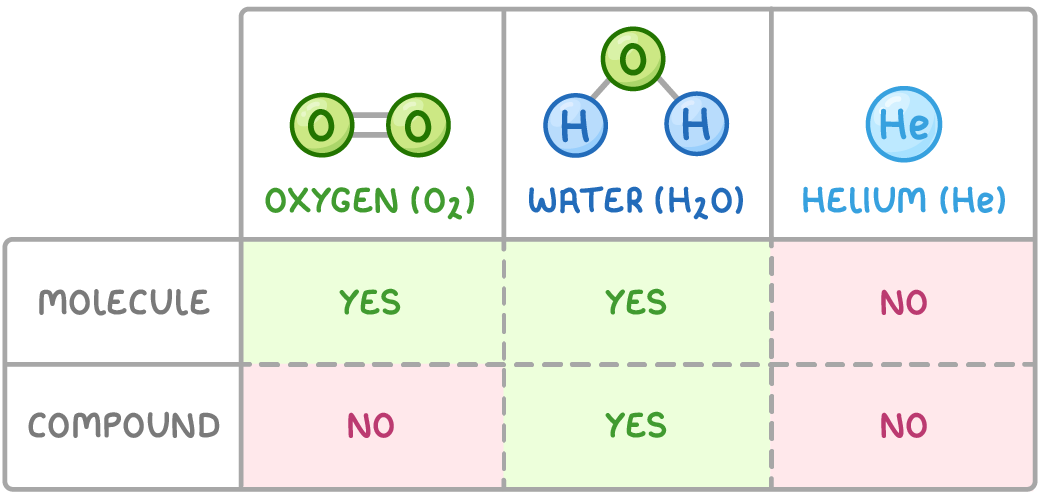
- A particle is a molecule if it has two or more atoms covalently bonded together.
- A substance is a compound if it contains two or more different elements.
- For example:
- Water (H2O) is both a molecule and a compound.
- Oxygen gas (O2) is a molecule, but it is not a compound because it contains only one type of atom.
Classifying substances
From a chemical formula
- One element symbol → it's an element (e.g. He, O2).
- Two or more different element symbols → it's a compound (e.g. H2O, NaCl).
- A mixture contains multiple substances, so it can't be written as a single chemical formula.
From a particle diagram
- All particles alike:
- Element if each particle contains only one type of atom.
- Compound if each particle contains two or more different types of atom.
- More than one kind of particle → mixture.
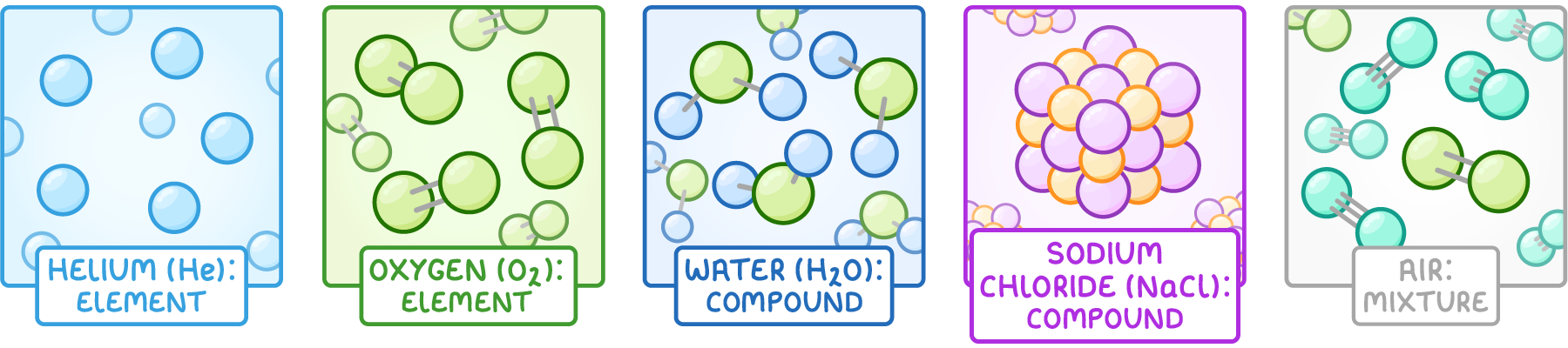
| Substance | What it contains | Class |
|---|---|---|
| Helium, He | Single atoms of one type | Element |
| Oxygen, O2 | Bonded pairs of one type of atom | Element |
| Water, H2O | Hydrogen and oxygen chemically joined | Compound |
| Sodium chloride, NaCl | Sodium and chlorine chemically joined | Compound |
| Air | Different substances not chemically joined | Mixture |
TermDefinition
Element
Compound
Mixture
Molecule
Diatomic molecule