1.9 - Electronic Structure
Electron shells and writing an electronic structure
- Electrons occupy shells (also called energy levels) around the nucleus.
- The innermost shell has the lowest energy and fills first.
Rules for filling shells
- Each shell holds a maximum number of electrons:
- First shell holds up to 2
- Second shell holds up to 8
- Third shell holds up to 8 (for elements up to calcium)
- An atom's number of electrons equals its atomic number (number of protons).
Why the outer shell matters
- A full outer shell is a very stable arrangement - the elements of Group 0 already have full outer shells.
- Most atoms have an incomplete outer shell, so they react to achieve a full outer shell.
Writing the electronic structure
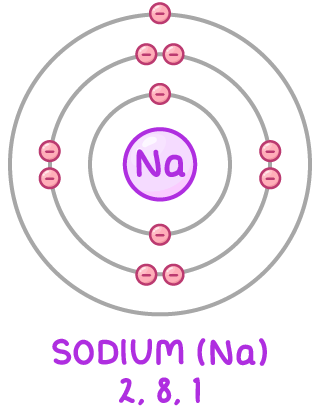
- As numbers - Listed from the innermost shell outwards, separated by commas. For example, sodium is 2,8,1.
- As a diagram - The nucleus in the middle, occupied shells drawn as circles, and electrons drawn as dots or crosses on each circle (the diagram of sodium below uses small circles).
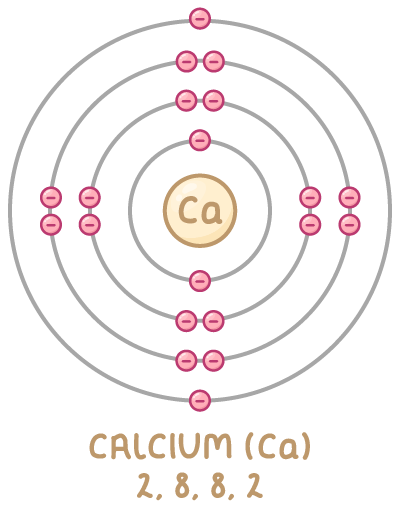
Worked example - Electronic structure of calcium
Work out the electronic structure of calcium.
Step 1 - Find the number of electrons
- Calcium's atomic number is 20, so it has 20 protons.
- An atom has no overall charge, so it must have 20 electrons.
Step 2 - Fill the first shell
The first shell holds a maximum of 2. That leaves 18 to place.
Step 3 - Fill the second shell
The second shell holds a maximum of 8. That leaves 10.
Step 4 - Fill the third shell
The third shell holds a maximum of 8. That leaves 2.
Step 5 - Place what's left
- The third shell is now full, so the last 2 electrons begin a fourth shell.
- The electronic structure of calcium is 2,8,8,2.
Check: the numbers add up to the atomic number - 2 + 8 + 8 + 2 = 20.
Electronic structure and the periodic table
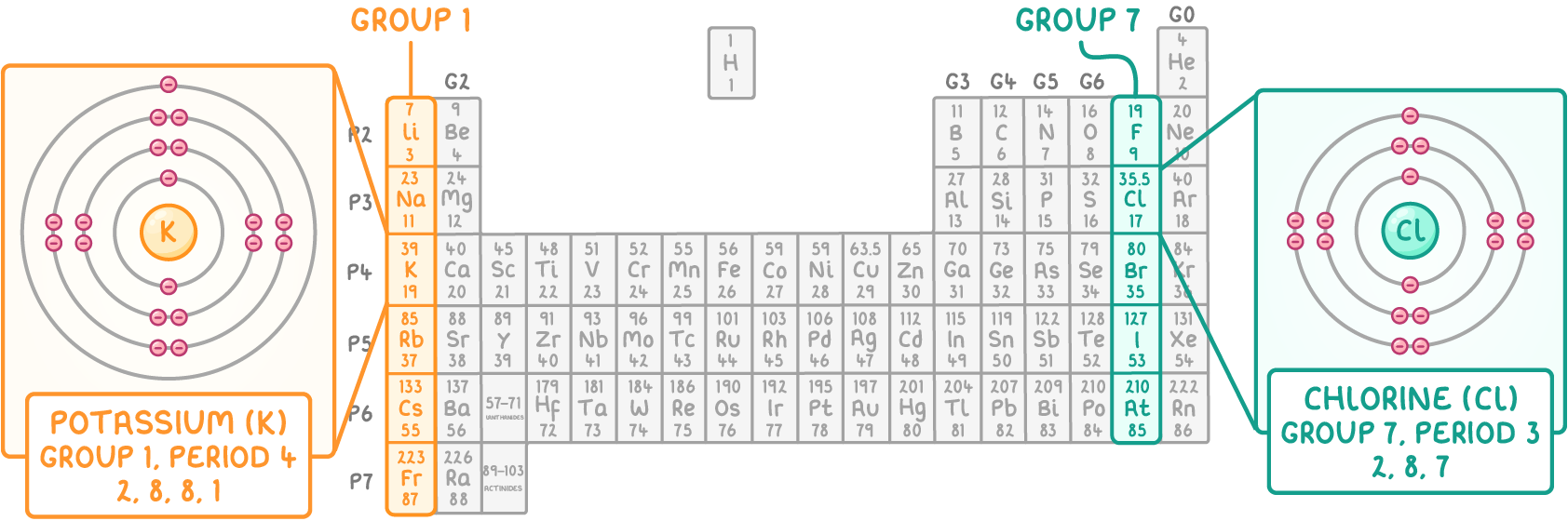
- The group number gives the number of outer-shell electrons (Groups 1 to 7).
- Group 0 is the exception: these atoms have a full outer shell of 8 electrons (except helium, which has 2).
- The period number gives the number of occupied shells. A Period 2 element has electrons in two shells, and a Period 4 element has electrons in four shells.
Putting the two together
- Potassium sits in Group 1 and Period 4: four shells are occupied and the outer shell holds 1 electron, giving 2,8,8,1.
- Chlorine has the electronic structure 2,8,7: three occupied shells place it in Period 3, and seven outer electrons place it in Group 7.
Why a group shares its chemistry
- When atoms react, only the outer-shell electrons are involved.
- Elements in the same group have the same number of outer electrons, so they react in similar ways and share chemical properties.
TermDefinition
Electron shell
Electronic structure