Properties of Materials - exam practice
Properties of Materials
Question 1 of 7
Surfboards and rigid hull dinghies are constructed from addition polymers.
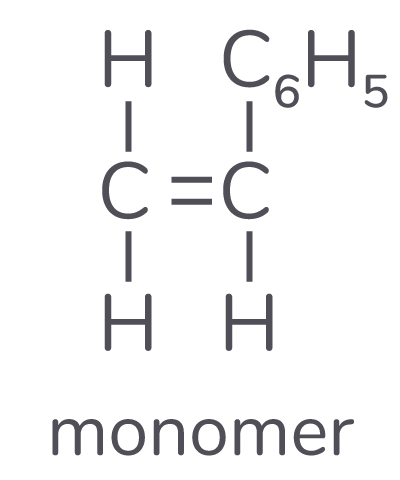
The diagram below shows the monomer form of one of these addition polymers.
Draw the repeating unit of the polymer below.
The outer skin of the surfboard is often made from a composite material made from glass fibres surrounded by a polyester.
Surfboards with composite coatings are more expensive.
Suggest two reasons why an outer skin is added to the poly(styrene) core.
The surfboard coating has a polyester which melts when it is heated.
Explain why the coating melts when heated.
Some polymers do not melt when heated.
Describe the difference between these polymers and those that melt when heated.
This question is about the properties of ceramics.
Which two processes are used to make ceramic plates?
Tick two boxes.
The table below shows some properties of ceramics.
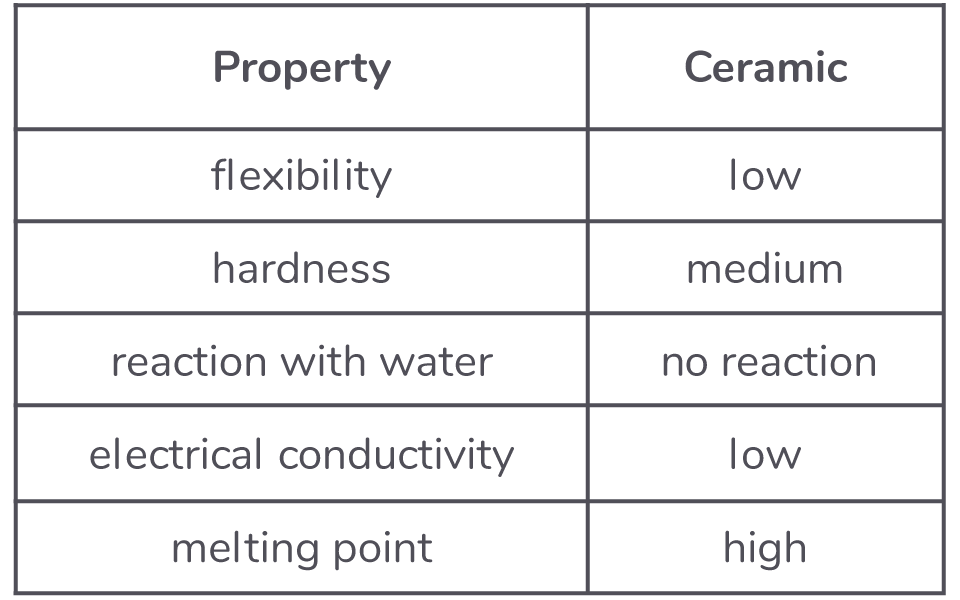
Explain, using information from the table, why ceramics are suitable to make a cup that will hold a hot drink.
Explain why ceramics could not be used for electrical wires.
Match the objects below to the materials they are made from.
This question is about the corrosion of iron.
State the name of the process that causes iron to corrode.
A group of students are discussing the conditions required for an iron nail to rust.
Student 1 says that all iron nails will rust eventually if left in air.
Student 2 says iron needs both oxygen and water to rust.
Student 3 says that iron only needs to be wet to rust.
Plan an investigation to test the predictions of the students.
Use the equipment and materials from the list below:
- test tubes
- stoppers
- iron nails
- boiled water
- drying agent
- oil
State the purpose of the drying agent in test tube 1.
The table below shows the students' results.
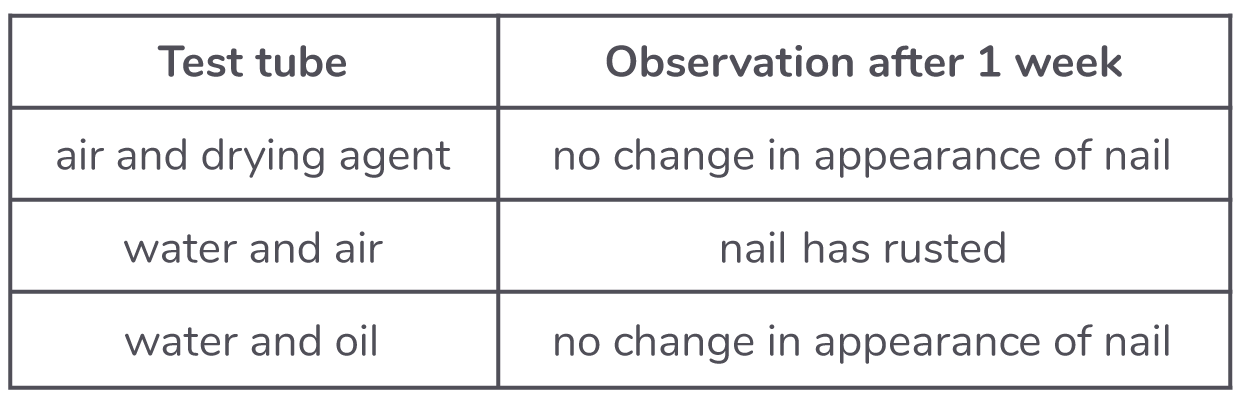
Use the results in the table to explain which students' prediction was correct.
This question is about the corrosion of metals and metal alloys.
Saucepans are made from stainless steel.
Give two reasons why saucepans are made of stainless steel rather than iron.
Iron rusts when exposed to both air and water.
Write a word equation for the rusting of iron to form hydrated iron oxide.
Explain why covering iron with paint or grease prevents the iron from rusting.
Iron is sometimes covered with zinc to prevent it rusting.
Explain how the zinc covering prevents the iron from rusting.
This question is about the corrosion of metals.
Iron reacts with oxygen in the air and water when it rusts.
Complete the balanced chemical equation below for the rusting of iron.
Which of the following would not prevent an iron nail rusting?
Which of the following metals could be used to galvanise iron?
Which type of reaction takes place when iron rusts?
This question is about the properties of LDPE and HDPE.
Low density poly(ethene) and high density poly(ethene) are both formed from the same ethene monomer.
Draw the ethene monomer used to create both LDPE and HDPE.
HDPE and LDPE are formed under different conditions.
State one condition that is different for the production of LDPE and HDPE.
Some polymers melt when heated and others do not.
State the name of the polymers that do not melt when heated.
Explain why the structure of these polymers allows them to remain rigid.
A student is using disposable cutlery to eat their lunch.
The cutlery is made from a polymer.
The student is eating hot food.
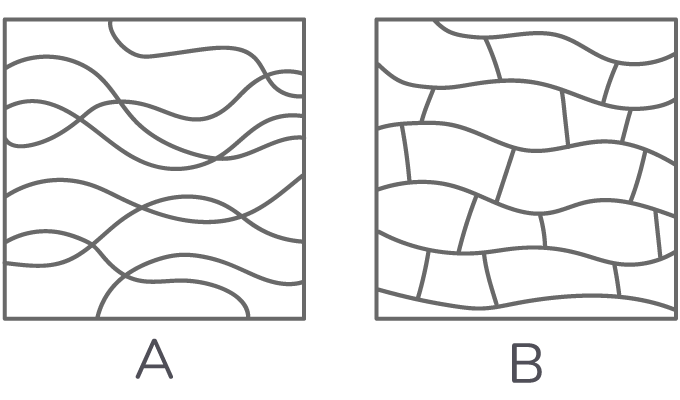
The diagram below shows two different polymers.
Explain, with reference to structure, which one is more suitable for making disposable cutlery.
The student drinks from a cup made from a polymer, poly(styrene).
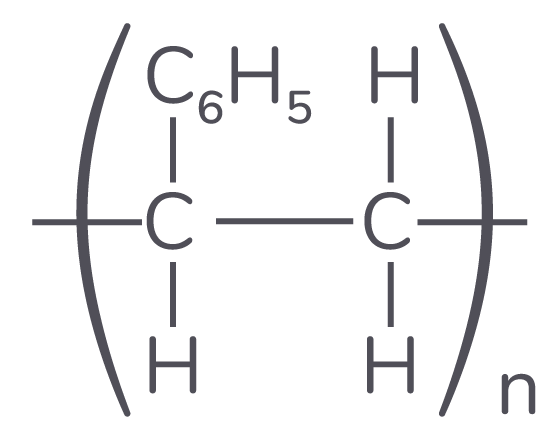
The diagram below represents the structure of poly(styrene).
Draw the monomer that is used to produce this polymer.
The school chose to use poly(styrene) cups for hot drinks instead of ceramic mugs.
Give one reason, why the school may have chosen to use poly(styrene).