Rates of Reaction - exam practice
Rates of Reaction
Question 1 of 8
A student is investigating the rate of reaction between magnesium and hydrochloric acid.
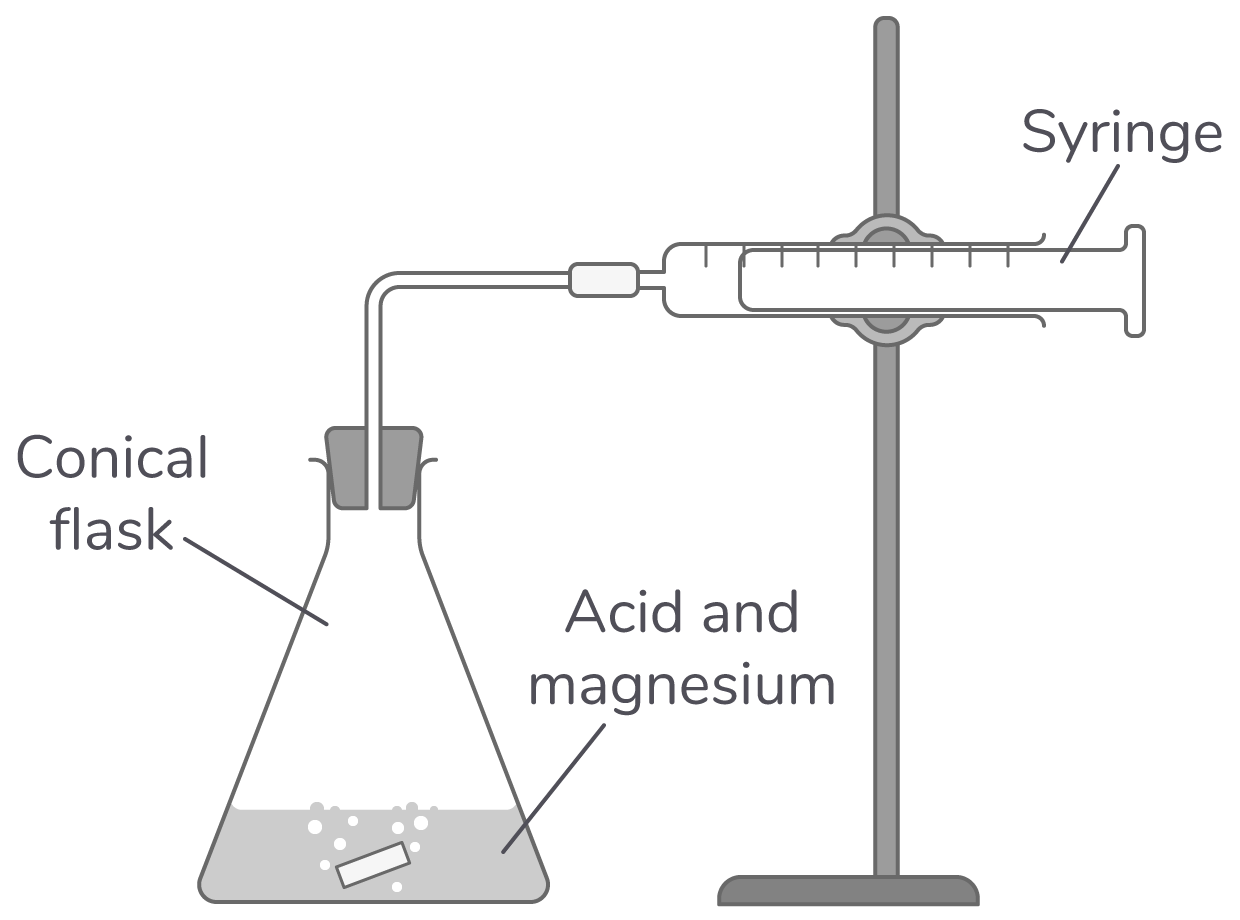
The student's method is detailed below:
- Measure 25 cm3 of 0.2 mol/dm3 hydrochloric acid and pour into a conical flask.
- Measure 3 g of magnesium ribbon using a digital balance.
- Place the magnesium ribbon in the conical flask with the acid and immediately attach a bung connected to a delivery tube and gas syringe and start the timer.
- Stop the timer when no more gas is being produced.
- Repeat with 3 g of magnesium ribbon cut into small chunks and then 3 g of magnesium powder.
State the independent variable in the student's investigation.
State two control variables for the student's investigation.
The table below shows the student's results.
Plot a graph of volume of gas produced vs time.
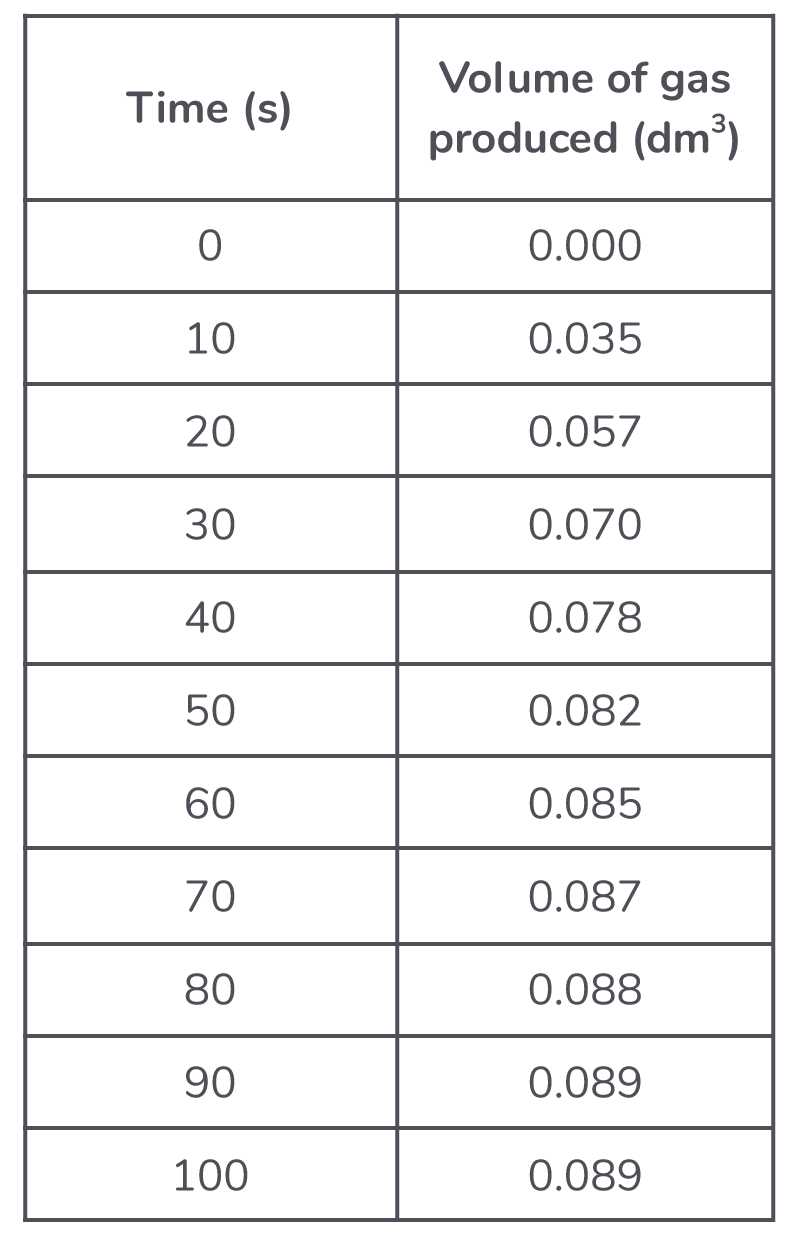
Estimate the volume of gas produced as 35 s.
The reaction produced 0.089 dm3 of gas in 90 s.
Calculate the average rate of reaction for the reaction between magnesium and hydrochloric acid.
Give your answer in cm3/s to 2 decimal places.
The student repeated the experiment with powdered magnesium.
Draw on the graph below how you would expect the volume of gas produced to vary with time.
A student investigated the rate of the chemical reaction between sodium and water.
The student recorded the time it took for a 1 g block of sodium to completely react with water.
The recorded time was 45 s.
Write a balanced symbol equation for the reaction between sodium and water.
The student plans another experiment, where they cut the 1 g of sodium into many small pieces before adding it to the water.
The student claims that the rate of reaction will to be slower when the sodium is added as small pieces.
Is the student's claim correct?
Explain your answer with reference to collision theory.
Explain the effect of using warm water instead of cold tap water on the rate of reaction.
This question is about the decomposition of hydrogen peroxide (H2O2) to form water and oxygen.
Write a balanced chemical equation to show the decomposition of hydrogen peroxide.
The student collects the gas produced in a test tube.
State the test for oxygen gas.
The reaction is completed in the presence of a solid manganese(IV) oxide.
Explain the role of the solid manganese(IV) oxide in the reaction.
Describe a method to show that solid manganese(IV) oxide is a catalyst in this reaction.
A student is investigating the effect of concentration on the rate of reaction between magnesium and hydrochloric acid.
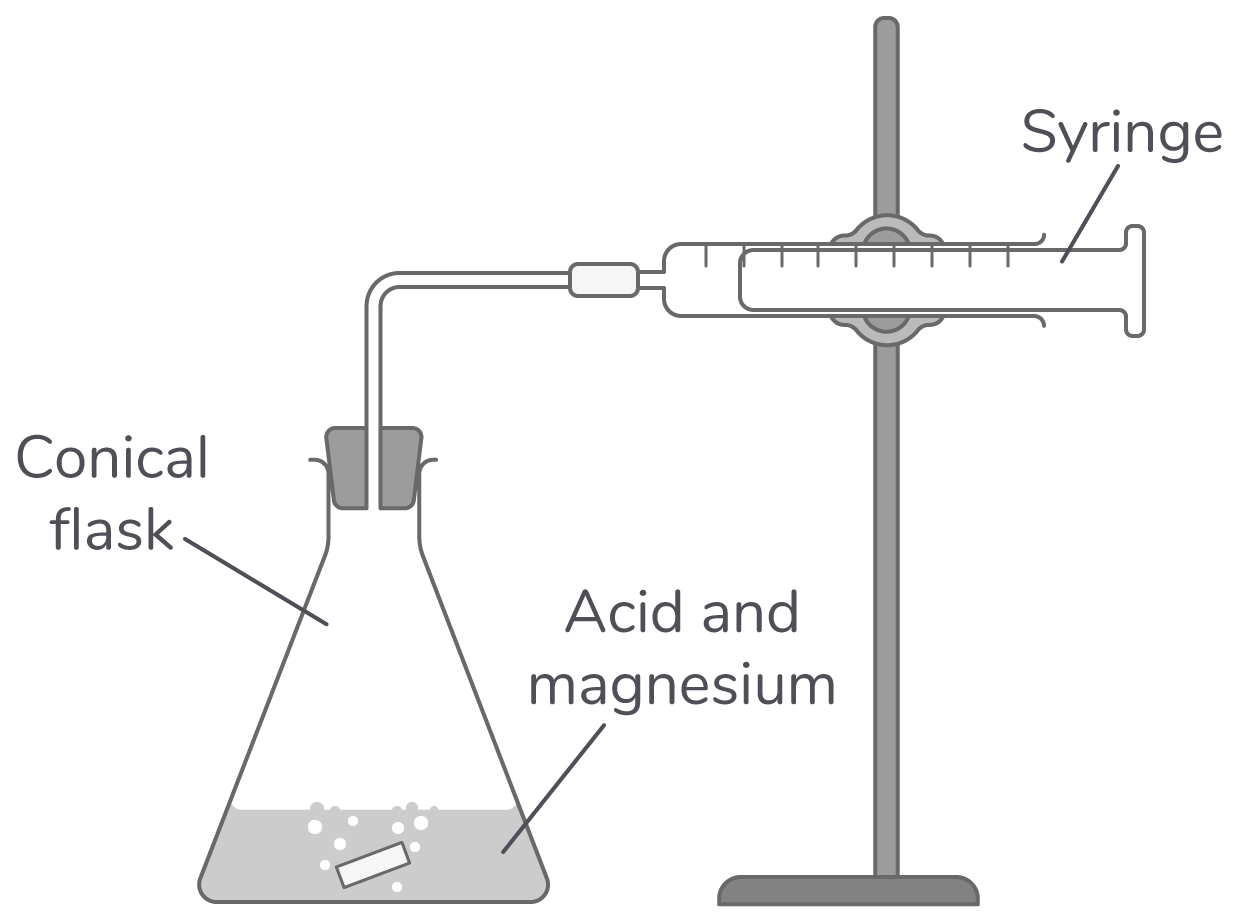
State the name of the piece of equipment used to measure volume of gas produced.
The student records the time taken for the reaction to finish.
Describe what the student should expect to observe as the concentration of hydrochloric acid is increased.
Explain, with reference to particle theory, why increasing the concentration increases the rate of reaction.
The graph below shows the reaction for three different concentrations of hydrochloric acid.
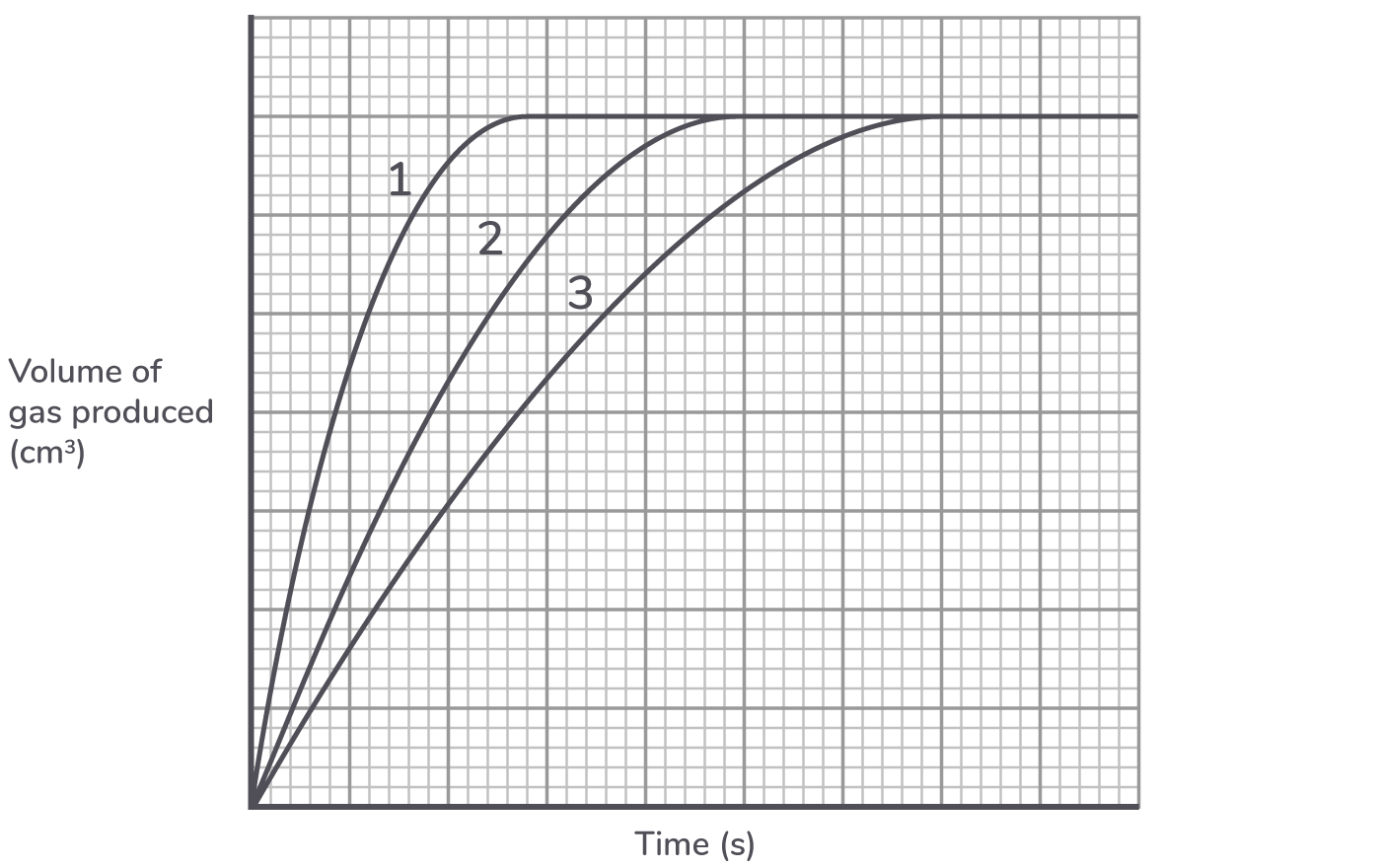
State which reaction used the highest concentration of hydrochloric acid.
This question is about the rate of reaction between magnesium and dilute hydrochloric acid.
In the first trial the student used 1 g of magnesium and 25 cm3 of 0.2 mol/dm3 hydrochloric acid.
For trials 2 and 3 the student varied conditions for the reaction.
The graph below shows the volume of gas produced for three trials of the experiment.
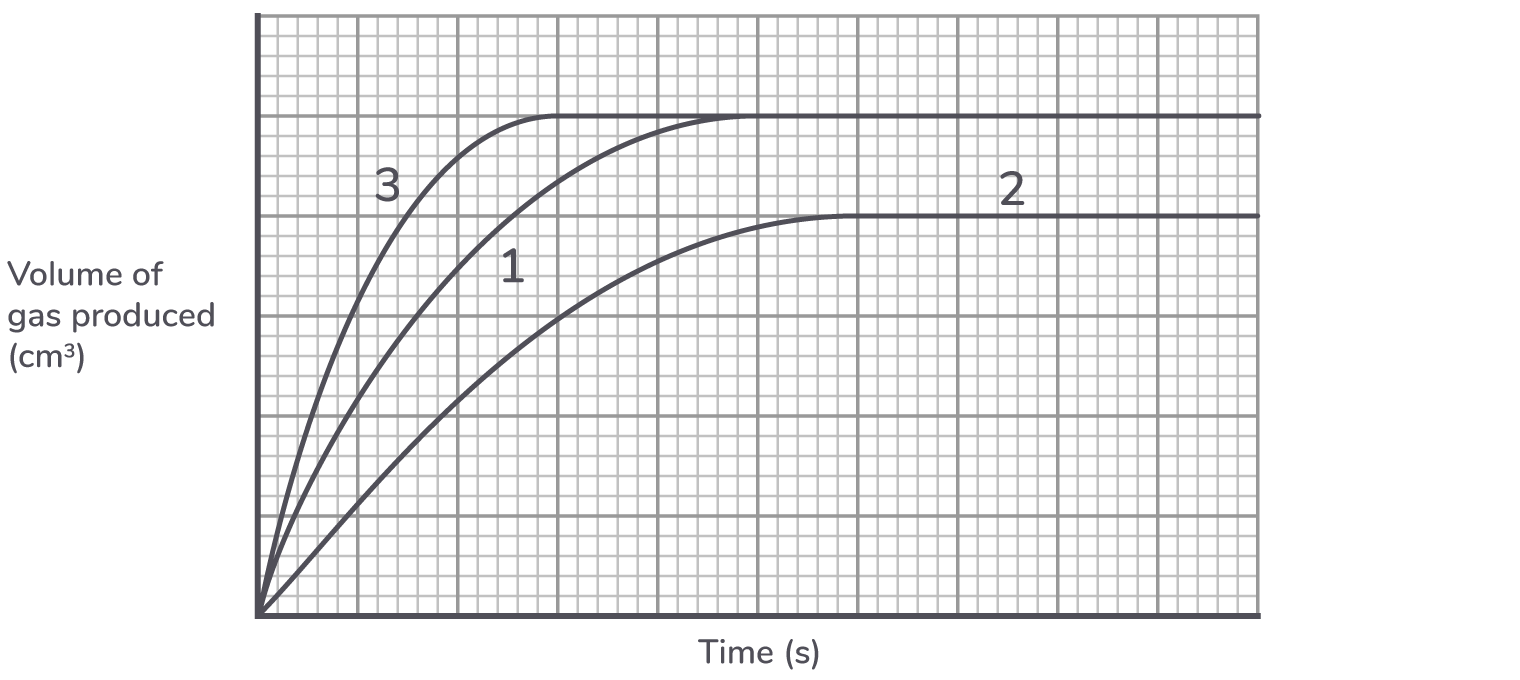
Which of the trials used the highest concentration acid?
Which of the following could be a possible change made by the student for trial 2?
After the experiment the student concluded that the quickest rate of reaction is obtained when they use high concentration of hydrochloric acid at a low temperature.
Do you agree with the students conclusion?
Explain why.
This question is about rates of reaction.
Which of the following would not increase the rate of reaction between marble chips and hydrochloric acid?
Explain the role of a catalyst in a chemical reaction.
A student collects 23 cm3 of gas from a reaction in 2 minutes.
Calculate the rate of reaction in cm3/s.
Give your answer to 2 decimal places.
This question is about the reaction between hydrochloric acid and sodium thiosulfate solution to form a precipitate.
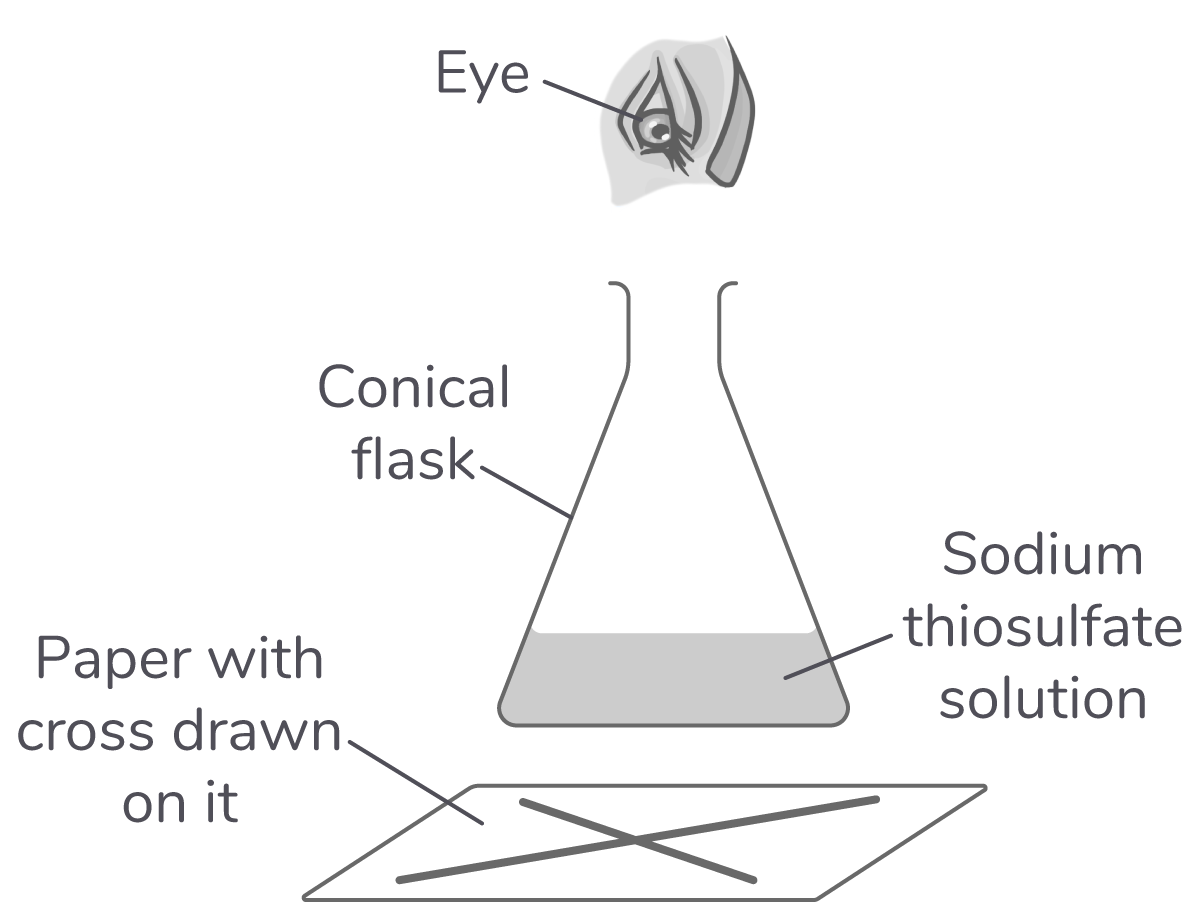
The students method is below.
- Measure 50 cm3 of sodium thiosulfate solution using a measuring cylinder and pour into a conical flask.
- Draw a cross on a piece of paper and place under the conical flask.
- Add 10 cm3 of 0.1 mol/dm3 hydrochloric acid and start the timer.
- Observe the cross from above and stop the timer when the cross is no longer visible.
- Repeat steps 1-4 using 0.2 mol/dm3, 0.5 mol/dm3, and 1.0 mol/dm3 hydrochloric acid.
State one control variable for the student's investigation.
The table below shows the student's results.
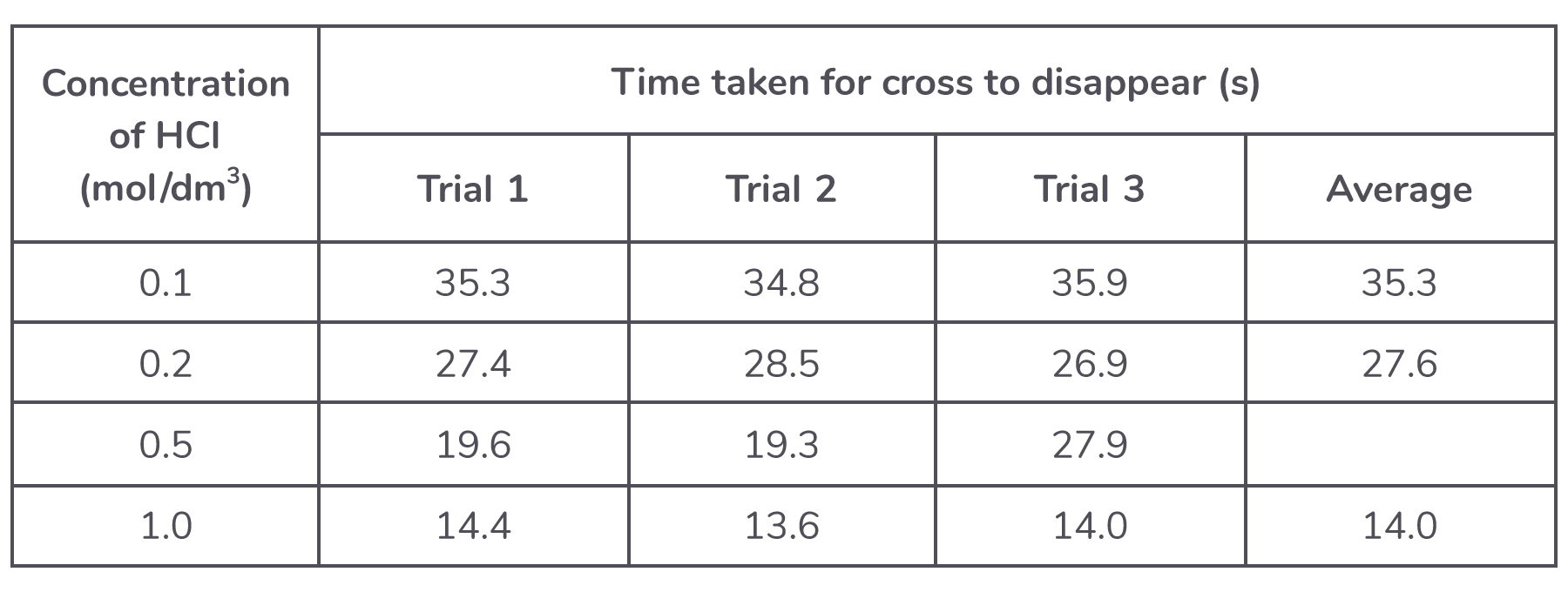
Calculate the average time taken for the cross to disappear for the reaction with 0.5 mol/dm3 hydrochloric acid. Give your answer to 1 decimal place.
Plot a graph of average time for cross to disappear against concentration.
Draw a straight line of best fit.
Describe how the student could improve the accuracy of their line of best fit.
Explain, with reference to particle theory, why the time taken for the cross to disappear decreases as the concentration of hydrochloric acid increases.
A student places a conical flask on a digital mass balance and tares it (sets it back to zero).
The student then adds 50 cm3 of dilute hydrochloric acid to the conical flask.
A magnesium ribbon is then added to the conical flask and cotton wool inserted into the top of the flask.
The student recorded the mass loss every 20 s until the mass remained constant.
The graph below shows the mass loss plotted against time.
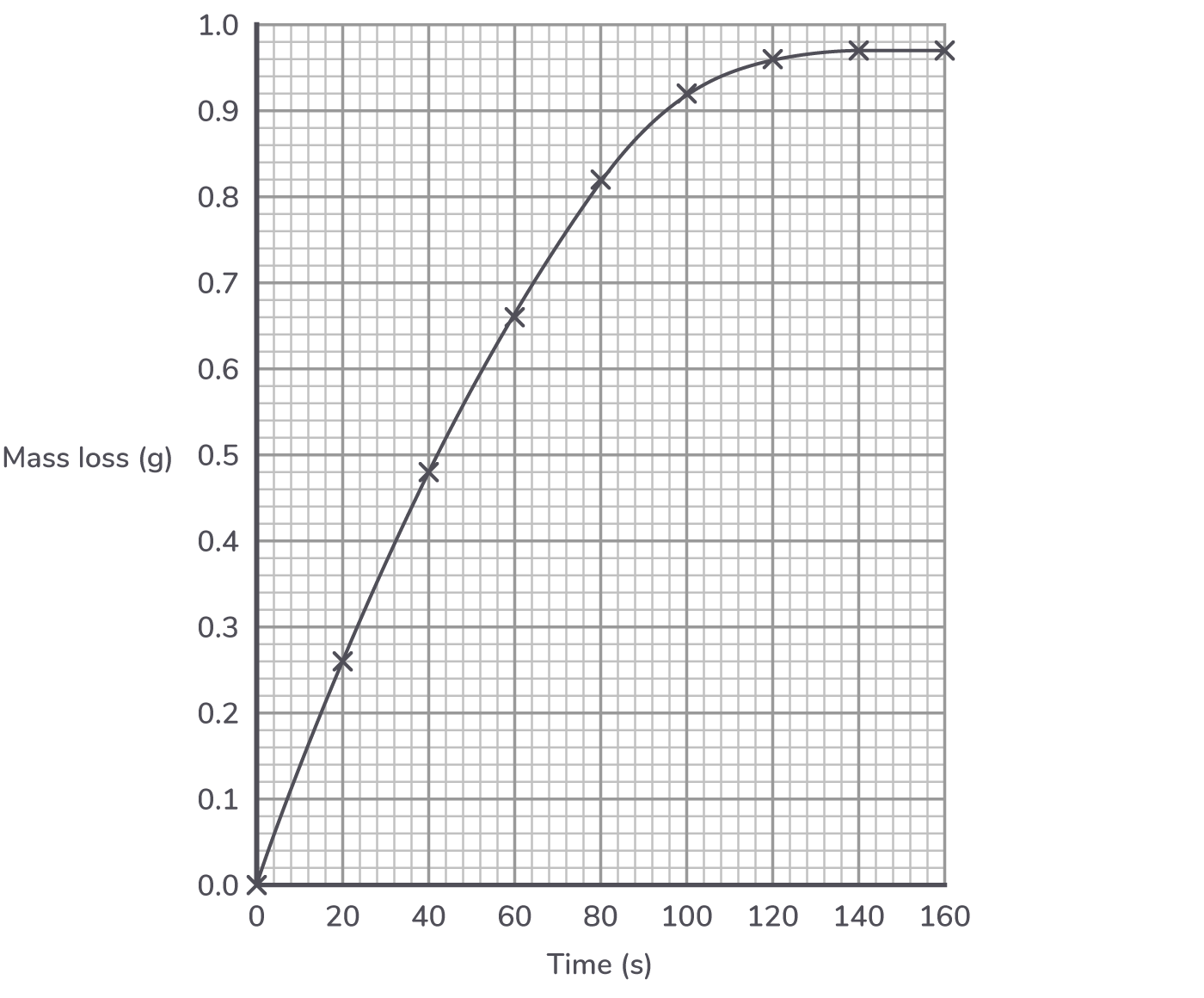
Calculate the rate of reaction at 100 s.