Purity, Formulations & Chromatography - exam practice
Purity, Formulations & Chromatography
Question 1 of 7
A student is investigating the colour dyes within an ink sample.
The student has the following equipment:
- chromatography paper
- pencil
- ruler
- container of water
- ink sample
Describe how the student can use the apparatus to find out which colour dyes are in the ink sample.
The diagram below shows the results of the chromatography of the ink sample and the chromatography of three brands of ink.
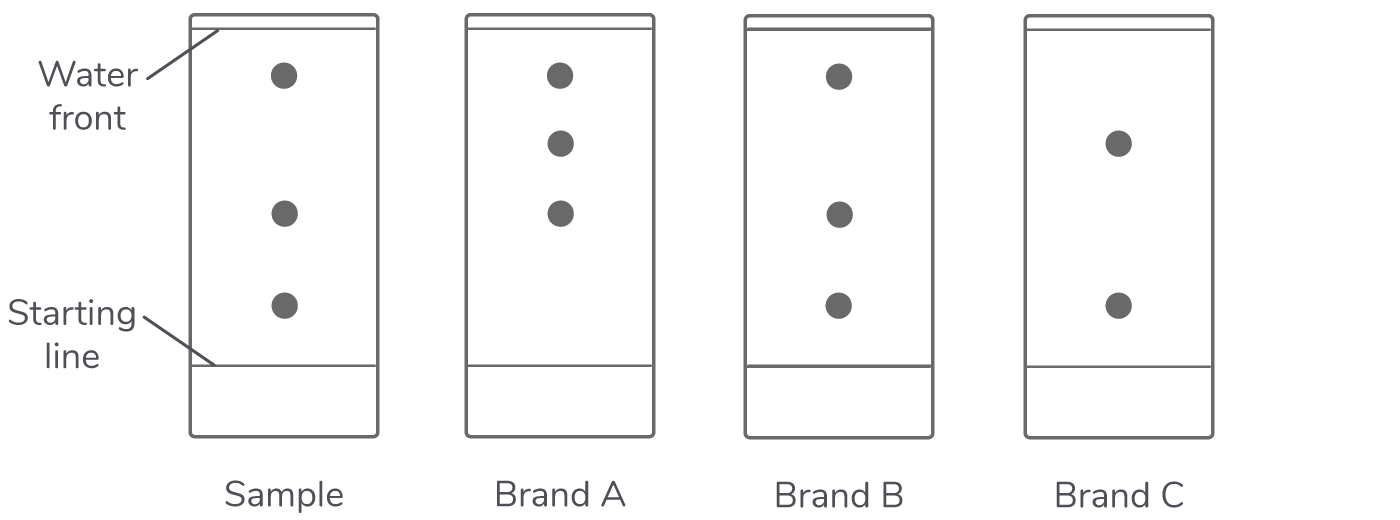
State which brand ink the sample was made from.
Give a reason for your answer in part b).
State two measurements the student should take to calculate the Rf value of the 3rd spot in the sample.
The student's measurements are in the table below.
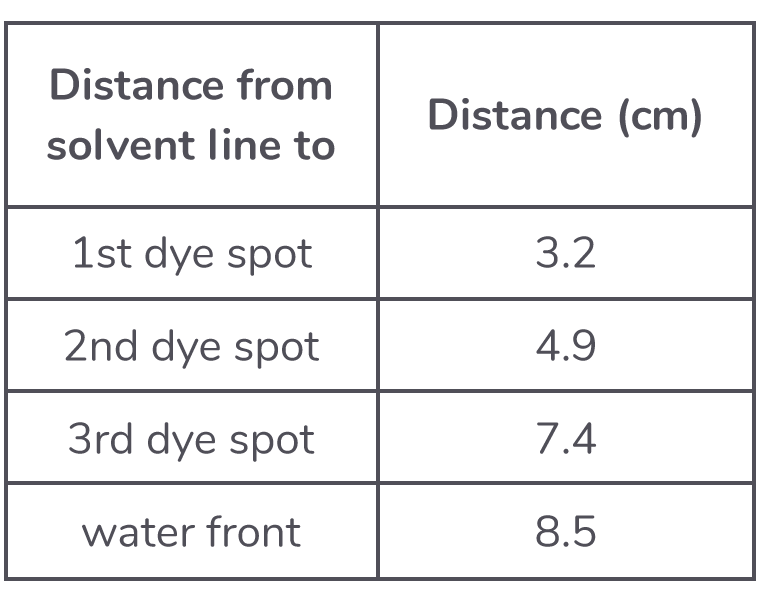
Calculate the Rf value for the 3rd dye spot.
Give your answer to 2 decimal places.
This question is about paper chromatography.
Plan an investigation to determine the Rf value for the dye in a food colouring sample.
Explain why the start line is pencil and not ink.
The student measures the solvent front and distance to the colouring to be 4.9 cm and 3.2 cm, respectively.
Calculate the Rf value for the food colouring.
This question is about pure substances and mixtures.
Which of the following is a mixture?
Chromatography can be used to separate a mixture of blue and green inks.
The Rf values for the inks are in the table below.
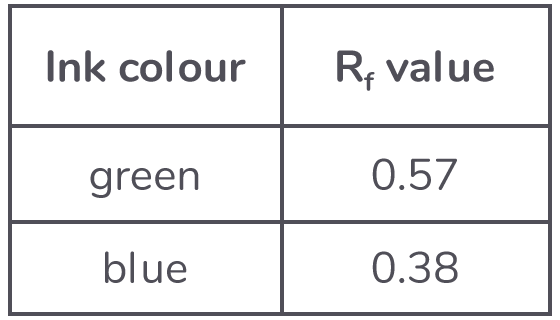
Complete the diagram below to show the pigments of green and blue ink on the chromatography paper.
Explain why the starting line is drawn in pencil.
Which of the following would be a suitable way of obtaining water from a mixture containing salt and water?
This question is about pure substances and mixtures.
Explain what is meant by a pure substance.
Complete the table below to sort the substances into pure substances and mixtures.
Add one tick per row.
Which of the following would be suitable for obtaining water from a mixture of sand and water?
A student is completing the paper chromatography of an ink containing several colour dyes.
The student's method is below.
- Draw a pencil line 1-2 cm from the bottom of the chromatography paper.
- place a spot of the ink sample on the pencil line.
- Suspend the chromatography paper above a container of water so that the bottom of the paper is submersed but the water level is below the pencil line.
- Wait for the water front to reach the top of the paper.
- Dry the chromatography paper and observe results.
State the name of the mobile phase in the student's experiment.
State the name of the stationary phase in the student's experiment.
The student's results are below.
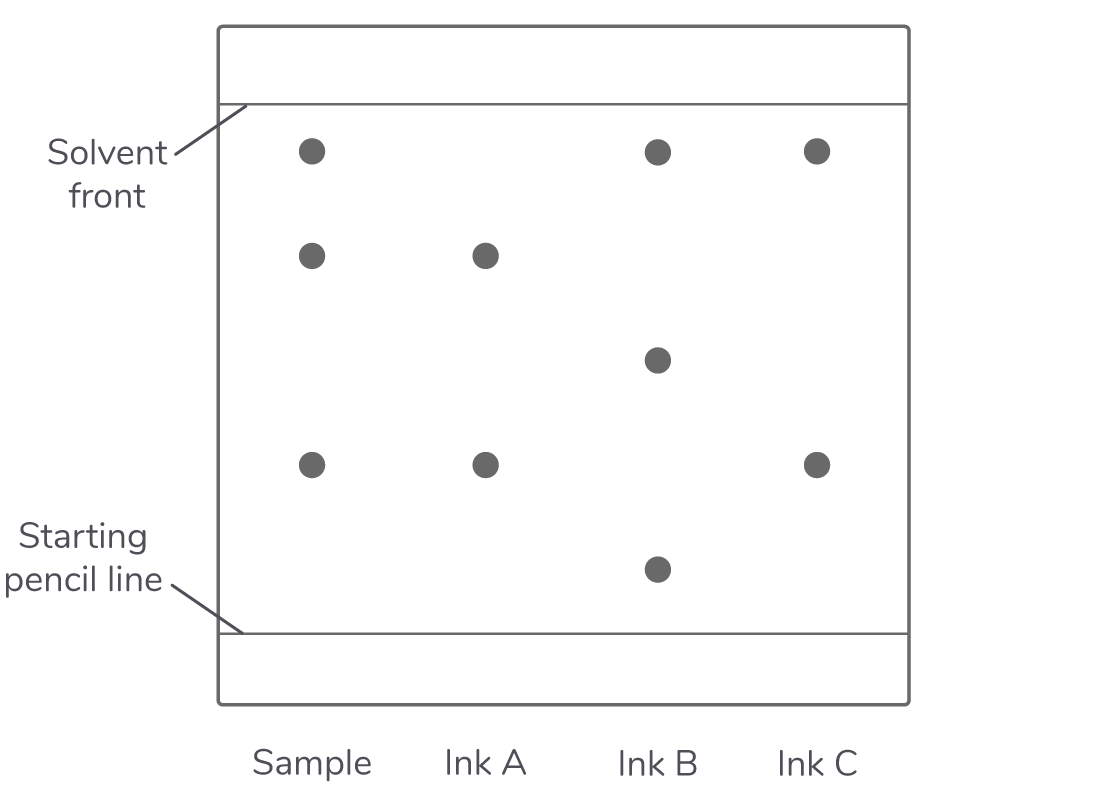
The ink sample contains dyes from 2 of the three inks tested.
State which two inks are in the sample. Explain your answer.
The student mixes ink A and ink B together.
Describe how the overall Rf value of the new sample compares to that in part c).
This question is about formulations.
Explain what is meant by the term formulation.
Give one example of a formulation.
Describe the role of the pigment in paint.
Describe the role of the solvent in paint.
This question is about pure and impure substances.
Explain what is meant by a pure substance.
The table below shows the boiling points of 4 different water samples.
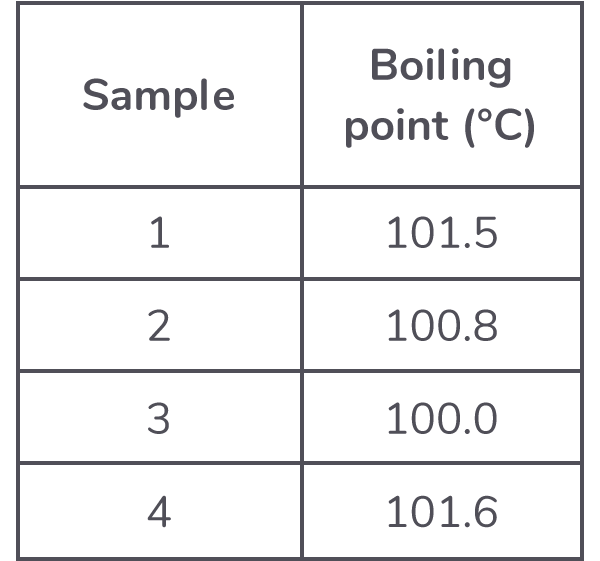
State and explain which water sample is pure.
Sample A is a sample of water which also contains salt impurities.
Describe how to obtain pure water from sample A.