Reversible Reactions & Equilibria - exam practice
Reversible Reactions & Equilibria
Question 1 of 9
A student mixes anhydrous cobalt chloride with water to form hydrated cobalt chloride.
The word equation for the reaction is below.
anhydrous cobalt chloride (blue) + water ⇋ hydrated cobalt chloride (pink)
What does the ⇋ symbol mean?
What will the student observe when the anhydrous cobalt chloride is mixed with water?
The forward reaction is exothermic.
Explain the effect of increasing the temperature of reaction on the yield of hydrated cobalt chloride.
This question is about the industrial production of methanol (CH3OH).
Methanol is produced by reacting carbon monoxide with hydrogen.
Write a balanced chemical equation for this reversible reaction.
Calculate how many moles of hydrogen are required to completely react with 5 x 10³ moles of carbon monoxide.
In industry the process is carried out at a pressure of 100 atmospheres.
Explain what happens if the reaction is carried out at a lower pressure than this.
A catalyst can be used in the production of methanol from carbon monoxide and hydrogen.
Explain the role of the catalyst in this reaction.
This question is about the industrial production of ethanol.
State the chemical formula of ethanol.
The chemical equation for the production of ethanol is below:
C2H4(g) + H2O(g) ⇋ C2H5OH(g)
The table shows the bond energies for this reaction.

Calculate the energy change during the production of ethanol and determine if the forward direction is endothermic or exothermic.
Describe the effect of increasing the temperature on:
- the rate of reaction
- the percentage yield of ethanol.
Explain the effect of using a high pressure on:
- the rate of reaction
- the percentage yield of ethanol
This question is about the production of hydrogen by reacting methane with steam.
Write a balanced chemical equation for the reversible reaction between methane and steam to produce carbon monoxide and hydrogen.
The reaction has a ΔH value of + 206 kJ/mol.
Explain what this means.
The reaction is usually completed at 700°C and 5 atmospheres.
State the effect on the change of yield of hydrogen at equilibrium if the pressure is decreased to 2 atmospheres.
Explain what happens to the dynamic equilibrium when the temperature is halved.
This question is about the reversible reaction between nitrogen dioxide and dinitrogen tetraoxide.
The equation for the reaction is below.
2NO2(g) ⇋ N2O4(g)
ΔH = -58 kJ/mol
What does the ⇋ symbol mean?
Which of the following would not shift the dynamic equilibrium to the right?
Explain what is meant by the term activation energy.
Another reaction is completed in the presence of a catalyst.
Explain the role of a catalyst in a chemical reaction.
This question is bout the reaction between hydrogen and iodine to form hydrogen iodide.
Write a balanced chemical equation for the reversible reaction between hydrogen (H2) and iodine (I2) to form hydrogen iodide (HI).
The statements below refer to the reaction between hydrogen and iodine.
The enthalpy change for the reaction ΔH = -9.48 kJ/mol.
Tick one box in each row to show whether each of the following statements is true or false.
Explain, with reference to particle theory, how increasing the temperature will affect:
- the rate of reaction
- the yield of hydrogen iodide
Draw a reaction profile to show the forward reaction between hydrogen and iodine to form hydrogen iodide.
A student is investigating the decomposition of ammonium chloride.
NH4Cl(s) ⇋ NH3(g) + HCl(g)
State what the ⇋ symbol means.
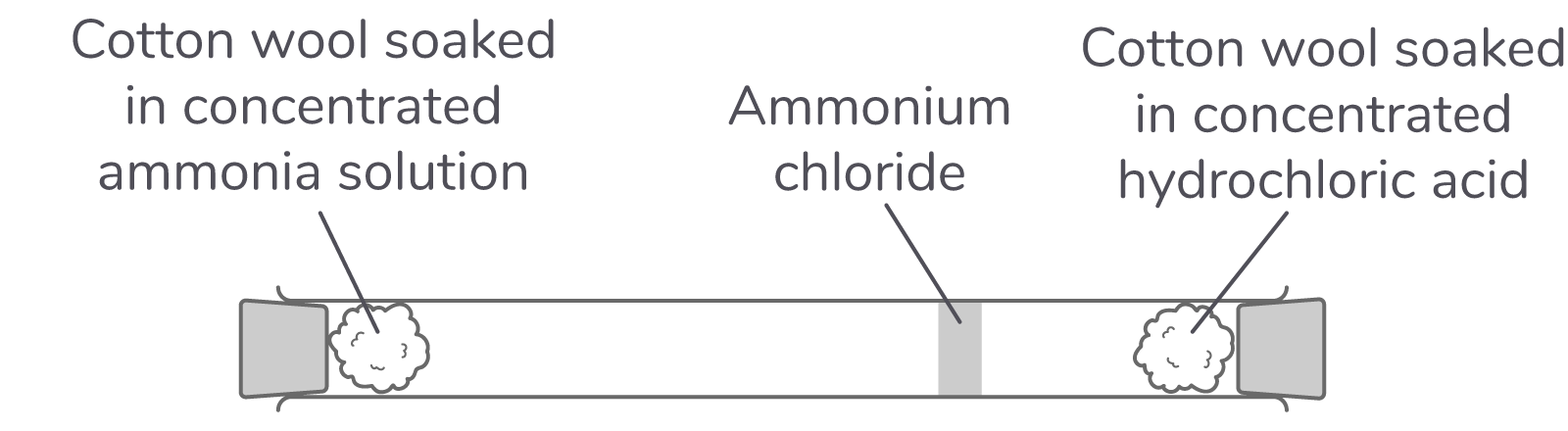
The student soaks one piece of cotton wool with hydrochloric acid, and one piece of cotton wool with ammonia.
The two pieces of cotton wool are placed inside a tube and sealed at each end with a bung, as shown in the diagram below.
After a few minutes, a ring of ammonium chloride forms in the tube.
Explain why the ring has not formed in the centre.
Explain how increasing the pressure would change the yield of ammonium chloride.
This question is about the production of hydrogen gas from methane and steam.
The chemical equation for the reaction is below.
CH4(g) + H2O(g) ⇋ CO(g) + 3H2(g)
ΔH = 160.5 kJ/mol
Explain what is meant by the term 'dynamic equilibrium'.
Tick one box in each row to show which changes would increase the yield of hydrogen.
The temperature and pressure of the reaction are increased.
Explain why it is difficult to predict how the percentage yield of hydrogen will change.
A student is investigating decomposition of hydrogen peroxide (H2O2).
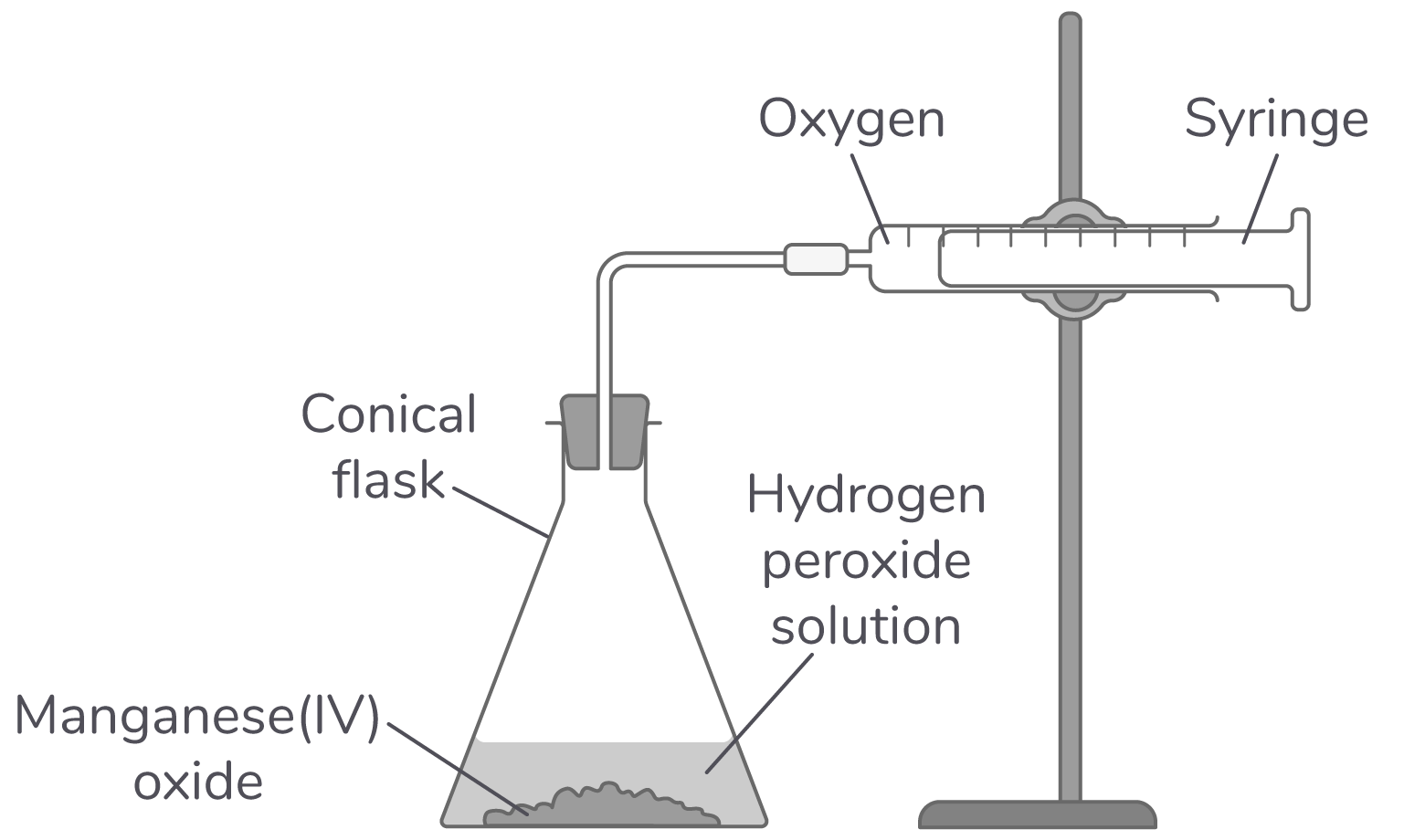
The students method is shown below:
- Measure 25 cm3 of hydrogen peroxide solution and pour into a conical flask.
- Add 3 spatulas of manganese(IV) oxide powder and secure the bung connected to the delivery tube and gas syringe.
- Start the timer and record the volume of gas produced every minute until the volume remains constant.
The graph below shows how the volume of gas produced varied with time.
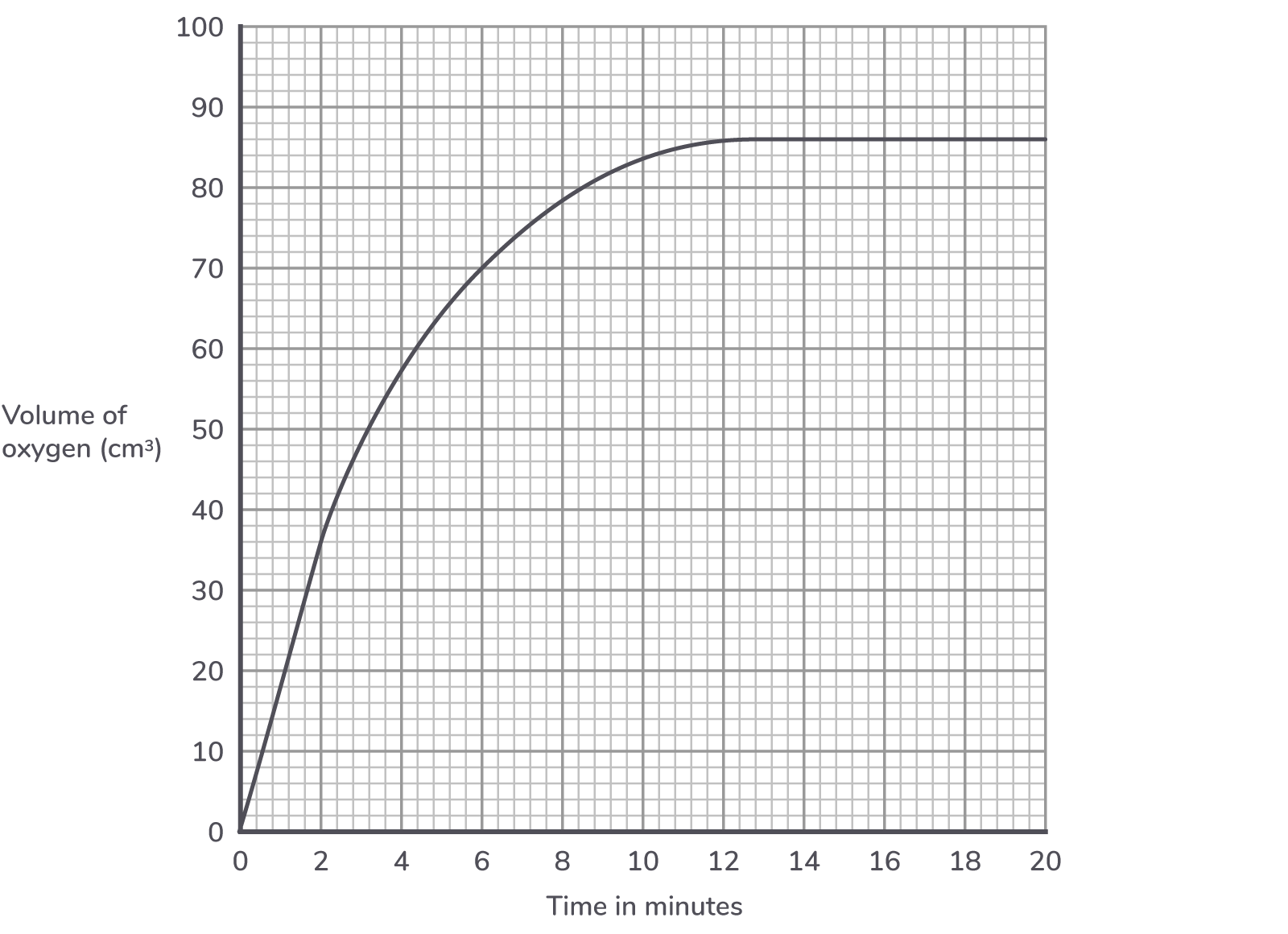
Describe how the rate of oxygen produced varied during the 20 minute experiment.
The student draws a tangent on the graph at 8 minutes.
Calculate the rate of reaction in cm3/min at 8 minutes.
Give your answer to 2 decimal places.
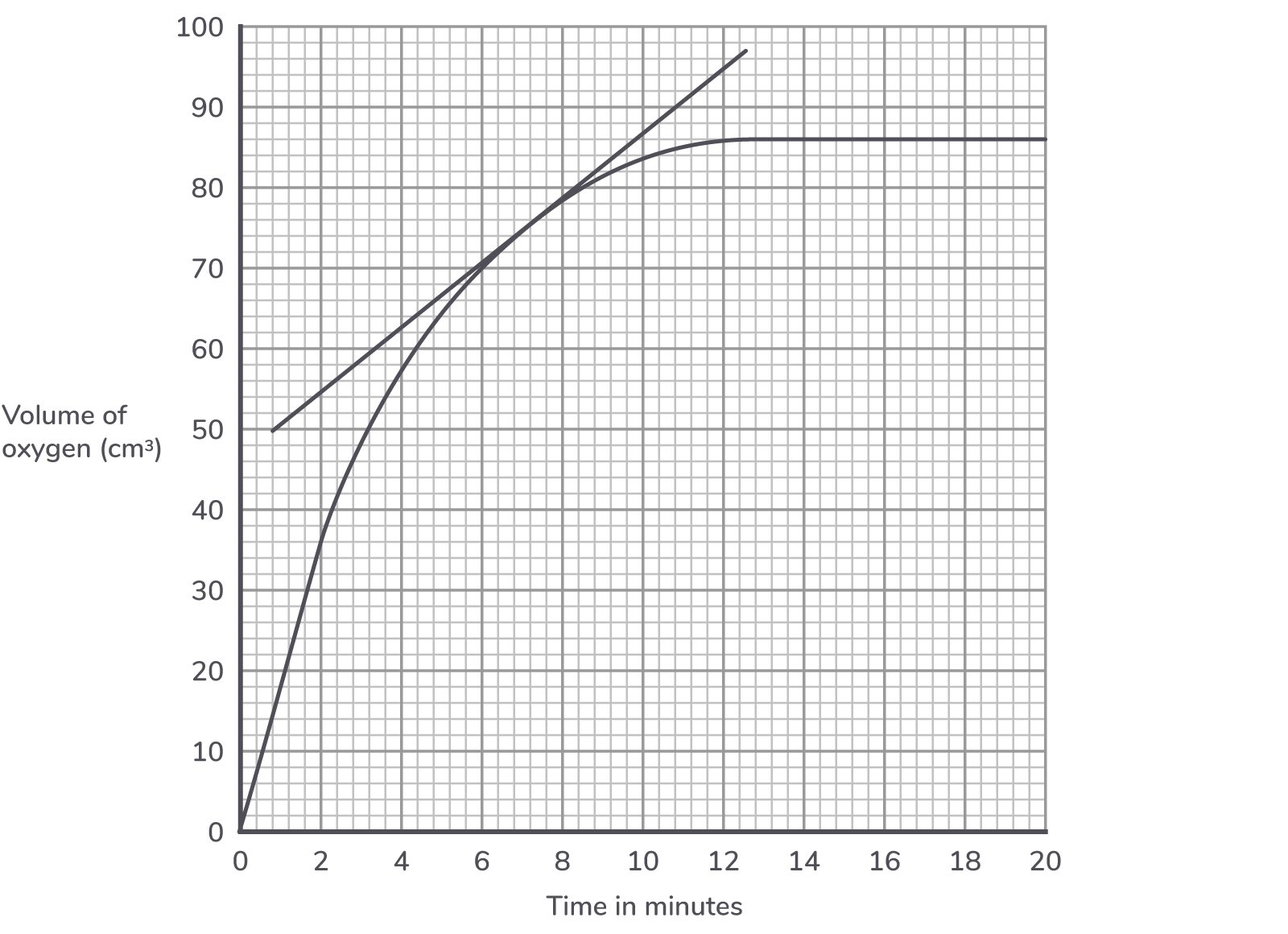
State the rate of oxygen production at 15 minutes.