Comparing Substances - exam practice
Comparing Substances
Question 1 of 10
The formation of both ions and covalent bonds involves electrons.
The table below shows the electronic configurations of atoms of hydrogen, lithium and chlorine.
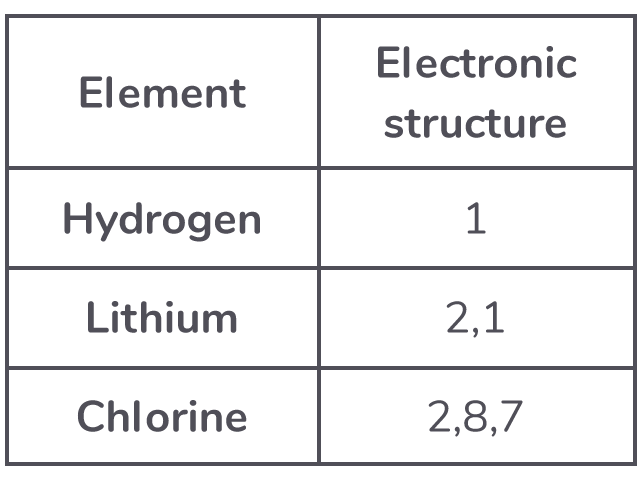
What is the atomic number of chlorine?
Draw a 'dot and cross' diagram to show how lithium (a group 1 metal) and chlorine (a group 7 non-metal) form lithium chloride.
Draw a dot and cross diagram to show the bonding in a molecule of hydrogen chloride, HCl.
Describe the different roles of electrons in the formation of:
- ions in lithium chloride
- covalent bonds in hydrogen chloride
Molten ionic compounds conduct electricity but molecular compounds are non-conductors, even when liquid.
Explain why.
KI, potassium iodide, is an ionic compound with a melting point of 681°C.
I2, molecular iodine, consists of two iodine atoms covalently bonded and has a melting point of 114°C.
State the number of outer shell electrons in potassium and iodine atoms.
Explain your answer.
Draw dot and cross diagram to show the bonding in molecular iodine.
Show only the outer shell of electrons.
Draw a 'dot and cross' diagram to show the formation of potassium iodide.
Show only the outer shell of electrons.
Explain why the melting point of potassium iodide is much higher than the melting point of molecular iodine.
Explain why fluorine (F2) is a gas at room temperature, but sodium fluoride (NaF) is a solid at room temperature.
This question is about different types of chemical bonding.
The image below shows two different structures, A and B.
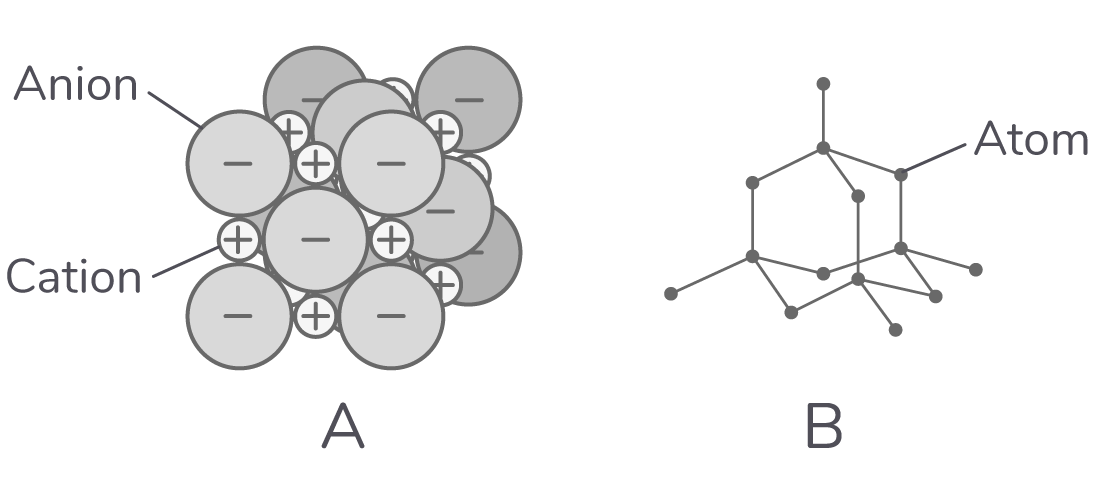
Which of the following is correct about the bonding in A and B?
Draw one line from each property of structure A to the explanation of the property.
Explain why structure B does not conduct electricity.
Explain why structure B has a high melting point.
This question is about structure and bonding.
The image below shows the structures of three compounds.
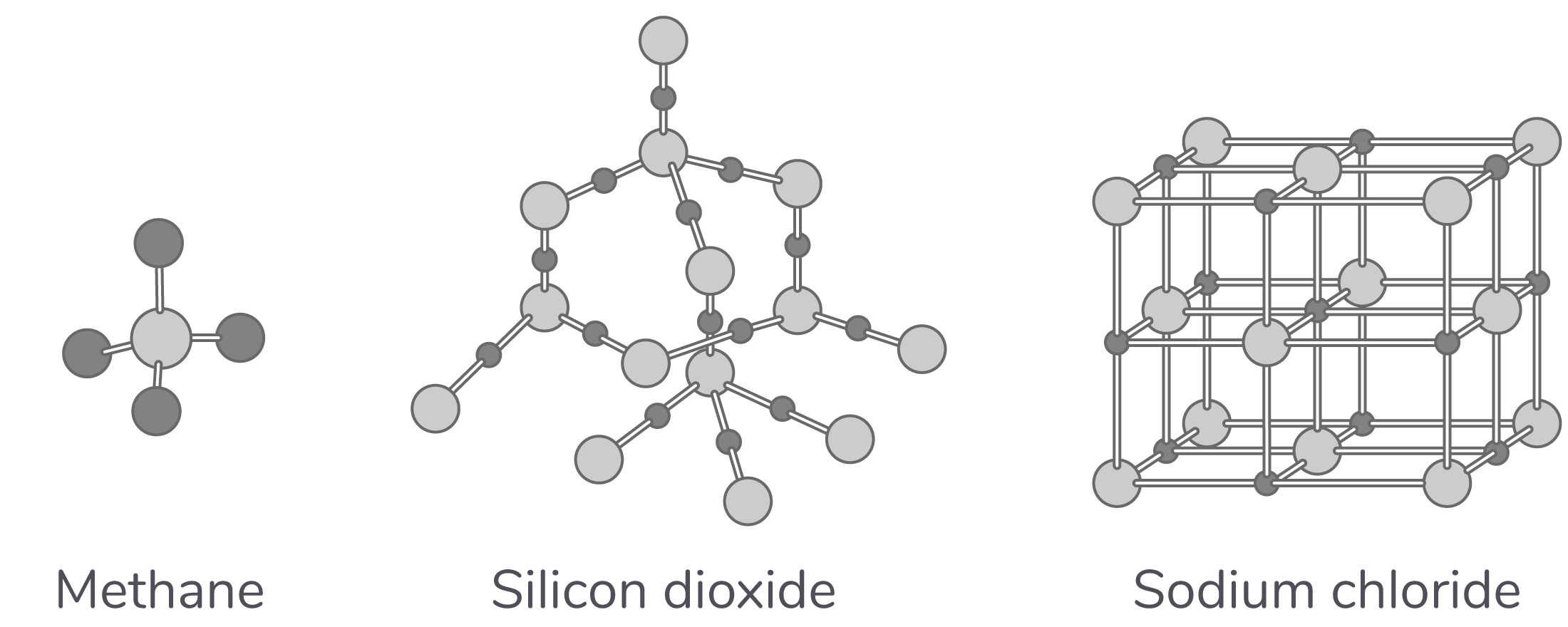
Draw one line from each property of methane to an explanation of the property.
Compare the structure and bonding of the three compounds:
- methane
- silicon dioxide
- sodium chloride
The ability to conduct electricity is an important property of many substances.
The table below shows the ability of different substances to conduct electricity.
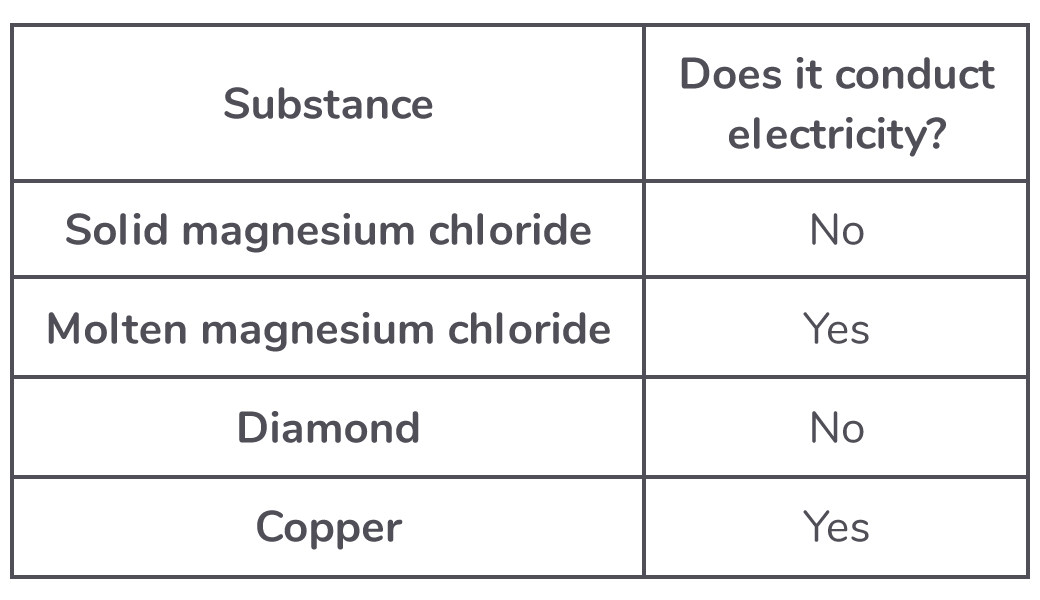
Explain these results by referring to the structures of the substances.
A student collected information about three substances, A, B and C.
The information is shown in the table below.
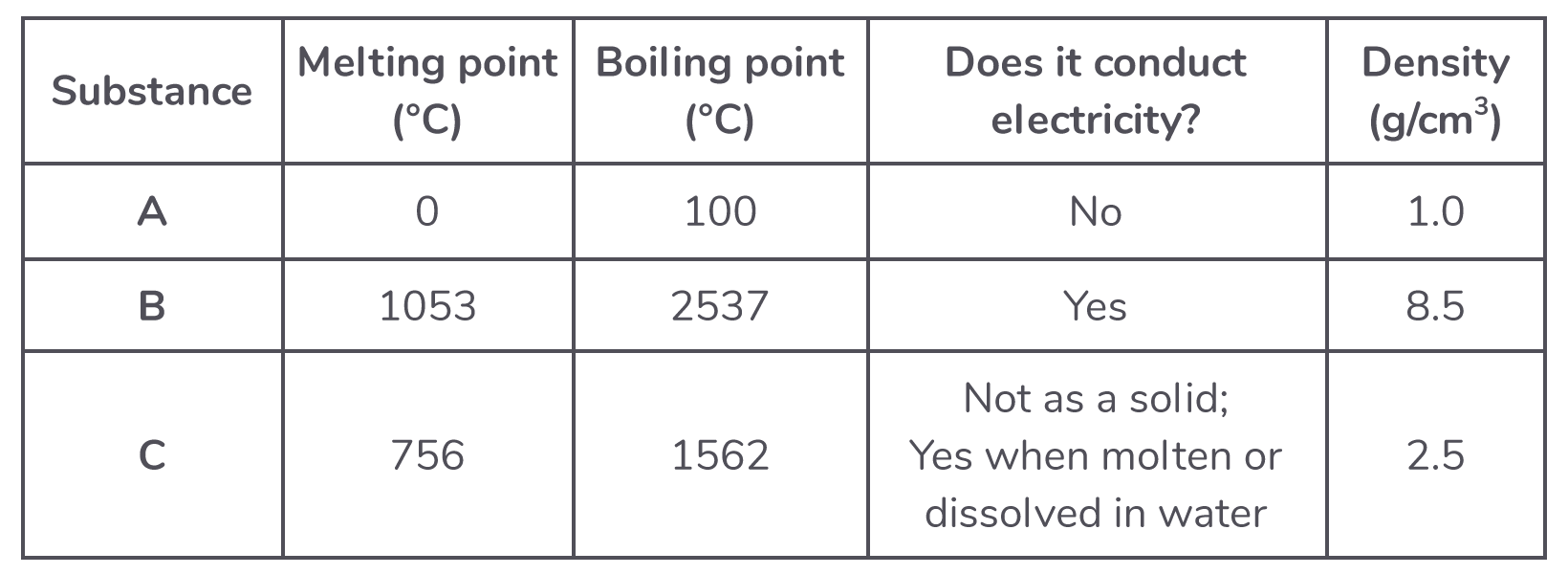
What is the type of bonding present in each of the substances A, B and C?
Justify your answer.
The table shows some properties of four substances, A, B, C and D.
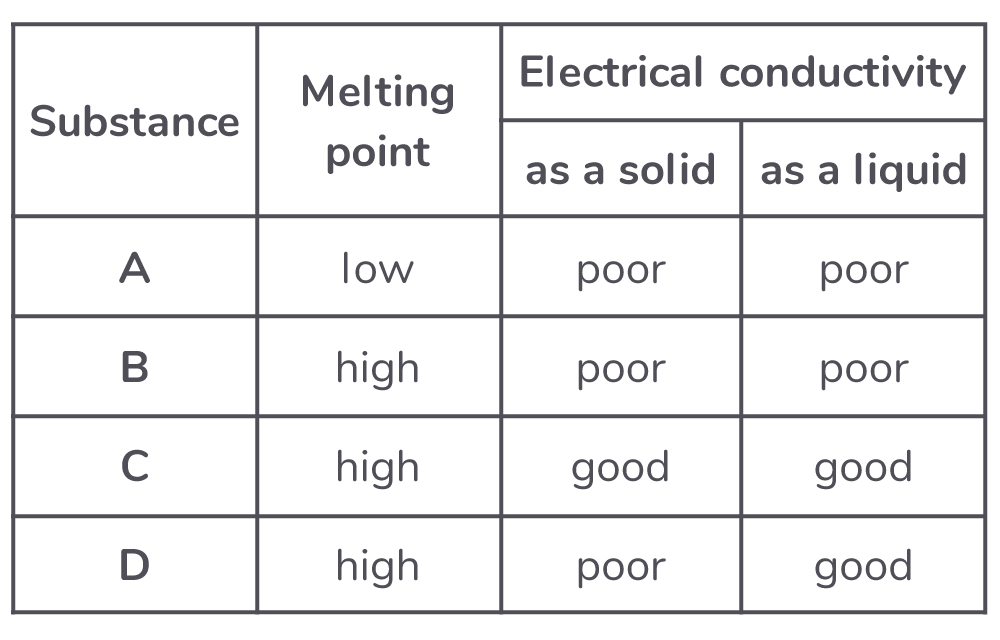
Use the information from the table to give the correct type of structure for each substance, from the following four types:
- giant covalent
- giant ionic
- giant metallic
- simple molecular
You may use each structure once, more than once or not at all.
The four substances are magnesium, magnesium oxide, silicon dioxide, and water.
Match the substances to the letters A to D.
Sodium chloride (NaCl) and silicon dioxide (SiO2) both have giant lattice structures.
The table below shows some of the properties of both compounds.
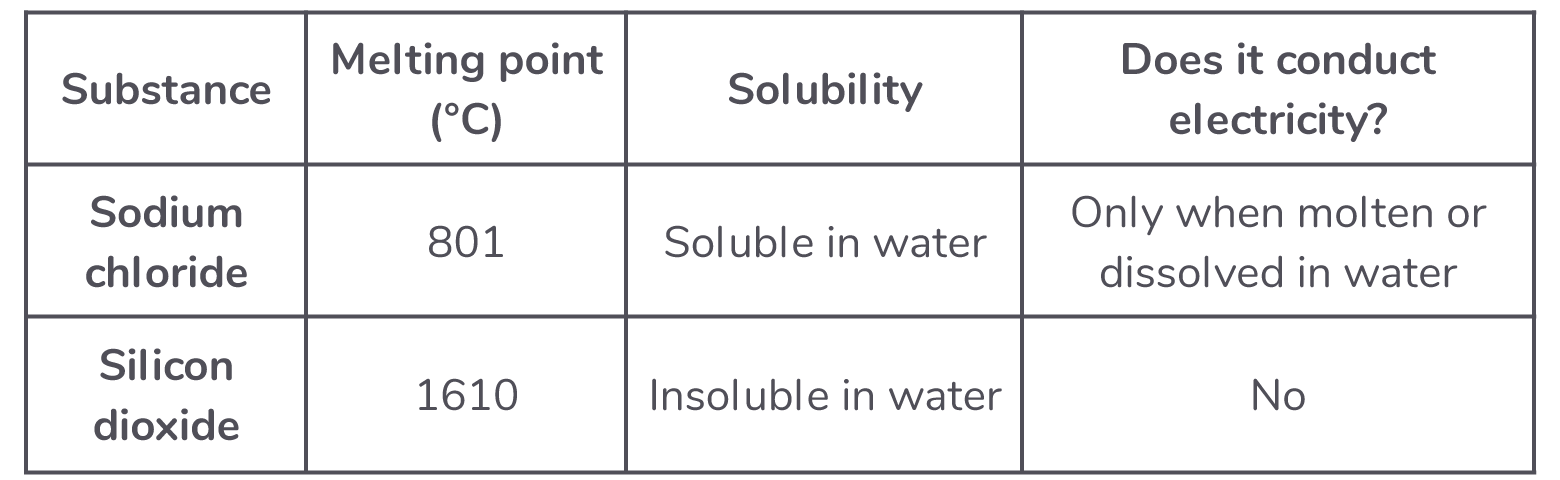
State which type of compound the following substances are:
- sodium chloride
- silicon dioxide
Explain why silicon dioxide has a high melting point.
Suggest why the melting point of silicon dioxide is higher than the melting point of sodium chloride.
Explain why sodium chloride can only conduct electricity when molten.
The properties of a substance depend on its type of bonding and structure.
There are four types of bonding and structure:
- simple molecular
- giant covalent
- giant ionic lattice
- giant metallic
Complete the table to match up each type of bonding and structure with its properties.
Which of these substances has intermolecular forces between particles?