The Particle Model - exam practice
The Particle Model
Question 1 of 10
This question is about the different states of matter.
The table shows some physical changes.
Complete the table by giving the state of the substances before and after each change.
The melting point of bromine is −7 °C.
The boiling point of bromine is 59 °C.
What state is bromine at room temperature?
What is the best description of the particles in a liquid?
Complete the diagram to show how the particles of a substance are arranged in the three different states.
Describe the arrangement and movement of particles in each of the three states of matter.
Give the state of matter in which the particles have the most energy.
The particle model can be used to explain the physical properties of solids, liquids and gases.
What is meant by 'physical property'?
The diagram shows the arrangement of particles in the three states of matter.
Each circle represents a particle.
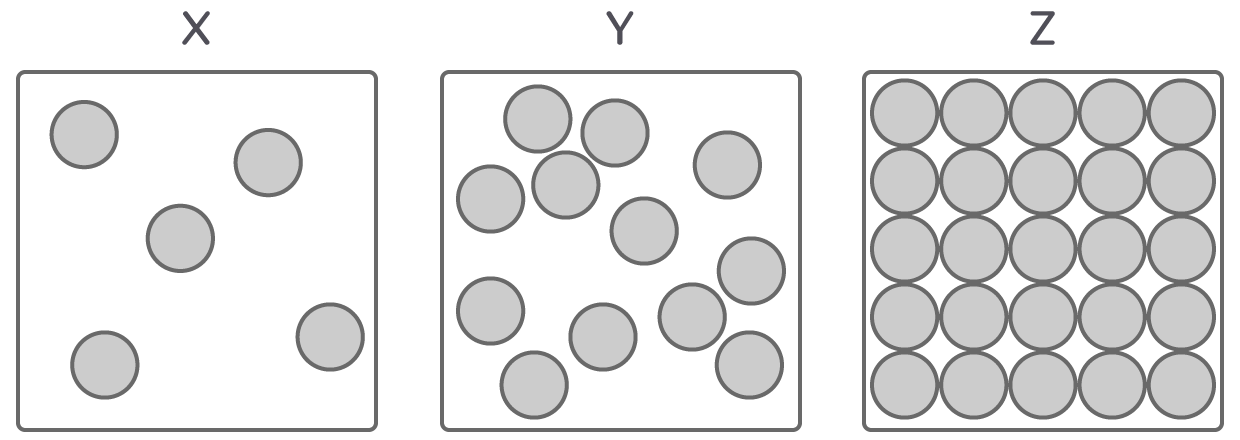
Use the letters X, Y and Z to give the starting and finishing states of matter for each of the changes in the table below.
Which word describes water changing from a liquid to a solid?
Which of these changes takes place when solid iodine is heated to form iodine gas?
Simple distillation uses evaporation and condensation to separate mixtures.
Write the missing state symbols for the physical changes shown below.
Describe the change in the arrangement of particles as substances evaporate.
Describe the change in the movement of particles as substances evaporate.
Explain why hot water evaporates more quickly than cold water.
The table below shows the melting and boiling points of four substances, A, B, C and D.
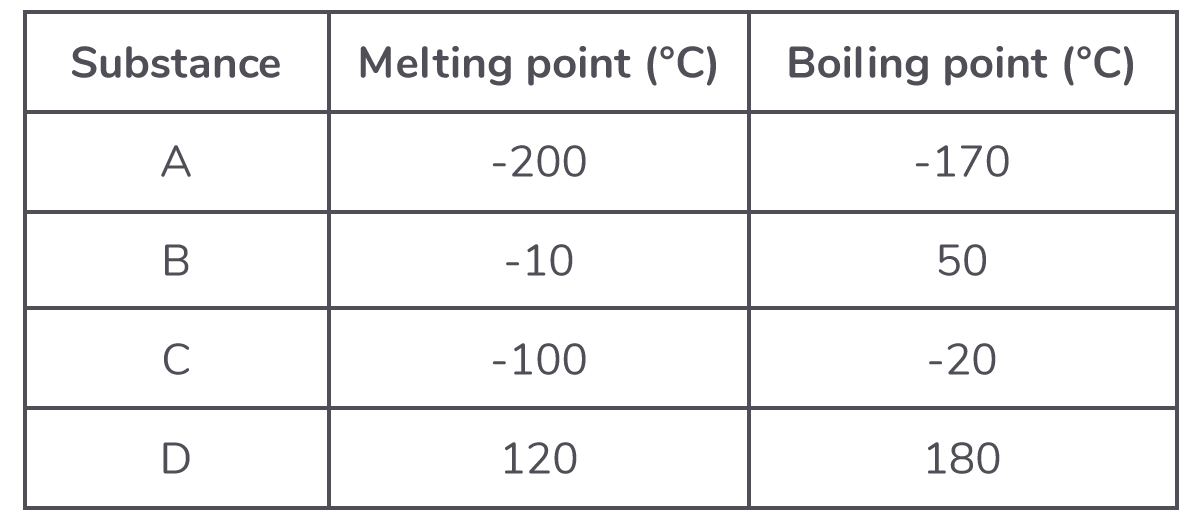
Give the letter of a substance that is a solid at 20°C.
Give the letter of a substance that is a liquid at 40°C.
Particles in a solid are closely packed, arranged in a regular pattern and vibrate about fixed positions.
Describe the arrangement and movement of the particles in a gas.
There are three states of matter: solid; liquid and gas.
They have different properties, which can be explained by looking at the arrangement of their particles.
What type of change is a change of state?
Which two statements are correct about the particles when a liquid turns into a gas?
What is the name of the process that occurs when a substance changes from a gas to a liquid?
This question is about changes of state.
The image below shows how the temperature of water changed with time as a student heated it from ice to steam.
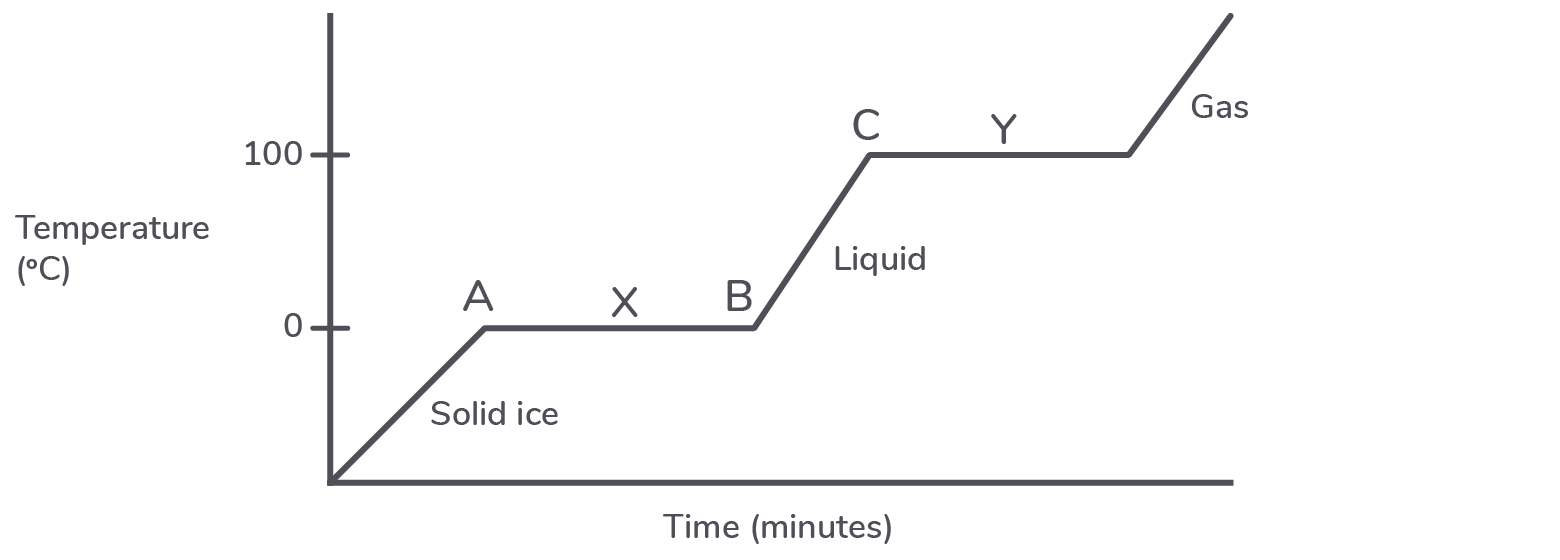
Name the changes of state represented by letters X and Y in the image above.
Explain what is happening to the substance in the sections A-B and B-C of the graph.
Give the boiling point and melting point of water.
The structures of four substances are shown in the image below.
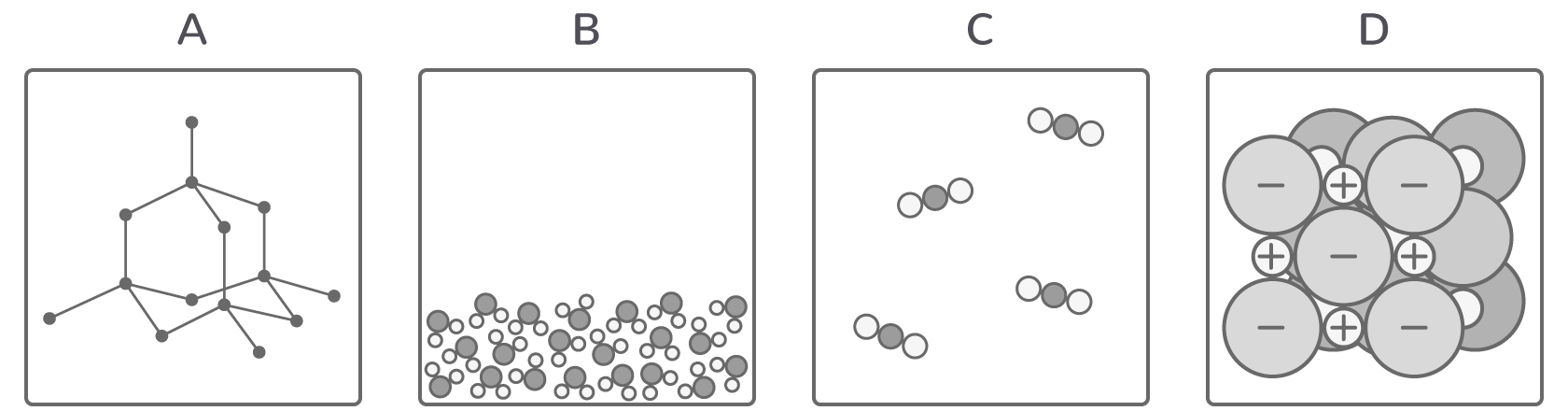
Which of the substances, A, B, C or D, is a gas?
Which of the substances, A, B, C or D, is a liquid?
Which of the substances, A, B, C or D, is a giant covalent structure?
Which of the substances, A, B, C or D, is a giant ionic lattice?
The equation for the production of substance D from the combustion of magnesium in oxygen is shown below.
Mg(s) + O2(g) ➔ MgO(s)
Give the meaning of the state symbols (s) and (g).
What is the name of the chemical compound represented in D?
Perfume is a mixture of fragrant oils in a solvent.
When perfume is sprayed, a fine mist of perfume droplets is created and suspended in the air.
The solvent evaporates from the droplets within a few seconds, leaving behind the fragrant compounds in the perfume.
Solvent molecules evaporate easily.
Explain why substances made of simple molecules evaporate easily.
Describe the movement of the molecules of solvent after they have evaporated into the air.
Explain, in terms of the particles, why gases are easy to compress.
This question is about the particle model.
The model is used to explain the physical properties of solids, liquids and gases.
The image below shows a simple model of the three states of matter.
Which states of matter are represented by A, B and C?
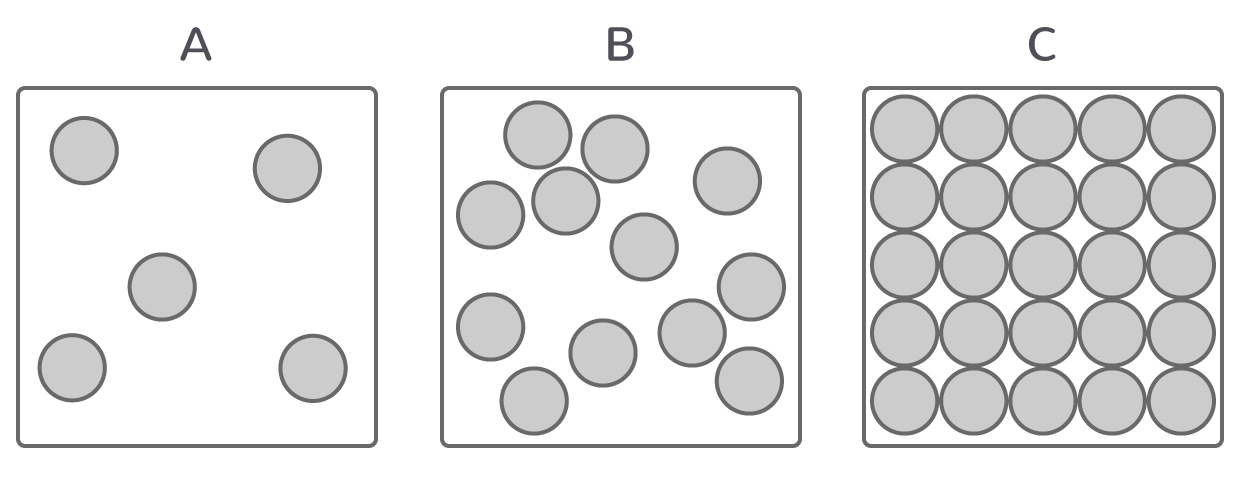
Give the state symbols for the states of matter represented by A, B and C.
Describe the difference between the solid and gas states, in terms of the arrangement and movement of their particles.
Use the model in the figure above in your answer.
There are limitations to the particle model.
Give two limitations of the particle model in the image above.