Covalent Bonding - exam practice
Covalent Bonding
Question 1 of 12
The 'dot and cross' diagram below represents a molecule of ammonia.
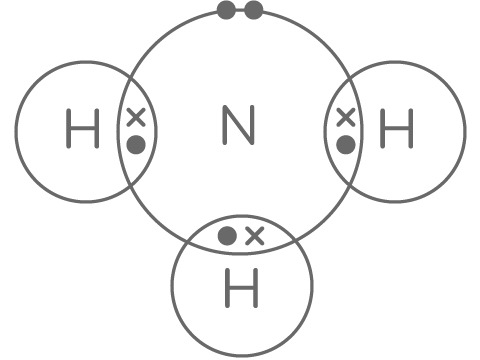
What is the chemical formula of ammonia?
What type of bond is present in a molecule of ammonia?
Explain how these bonds are formed.
Hydrogen halides are important chemicals.
The diagram below represents a molecule of hydrogen fluoride.
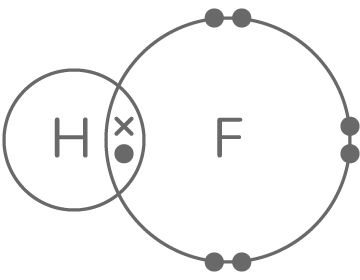
The diagram above is a 'dot and cross' diagram.
What type of particles are represented by dots and crosses?
What type of chemical bond holds the atoms in the hydrogen fluoride molecule together?
Predict the physical state of hydrogen fluoride at room temperature and pressure.
Explain your answer.
Methane, CH4, is a simple molecule.
Draw a 'dot and cross' diagram to represent a molecule of methane, CH4.
(You may need a periodic table)
The bonds in a methane molecule are covalent bonds.
What is a covalent bond?
Which one of the statements below about the properties of small covalent molecules is correct?
Nitrogen is an element in group 5 of the periodic table.
How many electrons does nitrogen need to gain in order to achieve a noble gas electron configuration?
The displayed formula of nitrogen gas, N2, is shown in the image below.

What does each single line represent in the formula above?
Draw a 'dot and cross' diagram to show the bonding in a molecule of nitrogen gas.
Air is made up of a mixture of different gases.
The principal constituents of Earth’s atmosphere are nitrogen (78%) and oxygen (21%).
There are also other gases at lower concentrations.
These gases include carbon dioxide, methane, as well as water vapour at varying concentrations.
Draw a dot and cross bonding diagram for two of the compounds mentioned above.
Chlorine is an element in group 7 of the periodic table.
What common name is used for the elements of group 7?
Write the electronic structure of a chlorine atom.
Draw a dot and cross diagram to show the bonding in a molecule of chlorine, Cl2.
Chlorine is a yellow-green gas at room temperature.
Explain why chlorine and other small covalent molecules are gases at room temperature.
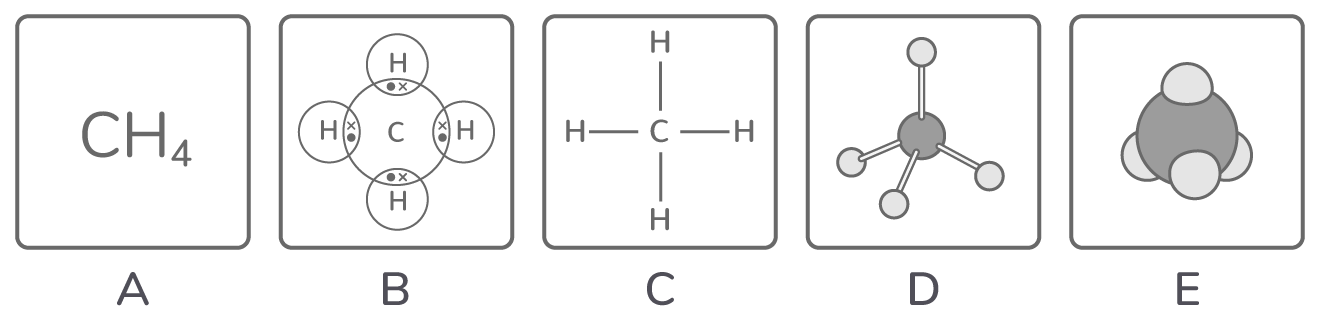
Images A to E show different ways of representing a methane molecule.
Describe what information can be obtained from each representation.
Include the limitations of these representations in your answer.
Water is a compound of hydrogen and oxygen.
Give the chemical formula of water.
Write the electronic structures of a hydrogen atom and an oxygen atom.
Complete the dot and cross diagram to show the bonding in a molecule of water.
Show outer shell electrons only.
Does pure water conduct electricity?
Explain your answer.
Carbon dioxide (CO2) is a greenhouse gas.
The image below shows the electronic configuration of an atom of carbon and an atom of oxygen.
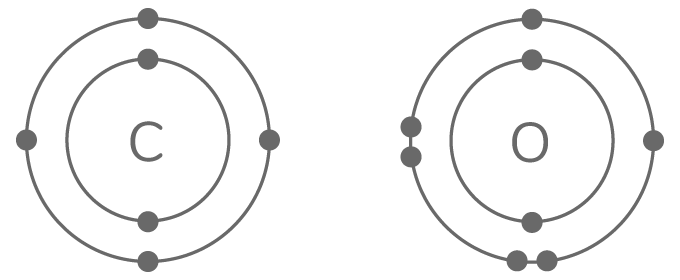
Give the atomic numbers of carbon and oxygen.
Draw a dot and cross diagram to show the covalent bonding in a molecule of carbon dioxide, CO2.
Show outer electrons only.
Explain why carbon dioxide is a gas at room temperature.
Carbon dioxide can also be represented using a displayed formula.
Draw the displayed formula of carbon dioxide.
Give one advantage of the dot and cross diagram compared to the displayed formula.
Oxygen, O2, is a simple molecular, covalent substance.
What is the name of the type of bond present in an oxygen molecule?
Explain the electrical conductivity of simple molecular substances such as oxygen.
Explain, in terms of structure, why oxygen is a gas, even at low temperatures.
The table below is missing certain pieces of data.
Complete the table by filling in the blank spaces.
(You may use a periodic table)
Glass is made from silicon dioxide.
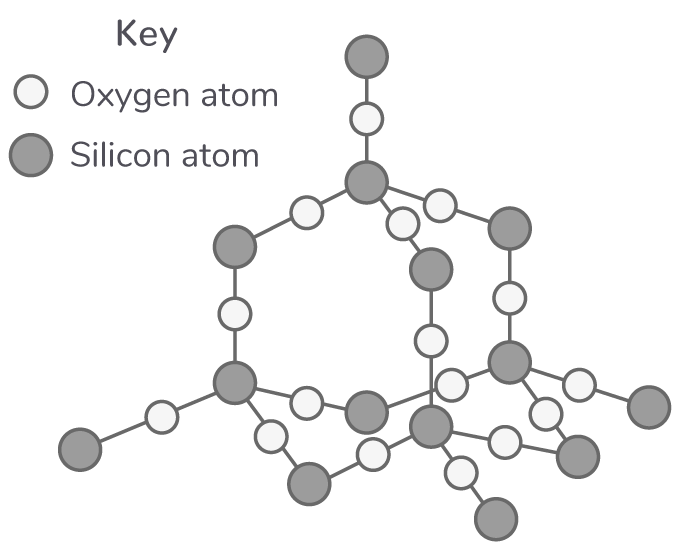
Describe the structure and bonding in silicon dioxide.
Silicon dioxide has a very high melting point.
Other substances are added to silicon dioxide to make glass.
Glass melts at a lower temperature than pure silicon dioxide.
Suggest why.