5.2 - Cells & Batteries
A chemical cell and its voltage
- A chemical cell uses a chemical reaction to produce electricity.
- While the reaction runs, the cell produces a voltage (also called a potential difference) across its two terminals.
- Connect the cell into a circuit and this voltage pushes a current round it.
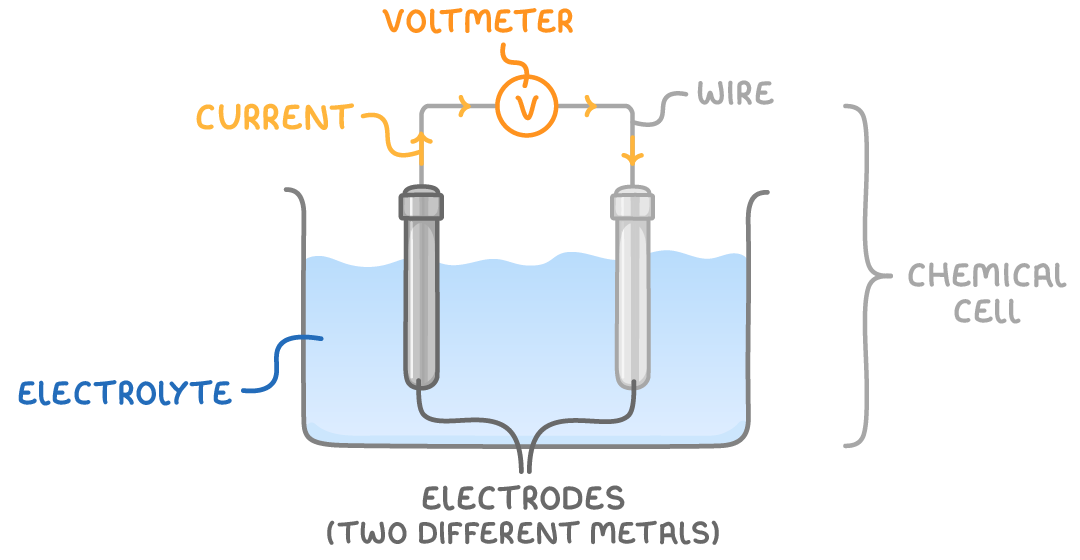
- A voltmeter placed across the cell reads the size of the voltage it produces.
The simplest cell
- Stand two strips of different metals in an electrolyte, and join them with a wire.
- The metal strips are the cell's electrodes, the electrolyte is what they dip into, and the wire completes the circuit.
- Reactions between the electrodes and the electrolyte set up a charge difference between the two electrodes.
- The two metals must be different. Two strips of the same metal react with the electrolyte identically, so no charge difference builds up and the voltmeter reads nothing.
What decides the size of the voltage
- The two metals used as electrodes - What matters is the difference in reactivity between them: the bigger the difference in reactivity, the bigger the voltage.
- The electrolyte - Different electrolytes contain different ions, which react differently with the electrodes and change the voltage.
Why a cell goes flat
- A cell doesn't produce electricity forever, because a chemical reaction uses up what it's made from.
- As the cell is used, its reactants are steadily turned into products.
- Once one reactant is completely used up, the reaction stops, so the voltage falls away and the current stops.
Batteries and rechargeable vs non-rechargeable cells
- A single cell produces a fairly small voltage; joining cells together produces a larger one.
- A battery is two or more cells connected together in series (joined end to end).
- The voltages of the individual cells add up: the battery's voltage is the total of the cells inside it (e.g. two 1.5 V cells make a 3.0 V battery).

Two kinds of cell
- Non-rechargeable - The reactions cannot be reversed. Once one reactant is used up, the reactions stop and no more electricity is produced, so the cell must be replaced (e.g. alkaline batteries).
- Rechargeable - The reactions can be reversed by connecting the cell to an external electrical current, which turns products back into reactants so the cell can produce a voltage again.
Worked example - Choosing the metals for a cell
A cell is built from two different metals standing in an electrolyte. The bigger the difference in reactivity between the metals, the bigger the voltage.
Four metals are listed in order of reactivity, most reactive first. Two cells are proposed, each made from two of these metals in the same electrolyte. Decide which supplies the larger voltage, and say why.
- Reactivity order, most reactive first: magnesium, zinc, iron, copper
- Cell A: zinc and iron
- Cell B: magnesium and copper
Step 1 - Find each cell's metals in the data
- Cell A - zinc is second, iron is third, so the two metals sit next to each other.
- Cell B - magnesium is first, copper is fourth, so the two metals sit at opposite ends of the order.
Step 2 - Compare how far apart each pair is
- Cell A's metals are neighbours, so the difference in reactivity is small.
- Cell B's metals have both others between them, so the difference in reactivity is the largest any pair from this data can have.
Step 3 - Apply the relationship
The larger the difference in reactivity, the larger the voltage. Cell B's metals are much further apart in reactivity, so cell B (magnesium and copper) supplies the larger voltage.
Step 4 - Interpretation
Both cells work, since each uses two different metals - but a cell needing the largest voltage should use metals as far apart in reactivity as possible. Pairing neighbours, as cell A does, wastes most of the available voltage.
